
 Worksheets
8th Grade Science Q1 Review
Total questions: 39
Worksheet time: 53mins
Name
Class
Date
1.
This variable in an experiment is the one being deliberately changed by the scientist.
a)
dependent variable
b)
independent variable
c)
data
d)
control group
2.

In this graph, what is the independent variable?
a)
Population
b)
Day
c)
Species 5
3.
A scientist hypothesizes the the temperature at which an alligator's egg is incubated will determine whether the alligator will be male or female. The dependent variable is
a)
the size of the baby alligators
b)
the gender of the baby alligators
c)
the incubator
d)
the temperature
4.
A student rolled a toy car down a ramp and timed how long it took to reach the bottom. After one trial, the student doubled the height of the ramp and added sandpaper to its surface. The student conducted 3 more trials. After reviewing the data, the student concluded the height of the ramp had no effect on the speed that the car traveled. Which is the most likely reason this conclusion is flawed?
a)
More trials were needed during the investigation.
b)
The student misunderstood how to calculate speed.
c)
A control should have been added to the investigation.
d)
Too many variable were changed during the investigation.
5.

The students observed that heavy objects fell faster than light objects and decided that heavy objects have less air resistance. Which best describes and error the students made when interpreting their data?
a)
The students should have considered air temperature.
b)
The students should have considered the shape of the objects.
c)
The students should have dropped the objects from different heights.
d)
The students should have dropped objects made from the same material.
6.
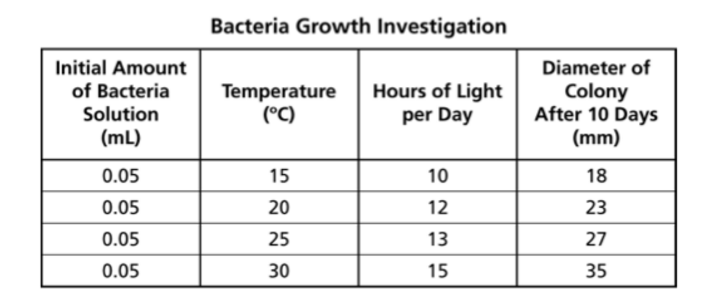
Students set up four petri dishes. Each petri dish contained the same amount of nutrient material and bacteria. The bacteria were grown under different conditions for 10 days. The diameter of the bacteria colonies was measured after 10 days. Which statement best identifies the error in their investigation?
a)
Two independent variable were used.
b)
The difference in temperatures between each trial was too small.
c)
Ten days was not enough time to gather accurate information.
d)
The investigation had only one control.
7.

The table shows the production, imports and consumption of electricity of a certain state. Pick the appropriate bar graph that represents the statistics in the data table.
a)
Graph 1
b)
Graph 2
c)
Graph 3
d)
Graph 4
8.

Directions: Select the correct graph.
Mikey had two mice that were about the same age and weight. Mikey fed each of the two mice a different feed for a month. He measured how much the mice weighed every two days until the month was over. Mikey's results showed that although both mice gained weight over the month, mouse 2 gained more weight than mouse 1.Which graph below best shows these results?
Mikey had two mice that were about the same age and weight. Mikey fed each of the two mice a different feed for a month. He measured how much the mice weighed every two days until the month was over. Mikey's results showed that although both mice gained weight over the month, mouse 2 gained more weight than mouse 1.Which graph below best shows these results?
a)
1
b)
2
c)
3
d)
4
9.
The volume of water in a graduated cylinder in 12 mL. A marble is dropped in & the volume raises to 15 mL. What is the volume of the marble?
a)
3 mL
b)
12 mL
c)
15 mL
d)
27 mL
10.
Frank has a paper clip. It has a mass of 9g and a volume of 3cm3. What is its density?
a)
3 g/cm3
b)
1/3 g/cm3
c)
27 g/cm3
d)
39 g/cm3
11.

What is the volume of the fish?
a)
18.0 cm3
b)
6.0 cm3
c)
38.0 cm3
12.

What do we know about the density of lamp oil, rubbing alcohol, and vegetable oil?
a)
The density is greater than 1.0 g/mL
b)
The density is less than 1.0 g/mL
c)
The density is equal to 1.0 g/mL
d)
The density can not be determined
13.
What units are used to measure Density?
a)
cm3/g
b)
g
c)
g/cm3
d)
cm3
14.
Mercury is a metal that is liquid at room temperature and has a density of 13.5 g/cm3. Which of these metals would sink below the mercury if dropped into a container of mercury?
a)
gold (density=19.3 g/cm3)
b)
lead (density=11.4 g/cm3)
c)
iron (density=7.9g/cm3)
d)
aluminum (density=2.7g/cm3)
15.
Scientists use this unit to measure temperature
a)
Celsius
b)
Fahrenheit
16.
You are finding the mass of a glue stick using a balance. The mass of the glue stick might be
a)
20 pounds
b)
20 centimeters
c)
20 grams
d)
20 degrees
17.
Unit for measuring mass?
a)
cm
b)
kg
c)
Liter
d)
lightyear
18.
When the temperature of matter increases the particles...
a)
speed up and move closer
b)
speed up and move farther apart
c)
slow down and move closer together
d)
slow down and move farther apart
19.

If the tops were removed from the cylinders, the following would happen:
a)
The solid would fly out of the container
b)
The liquid would fly out of the container.
c)
The gas would fly out of the container.
d)
They ALL would fly out of the container.
20.

Which of the following statements is NOT true of all different types of matter?
a)
They are made of atoms and molecules
b)
The particles are always in motion
c)
The particles always move at the same speed
d)
They are made of particles that are too small to see
21.
An experiment is performed on plants to see how different liquids affect plant growth. Each plant in the experiment is given a different liquid; water, apple juice, or milk. Each plant has the same amount of soil, sunlight, and listens to the same music. In this investigation, the independent variable is ...
a)
The type of plant
b)
The amount of sunlight
c)
The type of music
d)
The type of liquid
22.

The best graph to use if I want to compare the price of six different cars would be a
...
...
a)
Pie graph
b)
Bar graph
c)
Data table
d)
Line graph
23.

A scientist conducted an experiment to determine how the amount of salt in a body of water affects the number of plants that can live in the water. In this experiment the independent variable is...
a)
the temperature of the water
b)
the water
c)
the amount of salt in the water
d)
the number of plants in the water
24.
When experimenting with the growth of a plant, a scientist uses three (of the same type of) plants, two different fertilizers, equal light, and equal water. The fact that we kept the light, plant, and water the same in each experiment are examples of ____________.
a)
an dependent variable
b)
an independent variable
c)
a control
d)
constants
25.

What does a line graph do?
a)
Show change over time.
b)
Collect categorical data.
c)
Compare quantities.
d)
Measure quantities.
26.

According to the pie chart, the United States relies on fossil fuels for about what percentage of its energy?
a)
30%
b)
45%
c)
60%
d)
80%
27.

Which phylum has the smallest number of species?
a)
Acrasiomycota
b)
Rhizopoda
c)
Chlorophyta
d)
Bacillariophyta
28.

What is the annual salary of a person with a associates degree?
a)
$1012
b)
$9084
c)
$39364
d)
$757
29.

Which type of graph would you create for this data table?
a)
Bar
b)
Line
30.

If I was only going to graph the data for the Amoebae, which would go on the x-axis?
a)
Type of biocrust
b)
# of Amoebae
31.
Lauren is convinced that book/movie combinations are better if you have read the book before watching the movie. Lauren's friend, Alyssa, thinks that movies are just as good even if you don't read the book. They got 40 of their classmates to help them solve their debate. 20 classmates read the book Divergent and 20 more classmates viewed the movie without reading the book. All participants went to see the movie on Friday at 6 p.m. They had their classmates do a survey (1-4 stars). Then, Alyssa and Lauren averaged the number of stars for both groups.
What is the independent variable?
What is the independent variable?
a)
Watching the movie
b)
Reading the book
c)
Taking the survey
32.
Jessie is concerned about how tired his classmates seem. He created a drink that he thinks will boost their energy. He recruits 100 classmates with a history of tiredness. He has 50 of them drink his new special energy drink. The other 50 drink a beverage that looks like the special energy drink, but is just water and food coloring. Both groups were told that they were getting the special drink that would boost energy. After 2 hours, 30 classmates in the first group reported having more energy and 8 classmates in the second group reported having more energy.
What is the independent variable?
What is the independent variable?
a)
Amount of energy
b)
Special energy drink
c)
The food coloring
33.
A group of middle school students were given a short course in speed reading. The teacher was curious of money could influence their performance on a test taken at the end of the course. Half the students were offered $5 for a getting a certain percentage better at speed reading, the other half was offered no money. Which is the dependent variable.
a)
Students being offered money or not.
b)
Their test scores.
c)
Their age in school years.
d)
The length of the course.
34.
Jack has a rock. The rock has a mass of 14g and a volume of 2cm3. What is the density of the rock?
a)
7 mL
b)
7 g/cm3
c)
28 g/cm3
d)
1/7 g/cm3
35.
Which will float in water (density= 1 g/mL)?
Corn syrup 1.37 g/mL
Vegetable oil 0.91 g/mL
Honey 1.42 g/mL
Lamp oil 0.81 g/mL
Corn syrup 1.37 g/mL
Vegetable oil 0.91 g/mL
Honey 1.42 g/mL
Lamp oil 0.81 g/mL
a)
Corn syrup and Honey
b)
Vegetable oil and Lamp oil
c)
Corn syrup and vegetable oil
d)
Honey and Lamp oil
36.
If the density of a bar of gold is 19.3 g/cm3and you cut it into 4 pieces, what is the density of each piece of gold?
a)
4.825 g/cm3
b)
9.65 g/cm3
c)
19.3 g/cm3
d)
38.6 g/cm3
37.
Why does ice float?
a)
Liquid water is less dense than solid water.
b)
Solid water is less dense than liquid water.
c)
Gaseous water is less dense than solid water.
d)
Liquid water is less dense than gaseous water.
38.
Matter in this state has the greatest amount of energy:
a)
Liquid
b)
Solid
c)
Gas
d)
Elephants
39.

What is the substance most likely to look like if its density is 20.1 g/mL?
a)
Silver colored, relatively light for its volume
b)
Silver-colored, relatively heavy for its volume
c)
yellowish color, relatively expensive
d)
brown-colored, relative inexpensive
100 %

