wayground logo

Free Printable Worksheets

NEW

Font size

S
M
L
XL
Worksheets

Earth Science, Chapter 8, The Rock Record, Post Assessment

Total questions: 33

Worksheet time: 45mins

Name
Class
Date
1.

What type of dating indicates a specific age of a rock by using methods such as carbon dating or radioactive decay?

a)

Relative Dating

b)

Absolute Dating

2.
The time required for half of a sample of a radioactive isotope to break down by radioactive decay to form a daughter isotope is called what?
a)
uniformitarianism
b)
relative age
c)
half-life
d)
radioactive dating
3.
The trace or remains of an organism that lived long ago, most commonly preserved in sedimentary rock
a)
varve
b)
index fossil
c)
trace fossil
d)
fossil
4.
Which of the following is a method of determining the absolute age of an object by comparing the relative percentages of a radioactive (parent) isotope and a stable (daughter) isotope?
a)
radiometric dating
b)
uniformitarionism
c)
law of superposition
d)
paleontology
5.
A principle that geologic processes that occurred in the past can be explained by current geologic processes is called...
a)
paleontology
b)
law of superposition
c)
relative age
d)
uniformitarianism
6.
The age of an object in relation to the ages of other objects is known as what?
a)
relative age
b)
absolute age
c)
half-life
d)
unconformity
7.
What is the scientific study of fossils called?
a)
uniformitarianism
b)
unconformity
c)
paleontology
d)
radiometric dating
8.
The principle that a sedimentary rock layer is older than the layers above it and younger than the layers below it if the layers are not disturbed is called ...
a)
unconformity
b)
law of crosscutting relationship
c)
law of superposition
d)
varve
9.
What is a fossilized mark that formed in sedimentary rock by the movement of an animal on or within soft sediment called?
a)
index fossil
b)
fossil
c)
trace fossil
d)
varve
10.
A break in the geologic record created when rock layers are eroded or when sediment is not deposited for a long period of time is called what?
a)
law of crosscutting relationships
b)
unconformity
c)
radiometric dating
d)
varve
11.
A pair of sedimentary layers (one coarse, one fine) that is deposited in an annual cycle, commonly in glacial lakes, and that can be used to determine absolute age is called what?
a)
trace fossil
b)
index fossil
c)
varve
d)
fossil
12.
What is a fossil that is used to establish the age of a rock layer because the fossil is distinct, abundant, and widespread and the species that formed that fossil existed for only a short span of geologic time?
a)
index fossil
b)
trace fossil
c)
fossil
d)
varve
13.
The principle that a fault or body of rock is younger than any other body of rock that it cuts through is known as what?
a)
relative age
b)
law of crosscutting relationships
c)
varve
d)
law of super position
14.
Which type of fossil is formed when the remains of a former living thing is turned into stone?
a)
cast
b)
preserved
c)
carbonized
d)
petrified 
15.
What type of fossil fills a mold, and is a model of the actual organism?
a)
cast
b)
trace
c)
carbon imprint
d)
mummification
16.
 These are dinosaur footprints. What is this a example of?
a)
amber
b)
index fossils
c)
permineralized remains
d)
trace fossils
17.
Which of the following is a condition that will preserve remains?
a)
amber
b)
frozen in permafrost
c)
tar
d)
all of these are correct
18.
Which type of absolute dating is used for organic specimens.
a)
carbon-14 dating
b)
plutonium dating
c)
potassium-argon dating
d)
uranium dating
19.
According to the law of superposition, which layer is the youngest?
a)
A
b)
B
c)
C
20.
How far back in time can geologists study the history of the earth?
a)
1.6 billion years
b)
46 million years
c)
4.6 billion years
d)
160 billion years
21.
This rock diagram has a line running through with arrows pointing in the direction of rock movement.  What does the line represent?
a)
A fold
b)
A fault
c)
A tilt
d)
An intrusion
22.

The process by which the remains of an organism are preserved by drying and wrapping with cloth is called:

a)

petrification

b)

mummification

c)

amber

d)

freezing

23.

Which type of fossil is formed when an organism is trapped in hardened tree sap and is preserved.

a)

tar seeps

b)

amber

c)

mummification

d)

petrification

24.

Per the video we watched in class, carbon dating is only useful for organisms that have died in the last _______ years.

a)

100,000

b)

200,000

c)

150,000

d)

50,000

25.

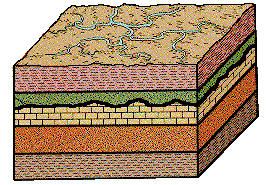
What type of unconformity is shown here?

a)

Non-conformity

b)

Disconformity

c)

Angular unconformity

26.

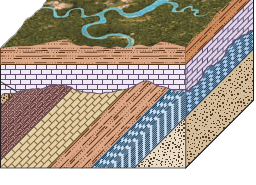
What type of unconformity is shown here?

a)

Non-conformity

b)

Disconformity

c)

Angular unconformity

27.
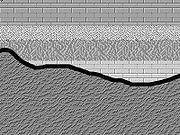
a)
Disconformity
b)
Nonconformity
c)
Angular unconformity
d)
Paraconformity
28.

He was a Scottish naturalist and farmer who came up with the Principle of Uniformitarianism. He is considered the person who developed the idea of geologic time and proposed that the Earth was much older than people thought at the time.

a)

James Hutton

b)

Nicolaus Steno

c)

James Newton

d)

Nicolaus Copernicus

e)

Nicolaus Tesla

29.

According to this Principle, sediments are deposited in large, flat sheets.

a)

Original Horizontality

b)

Superposition

c)

Lateral Continuity

d)

Cross-Cutting Relationships

e)

Inclusion

30.

Rocks and fossils preserve many examples of these when many species on Earth died or became extinct within a relatively short time.

a)

mass extinction

b)

mass wasting

c)

mass preservation

d)

invasive species

e)

meteor impacts

31.

______ bedding is when the particles sizes become progressively finer and lighter toward the top layers.

a)

cross

b)

graded

c)

ripple

d)

sorted

32.

_______ bedding is formed as inclined layers of sediment are deposited across a horizontal surface.

a)

graded

b)

cross

c)

ripple

d)

deposition

33.

When sediment is moved into small ridges by wind or wave action or by river current it forms _______ marks.

a)

cross

b)

graded

c)

stria

d)

ripple