wayground logo

Free Printable Worksheets

Font size

S
M
L
XL
Worksheets

Internal Processes

Total questions: 76

Worksheet time: 54mins

Name
Class
Date
1.
What is a break in the lithosphere along which movement in an earthquake has first occurred?
a)
Earthquake
b)
Epicenter
c)
Fault
d)
Focus
2.
Where is the point at which the first movement occurs during an earthquake?
a)
Epicenter
b)
Focus
c)
Fault
d)
Plate
3.
Where is the point on the Earth’s surface directly above the focus of an earthquake?
a)
Epicenter
b)
Fault
c)
Hypocenter
d)
Tremor
4.
Which type of wave is the first to arrive after an earthquake occurs?
a)
P Wave
b)
Rayleigh Wave
c)
S Wave
d)
Shear Wave
5.
S Waves can move through which of the following?
a)
Gas
b)
Liquid
c)
Solid
d)
All of these
6.
What is the measure of the amount of energy released in an earthquake?
a)
Earthquake
b)
Epicenter
c)
Magnitude
d)
Seismogram
7.
What is the temporary state in which loose soil and rock materials take on the property of a liquid?
a)
Aftershock
b)
Liquefaction
c)
Seismic Gap
d)
Tsunami
8.
What is a smaller earthquake that follows a larger earthquake?
a)
Aftershock
b)
Liquefaction
c)
Seismic Gap
d)
Tsunami
9.
What is a large ocean wave that results from an underwater earthquake, landslide, or volcanic eruption?
a)
Aftershock
b)
Liquefaction
c)
Seismic Gap
d)
Tsunami
10.
You use a travel-time graph (difference in P and S Wave arrival times) to find:
a)
Distance to epicenter
b)
Distance to fault
c)
Distance to core
11.
Where is the epicenter for this earthquake located based on triangulation?
a)
A
b)
B
c)
C
d)
D
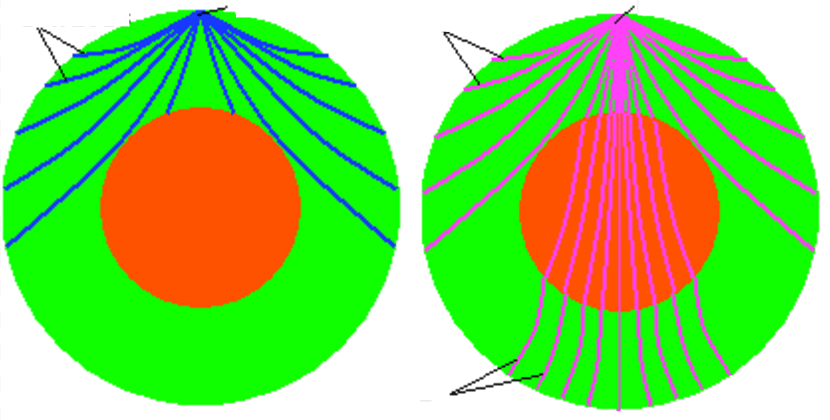
12.
What type of wave are the BLUE waves? (orange circle is the core)
a)
P-waves
b)
S-waves
c)
Love waves
d)
Raleigh waves
13.
Where are the S-waves located on this seismogram?
a)
A
b)
B
c)
C
d)
D
14.
The volcanoes on the Hawaiian Islands form due to which of the following?
a)
Divergent Boundary
b)
Hot Spot
c)
Subduction Boundary
d)
Transform Boundary
15.
What type of lava cools slowly and forms rock with smooth, ropelike features?
a)
Aa
b)
Magma
c)
Pahoehoe
d)
Pillow Lava
16.
What type of lava cools quickly and forms rock with jagged edges?
a)
Aa
b)
Magma
c)
Pahoehoe
d)
Pillow Lava
17.
Which type of magma has the lowest amount of silica content?
a)
Andesitic Magma
b)
Basaltic Magma
c)
Rhyolitic Magma
d)
Viscous Lava
18.
What is the resistance of a liquid, such as lava, to flow?
a)
Elasticity
b)
Pyroclasticity
c)
Silica
d)
Viscosity
19.
What are solid rock fragments that are ejected during a volcanic eruption?
a)

Lahar

b)
Magma
c)
Pyroclastic Material
d)
Silica
20.

What type of volcano has steep slopes made of alternating layers of ash and silica rich lava?

a)

Caldera

b)

Cinder Cone

c)

Stratovolcano (aka composite volcano)

d)

Shield Volcano

21.
What type of volcano is made of lava fragments that have been ejected from a volcanic vent?
a)
Caldera
b)
Cinder Cone
c)
Composite Volcano
d)
Shield Volcano
22.

What type of volcano is Kilauea, which is located in Hawaii?

a)

Caldera

b)

Cinder Cone

c)

Stratovolcano (aka composite volcano)

d)

Shield Volcano

23.
What kind of magma produces violent volcanic eruptions?
a)
Magma low in silica
b)
Magma that is fluid, and runny
c)
Magma that is high in gas content
d)
Magma rich in iron
24.
What factor(s) determine(s) whether an eruption will be explosive?
a)
The amount of gases in the magma
b)
The amount of silica in the magma
c)
The amount of gas and silica in the magma
d)
None of these affect the explosiveness of the volcano
25.
A high silica volcano makes what type of an explosive?
a)
quiet eruption
b)
explosive eruption
26.
Intrusive Igneous rocks will be 
a)
coarse grain
b)
fine grain
27.
If an Igneous rock is dark-colored, what is the amount of silica?
a)
high
b)
low
c)
doesn't matter
28.
Is Granite high or low in Silica?
a)
high
b)
low
29.
Coarse or Fine?
a)
coarse
b)
fine
30.
How do Intrusive Igneous rocks cool?
a)
quickly
b)
slowly
c)
really fast
31.
What category of igneous rock has two different sizes of crystals?
a)
glassy
b)
extrusive
c)
intrusive
d)
porphyritic
32.
Which of the following textures are found in rocks that are formed intrusively?
a)
Glassy
b)
Vesicular
c)
Phaneritic
33.

Is this rock felsic or mafic?

a)

Felsic

b)

Mafic

34.
The laccolith, batholith an dike are types of __________ ___________.  These are magma that has pushed into existing layers of rock and cooled there.
a)
extrusive sediments
b)
igneous intrusions
c)
metamorphic layers
35.

From which of these does a batholith form?

a)

a small body of magma

b)

a large body of magma

c)

a small body of lava

d)

a large body of lava

36.

Magma that squeezes between horizontal rock layers and hardens is called a ______.

a)

volcanic neck

b)

dike

c)

sill

d)

lava plateau

37.
Igneous intrusions cause which type of metamorphism?
a)
contact
b)
regional
38.
Marble is formed from what sedimentary rock?
a)
limestone
b)
granite
c)
shale
d)
conglomerate
39.
What force is associated with contact metamorphism?
a)
heat
b)
pressure
40.
Where do we usually find regional metamorphism?
a)
ocean floor
b)
mountain
c)
plate boundaries
d)
deserts
41.
The original rock before metamorphism is called a _?_.
a)
original
b)
parent rock
c)
kid rock
d)
starter rock
42.
What are the two main types of metamorphic rocks and how are they different?
a)
intrusive and extrusive; intrusive rocks are formed inside the earth and extrusive rocks are formed on the surface
b)
foliated and nonfoliated; foliated rocks do not have visible bands/layers and nonfoliated rocks do have visible bands/layers
c)
intrusive and extrusive; intrusive rocks are formed on the earth's surface and extrusive rocks are formed in the Earth
d)
foliated and nonfoliated; foliated rocks have visible bands/layers and nonfoliated rocks do not have visible bands/layers
43.
The difference between regional metamorphism and contact metamorphism is that regional metamorphism is caused by _____ from __________ and contact metamorphism is caused by _________ from _______ intruding into other rock.
a)
heat, tectonic plates, pressure, magma
b)
pressure, tectonic plates, heat, magma
c)
heat, magma, pressure, tectonic plates
d)
pressure, magma, heat, tectonic plates
44.

What type of foliation results from the parallel alignment of abundant, coarse-grained, mica flakes in a metamorphic rock?

a)

Porphyroblastic texture

b)

Schistosity

c)

Slaty cleavage

d)

Gneissic banding

45.

What type of foliation results has the highest grade (most) foliation?

a)

Porphyroblastic textrure

b)

Schistosity

c)

Slaty cleavage

d)

Gneissic banding

46.

Reverse faults have __________________ and folding that formed the Alps and Himalayas.

a)

tension

b)

compression

c)

stress

47.

Normal faults create _________________.

a)

valleys

b)

mountains

c)

faults

48.

Strike slip faults move by ____________________.

a)

pulling apart

b)

pushing together

c)

slipping past each other

49.

_______________ stress occurs at a normal fault.

a)

tension

b)

compression

c)

shearing

50.
What type of stress is experienced at a convergent boundry?
a)
Compression
b)
Tension
c)
Shearing
d)
Convergent
51.

Theses are created where two or more of Earth's tectonic plates are pushed together.

a)

Dome

b)

Fold

c)

Volcanic

52.

At these colliding, compressing boundaries, rocks are warped & folded into hills & mountains

a)

Fold

b)

Block

c)

Volcanic

53.
What is deformation?
a)
Process when the rocks break apart or erode.
b)
Process of when rocks melt away. 
c)
Process when rocks change shape under pressure.
d)
Process when 
54.
How do Fault-Block mountains form?
a)
When tension makes the earth move. 
b)
When tension makes the lithosphere break into many pieces. 
c)
When tension makes the mountains break.
d)
When tension makes the mountains rise up into the atmosphere.  
55.
How do Folded Mountains form?
a)
Forms when layers are turned upside down.
b)
Forms when layers are small and begin to grow. 
c)
Forms when layers are move downward into the core. 
d)
Forms when layers are squeezed and pushed together upward. 
56.

When stress in applied and rock behaves like a rubber band, rock will return to its original shape. This is called ____________.

a)

Elastic Deformation

b)

Plastic Deformation

c)

Stretched Deformation

d)

Folded Deformtion

57.
Type of lava that is typical of explosive volcanoes.
a)
Felsic
b)
Mafic
58.
Deadly cloud of gas and ash that comes out of a volcano.
a)
pyroclastic flow
b)
Lahar
c)
mafic
d)
pahoehoe
59.
Smallest volcano type.
a)
Composite
b)
Shield
c)
Cinder Cone
d)
Hot Spot
60.
Which ingredient in magma determines whether an eruption is explosive or quiet?
a)
Amount of rock.
b)
Amount of magma.
c)
Amount of obsidian rock.
d)
Amount of silica.
61.

What provides the force that causes a volcano to become explosive?

a)

Mafic flows

b)

Magma density

c)

Dissolved gases trapped in magma

d)

Extreme heat

62.

What volcanoes are described as having a wide base?

a)

Shield Volcanoes

b)

Cinder Cones

c)

Composite Volcanoes

d)

Calderas

63.

When volcanic ash mixes with water, it forms violent mudflows called ______________

a)

Rolling Ash

b)

Lapilli

c)

Ash Flood

d)

Lahar

64.

What is the most common cause for tsunamis?

a)

underwater earthquakes

b)

meteor crashes

c)

underwater volcanoes

d)

land slides in the ocean

65.

Which of the following shows the correct order of events for a tsunami?

a)

Water recedes back into the ocean carrying all the debris, tsunami waves hit, tide retreats as a warning

b)

Tide retreats as a warning, water recedes back into the ocean carrying all the debris, tsunami waves hit

c)

Tide retreats as a warning, tsunami waves hit, water recedes back into the ocean carrying all the debris

d)

I have NO idea

66.

Downward vertical motion of Earth's surface

a)

uplift

b)

isostasy

c)

fracture

d)

subsidence

67.
Which kind of waves travel through the Earth’s core?
a)
P waves
b)
S waves
c)
Both
68.

When S waves leave the Mantle and enter the outer core, they...

a)

speed up

b)

slow down

c)

get absorbed

69.

Which location is farther from the epicenter?

a)

Seismogram B (top)

b)

Seismogram C (bottom)

70.

Magma that forces itself across rock layers and hardens is called a _________.

a)

volcanic neck

b)

sill

c)

dike

d)

batholith

71.
The deeper a rock is buried, the greater the pressure is on it
a)
True 
b)
False
72.
Which texture best describes the rock above?
a)
porphyritic 
b)
nonfoliated
c)
foliated
d)
clastic
73.
Which of the following best describes the type of environment a metamorphic rock forms in
a)
High heat, low pressure
b)
Low heat, high pressure
c)
High heat, high pressure
d)
Low heat, low pressure
74.

Contact metamorphism takes place...

a)

over a large area, and involves only heat.

b)

over a large area, and involves heat and pressure.

c)

over a smaller area, and involves only heat.

d)

over a smaller area, and involves heat and pressure.

75.

Regional metamorphism takes place...

a)

over a large area, and involves only heat.

b)

over a large area, and involves heat and pressure.

c)

over a smaller area, and involves only heat.

d)

over a smaller area, and involves heat and pressure.

76.

Which conditions will cause foliation in metamorphic rocks

a)

heat and pressure in a subduction zone

b)

heat and pressure in regional metamorphosis

c)

confining pressure from burial

d)

heat from contact metamorphosis

e)

heat from hydrothermal metamorphosis