
 Worksheets
Basic Economics
Total questions: 91
Worksheet time: 59mins
Name
Class
Date
1.
Which type of economy is usually paired with a Communist government?
a)
Mixed
b)
Market
c)
Command
d)
Traditional
2.
Which type of economy is run by the businesses & business owners?
a)
Command
b)
Mixed
c)
Communist
d)
Market
3.
Which type of economy is controlled by the government?
a)
Command
b)
Market
c)
Mixed
d)
Democratic
4.
What are tariffs?
a)
political boundaries between nations
b)
military blockades of specific countries
c)
disputes between state governments over boundaries
d)
taxes on the import or export of goods from a country
5.
Which of the following is an example of an export for the USA?
a)
America sells paper to Germany
b)
Germany sells printers to America
c)
America sells printers to central Florida
d)
South Africa buys meat from Chile
6.
What is one basic question of economics?
a)
What will be produced?
b)
Who acquires what goods and services?
c)
What resources are available?
d)
What is the opportunity cost?
7.
What are some characteristics of a free market economy?
a)
lack of choice, competition
b)
individual choice, centrally-planned
c)
competition, consumer sovereignty
d)
central ownership of property, profit
8.
When Javier sends his employees to a training seminar where they will become better workers, he is investing in.......
a)
Human capital
b)
Capital goods
c)
His business
d)
GDP
9.
What do businesses provide for consumers according to the circular flow model?
a)
goods and services
b)
only goods
c)
only services
d)
taxes
10.
Investing in machines, technology, factories would be investing in
a)
Human Capital
b)
Capital Goods
c)
Entrepreneurs
d)
Natural Resources
11.
A person who risks his own money to start a business.
a)
Explorer
b)
Conquerer
c)
Entrepreneur
d)
Government
12.
This term refers to the limited Supply of something. Ex: Fresh Water in a desert.
a)
Abudance
b)
Scarcity
c)
Quota
d)
None of the above
13.
When supply goes down and demand goes up, prices go _____
a)
Higher
b)
Lower
c)
Stay the Same
d)
None of the above
14.
When supply goes up and demand is low, prices go ______
a)
Higher
b)
Lower
c)
Stay the Same
d)
None of the above
15.
Most countries fall somewhere between a command and a market economy. Consumers need laws to be protected from producers and need competition and variety of products. Therefore they are considered
a)
Command
b)
Market
c)
Mixed
d)
Traditional
16.
This type of economic system is found in agricultural societies where people live the same way their parents did. Ex: Indigenous Tribes in Brazil
a)
Command
b)
Market
c)
Mixed
d)
Traditional
17.
What three basic questions must a country's economic system answer?
a)
What to Produce, How to Produce, For Whom to Produce
b)
When, Where, Why to Produce
c)
For Whom, Who, and When to Produce
d)
What to Produce, Where to Produce, How to Produce
18.
What is a monopoly?
a)
The exclusive possession or control of the supply or trade in a commodity or service.
b)
A company that owns 0% of the market share
c)
A company among many other companies
d)
A board game
19.
What is the point at which both the supply line and the demand line cross?
a)
Y Point
b)
X Point
c)
Equilibrium
d)
Benefit
20.
The Law of Supply states that a business would want to supply _____ of a product if the selling price of that product is high.
a)
more
b)
less
c)
the same amount
d)
None of these.
21.
This was created to regulate railroads
a)
Sherman Anti-Trust Act
b)
Interstate Commerce Commision
c)
Railway Regulation Firm
d)
Clayton Anti-Trust Act
22.
What type of business did the Sherman Antitrust Act try to break up?
a)
Monopolies
b)
Small Business
c)
Meat Packaging
d)
Joint-Stock Companies
23.
When you choose one thing over another, what you give up is the __________.
a)
barter
b)
opportunity cost
c)
urban
d)
technology
24.
A person who makes goods to sell is a __________.
a)
rural
b)
consumer
c)
producer
d)
interdependent
25.
The amount of an item that sellers are willing to offer at different prices is the ______.
a)
technology
b)
opportunity cost
c)
barter
d)
supply
26.
A person who buys things is called a _________.
a)
consumer
b)
producer
c)
barter
d)
demand
27.
The amount of an itemthat consumers are willing to buy at different prices is called the________.
a)
demand
b)
supply
c)
barter
d)
producer
28.
Any place where buyers and sellers meet to exchange goods and services.
a)
Trade
b)
Market
c)
Economy
29.
Tax on the value of goods and services purchased & is the leading source of revenue for many state governments.
a)
Sales Tax
b)
State Tax
c)
Income Tax
30.
Things that you must have in order to survive.
a)
Want
b)
Need
c)
Inspiration
d)
Goals
31.
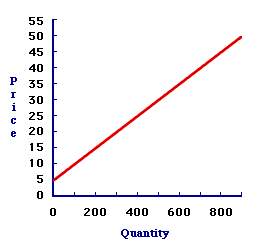
What does this curve represent?
a)
demand
b)
supply
c)
equilibrium
d)
shortage
32.
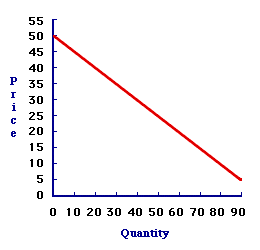
What does this curve represent?
a)
supply
b)
equilibrium
c)
demand
d)
surplus
33.
An increase in the price of aspirin is likely to be paired with a(n) ___________________ in the demand for Tylenol because the two goods are __________________.
a)
increase; complements
b)
increase; substitutes
c)
decrease; complements
d)
decrease; substitutes
34.
If the price of printers goes down, what happens in the market for ink cartridges?
a)
Supply increases.
b)
Supply decreases.
c)
Demand increases.
d)
Demand decreases
35.
Consuming more of one good because of a change in price of another good is known as the
a)
income effect
b)
substitution effect
c)
elasticity effect
d)
demand effect
36.
If a consumer knows that a product will be going on sale this week, how will his/her CURRENT demand be affected?
a)
it will go up
b)
it will go down
c)
it will stay the same
d)
what does this have to do with the price of tea in China?
37.
In a market economy, who decides on the prices of goods and services?
a)
government
b)
buyers and sellers
c)
firms
d)
local leaders
38.
For the law of demand, as price rises, what happens to quantity demanded?
a)
it goes up
b)
it goes down
c)
it stays the same
d)
it is not effected
39.
For the law of supply, as price rises, what happens to quantity supplied?
a)
it goes up
b)
it goes down
c)
it stays the same
d)
it is not effected
40.

When there is a shortage the price will usually?
a)
rise
b)
fall
c)
remain the same
d)
equilibrium
41.
Which of the following is a benefit for consumers caused by the competition between businesses?
a)
Innovation (new goods and services)
b)
lower priced goods and services
c)
better quality goods and services
d)
All of these.
42.
An incentive that encourages people and organizations to improve their financial and material well-being
a)
Profit Motive
b)
Absolute Advantage
c)
Comparative Advantage
d)
Socialism
43.
Productive resources that make up the four categories of land, capital, labor, and entrepreneurs
a)
Factors of Production
b)
Profits
c)
trade offs
d)
specialization
44.
Natural resources or other "gifts of nature" not created by human effort
a)
Land
b)
Labor
c)
Capital
d)
Entreprenuer
45.
People with all their efforts, abilities and skills
a)
land
b)
labor
c)
capital
d)
entrepreneur
46.
The tools, equipment, and factories used in the production of goods and services
a)
Land
b)
Labor
c)
Capital
d)
Entrepreneur
47.
The social science dealing with the study of how people satisfy seemingly unlimited and competing wants with the careful use of scarce resources
a)
Economic systems
b)
Economics
c)
Economy
d)
Economic growth
48.
Taxes on alcohol and tobacco are examples of what?
a)
Social Security
b)
Estate Tax
c)
Excise Tax
d)
Luxury Tax
49.
Tax on the money you get from your salary and wages is called what?
a)
Wage tax
b)
Income tax
c)
Estate tax
d)
Excise tax
50.
Which word means the more income or profit you make, the more tax you pay?
a)
Progressive Tax
b)
Regressive Tax
c)
Flat Tax
d)
Excise Tax
51.
A tax that works as a basic retirement program is called what?
a)
Medicaid
b)
Medicaire
c)
Social Security
d)
IRS
52.
The federal government's heath care system for 65 and over is called what?
a)
Social Security
b)
Health Insurance
c)
Medicare
d)
FICA
53.
I own a house. The tax I pay on the house and land is called what?
a)
Property tax
b)
Death tax
c)
Estate tax
d)
House tax
54.
The "death tax" on everything people own after they die is called what?
a)
Property tax
b)
Progressive tax
c)
Income Tax
d)
Estate tax
55.
The money that you are paid before taxes and deductions is --
a)
discretionary income
b)
net pay
c)
gross pay
d)
a cruel, cruel joke
56.
The government taxes its citizens to:
a)
ensure that all citizens help fund our government operations.
b)
make sure everyone has the same amount of income
c)
provide goods and services that we cannot provide ourselves
d)
strengthen our relationship with other countries
57.
Public schools, libraries and highways are referred to as public services because they:
a)
encourage cooperation between government branches
b)
are funded through individual investment
c)
are created by large corporations
d)
provide benefits to many people simultaneously
58.
Which statement below best describes the Federal Reserve System?
a)
it is responsible for legislative purchases
b)
it is the federal government tax collector
c)
it is the federal government's bank
d)
it is accountable for legislative actions
59.
You must file your federal income tax return no later than
a)
December 31
b)
January 1
c)
January 31
d)
April 15
60.
Bruce makes $100,000 per year.
Steve makes $50,000 per year.
Tony makes $30,000 per year.
Bruce pays 30% in taxes, Steve pays 20%, and Tony pays 10%. This tax is
Steve makes $50,000 per year.
Tony makes $30,000 per year.
Bruce pays 30% in taxes, Steve pays 20%, and Tony pays 10%. This tax is
a)
Proportional
b)
Progressive
c)
Regressive
d)
I have no idea.
61.

What is the cartoonist's message from the picture provided?
a)
Taxes are a pleasure to pay.
b)
Taxes are a constant in life.
c)
Taxes are a heavy burden for the taxpayer.
d)
Taxes are a ball of fun.
62.
On which of the following does the federal government spend the largest portion of its budget?
a)
Medicare
b)
Defense
c)
Social Security
d)
Education
63.
What we call the planned earning and spending for the nation
a)
Federal Budget
b)
Discretionary Spending
c)
Tax Plan
64.
What are those items of the national budget that Must be funded?
a)
Mandatory spending
b)
Discretionary spending
c)
Planned spending
d)
Revenue spending
65.
What are those areas of the National Budget that can but do not have to be funded?
a)
Mandatory spending
b)
Discretionary spending
c)
Revenue spending
d)
Defecit spending
66.
What are the sources of income for the national government called?
a)
surplus
b)
revenue
c)
budget
d)
appropriations
67.
What means the government has spent more than it has raised?
a)
revenue
b)
surplus
c)
deficit
d)
appropriations
68.
What is it called when the government takes in more in revenue than it appropriates?
a)
surplus
b)
revenue
c)
deficit
d)
appropriations
69.
This function of money allows you to use it purchase the goods and services you need and want.
a)
medium of exchange
b)
unit of account
c)
store of value
d)
liquidity
70.
A checking account is also called a(n) ____________________________ deposit, because the money may be withdrawn at any time.
a)
safe deposit
b)
certified
c)
demand
d)
debt
71.
This is a written order to a bank to pay the amount stated to the person or business named on it.
a)
safe deposit
b)
demand
c)
overdraft
d)
check
72.
This card is a plastic card that allows immediate deductions from a checking account to pay for purchases.
a)
check
b)
debit
c)
register
d)
certified
73.
To take money out of the bank
a)
Deposit
b)
Overdraw
c)
Withdraw
d)
Balance
74.
To put money in the bank
a)
Deposit
b)
Withdraw
c)
Overdraw
d)
Balance
75.
Why do banks pay customers who keep their money in savings accounts?
a)
Banks pay people, through interest, for the bank's use of their deposited money.
b)
Banks want to entice more business.
c)
Interest doesn't cost anything, and can be applied to all customers.
d)
The government legally requires banks to pay interest to account holders.
76.
Which of the following is an example of money as a unit of account?
a)
Purchasing a toy for $8.99
b)
Lending a friend $25.00
c)
Opening a savings account at a bank
d)
Checking the price of a camera at several stores before buying it at the lowest price
77.
How does a bank make most of its profit on its business?
a)
By collecting fees on credit card purchases.
b)
By collecting fees on safety deposit boxes, traveler’s checks and certified checks
c)
By receiving fees from the government for handling federal and state accounts
d)
By paying out less interest on deposits than it earns in interest on loans
78.
Savers and borrowers are linked through financial institutions when
a)
both savers and borrowers invest in the same markets.
b)
savers deposit money that is then used to lend money to borrowers.
c)
the financial institutions offer the same rate of exchange to each.
d)
borrowers take money from financial institutions to invest with savers.
79.
The coins and paper bills used as money in a society
a)
Prices
b)
Currency
c)
Bond
d)
Checks
80.
An institution for receiving, keeping and lending money
a)
Bank
b)
Bond
c)
Stock
d)
Company
81.
A government institution that covers bank accounts against bank failure
a)
FDIC
b)
FAA
c)
FDA
d)
SEC
82.
How many district banks are in the Federal Reserve?
a)
1
b)
5
c)
8
d)
12
83.
The rise of prices over time.
a)
Loan
b)
Interest
c)
Federal Reserve
d)
Inflation
84.
A person's source of money, dependent on the ability to produce.
a)
Income
b)
Reserve
c)
Investment
d)
Entrepreneur
85.
Money that a bank keeps and does not lend out.
a)
Income
b)
Reserve
c)
Investment
d)
Entrepreneur
86.
Supervising banks and ___________ are 2 jobs of the Federal Reserve.
a)
Collecting tax revenue
b)
building schools
c)
protecting the economy
d)
conducting political campaigns
87.
If there is less money in circulation, the value of the dollar
a)
Decreases
b)
Doesn't change
c)
Increases
d)
All of these
88.
Which is the primary role of the FDIC?
a)
Regulate saving and loans
b)
Advise the Secretary of Treasury
c)
Insure citizens’ deposits made at commercial banks
d)
Provide financial support for home mortgage borrowers
89.
If the reserve requirement is 8 percent, how much of a $100 deposit must be kept by a customer's bank and not loaned to other customers?
a)
$8.00
b)
$92.00
c)
$80.00
d)
$12.00
90.
Influencing the economy by changing the reserve requirement is called:
a)
Fiscal policy
b)
Monetary policy
c)
Tight Money
d)
Easy Money
91.
The primary role of the Federal Reserve Bank is to steer the economy by
a)
controlling the budget
b)
setting spending levels.
c)
controlling the money supply.
d)
loaning out money.
100 %

