
 Worksheets
Inner & Outer Planets
Total questions: 35
Worksheet time: 30mins
Name
Class
Date
1.
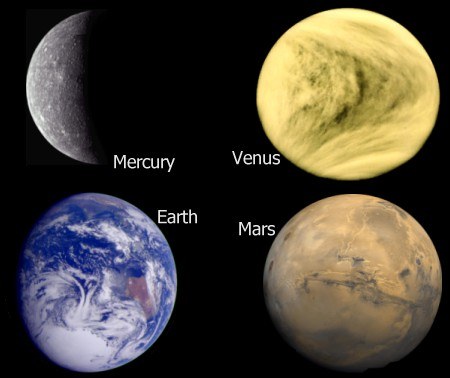
Earth and the other planets closest to the Sun are made mostly of _______
a)
gas
b)
metal
c)
water
d)
rock
2.

Earth's ________ on its axis causes day and night.
a)
rotation
b)
revolution
c)
phase
d)
comet
3.

One kind of _______ is the crescent Moon.
a)
axis
b)
asteroid
c)
phase
d)
space probe
4.

One full orbit of an object around another object is called a ________.
a)
axis
b)
rotation
c)
revolution
d)
satellite
5.

The __________ has planets, moons, comets, and asteroids.
a)
solar system
b)
earth
c)
rotation
d)
United States
6.
One of the main differences between the outer and inner planets is __________.
a)
The inner planets all have water
b)
the inner planets are much bigger than the outer planets
c)
the outer planets are gas planets
d)
the outer planets have rings, and the inner planets don't
7.
Where is the asteroid belt found?
a)
between earth and mars
b)
Between Uranus and Neptune
c)
Between Mercury and Venus
d)
Between Mars and Jupiter
8.
Select the order from smallest to largest.
a)
Sun, Milky Way, solar system, universe
b)
Sun, Milky Way, universe, solar system
c)
Sun, solar system, Milky Way, universe
d)
Sun, solar system, universe, Milky Way
9.
Why does Earth have different seasons?
a)
because of the distance between Earth and the sun
b)
because of the speed of Earth as it rotates on its axis
c)
because of the amount of light blocked by the moon on its axis
d)
because of the tilt of Earth on its axis as it moves around the sun
10.
Which factor makes Earth different from all the other planets in the solar system in its ability to support life?
a)
The Earth is exposed to rays from the sun.
b)
The Earth has only one moon that orbits around it.
c)
The Earth rotates in an elliptical orbit around the sun.
d)
The Earth has a breathable atmosphere.
11.
Which best explains why the moon has phases?
a)
The moon’s position changes in relation to the sun and Earth.
b)
The sun’s position changes in relation to the moon and Earth.
c)
The Earth casts a shadow on the moon as it rotates.
d)
The moon rotates along its axis
12.
A spiral galaxy of stars that contains our Sun
a)
Planisphere
b)
Intensity
c)
Star
d)
Milky Way
13.
Which planet is closest to the sun?
a)
Uranus
b)
Mercury
c)
Neptune
d)
Earth
14.
A ball of ice and dust with a tail of gas and dust pointing away from the sun.
a)
Asteroid
b)
Comet
c)
Moon
d)
Meteor
15.
Which planet is the largest in the solar system?
a)
Earth
b)
Venus
c)
Saturn
d)
Jupiter
16.
Which planet is the hottest?
a)
Mercury
b)
Uranus
c)
Venus
d)
Saturn
17.
Which planet is known as the Red Planet?
a)
Jupiter
b)
Mars
c)
Earth
d)
Neptune
18.
What are Saturn's rings made of?
a)
light
b)
slime
c)
crystals
d)
ice and rocks
19.
What is the Great Red Spot?
a)
A volcano
b)
a crater
c)
a cloud
d)
A giant storm
20.
Which planet spins on its side?
a)
Saturn
b)
Uranus
c)
Venus
d)
Mercury
21.
Which planets have no moons?
a)
Earth and Saturn
b)
Mercury and Venus
c)
Saturn and Jupiter
d)
Neptune and Uranus
22.
Which planet has the smallest pull of gravity?
a)
Saturn
b)
Jupiter
c)
Neptune
d)
Mercury
23.
A small object that appears as a streak of light as it enters earth's atmosphere.
a)
Asteroid
b)
Comet
c)
Moon
d)
Meteor
24.
The inner planets are:
a)
Jupiter, Earth, Mars, Mercury
b)
Saturn, Uranus, Mars, Earth
c)
Earth, Pluto, Neptune, Mars
d)
Mercury, Venus, Earth, Mars
25.
Why does the moon appear to shine?
a)
It is like a star and gives off light
b)
it refracts light from space
c)
It reflects light from the sun
d)
It absorbs light from the sun
26.
The planet with the shortest year is
a)
Earth
b)
Neptune
c)
Pluto
d)
Mercury
27.
What is the definition of orbit?
a)
the spinning of the earth on its axis
b)
when the lit part of the moon increases
c)
all of the planets, moon, and other space objects going around the sun
d)
the imaginary line that goes through the north and south poles that the earth spins on
28.
What is the center of our solar system?
a)
moon
b)
earth
c)
sun
d)
Jupiter
29.
How many days does it take Earth to complete its orbit around the sun?
a)
30
b)
28
c)
365
d)
700
30.
List the planets in order beginning with the one that is closest to the sun.
a)
Mercury, Venus, Earth, Moon, Jupiter, Saturn, Uranus and Neptune
b)
Earth, Mars, Jupiter, Saturn, Uranus, Neptune, Mercury, and Venus
c)
Neptune, Uranus, Saturn, Jupiter, Mars, Earth, Venus, and Mercury
d)
Mercury, Venus, Earth, Mars, Jupiter, Saturn, Uranus, and Neptune
31.
Which of the following characteristics does NOT APPLY to the inner planets?
a)
They are close to the sun.
b)
They have a rocky surface.
c)
They are larger than the outer planets.
d)
None of them have more than two moons.
32.
How long does it take the moon to complete all of its phases?
a)
One year
b)
One day
c)
One month
d)
One week
33.

A small space rock that makes it into Earth’s surface without burning up is called a ...
a)
Meteor
b)
Meteoroid
c)
Asteroid
d)
Meteorite
34.

Name this moon phase.
a)
Waxing crescent
b)
Waxing gibbous
c)
Waning gibbous
d)
Waning crescent
35.

Name this moon phase.
a)
Waning crescent
b)
Waxing crescent
c)
Waning gibbous
d)
Waxing gibbous
100 %

