
NEW
Font size
S
M
L
XL
 Worksheets
Water Cycle
Total questions: 15
Worksheet time: 12mins
Name
Class
Date
1.

What part of the water cycle does this picture show?
a)
condensation
b)
precipitation
c)
evaporation
2.
Which of these is an example of precipitation?
a)
snow
b)
air
c)
clouds
d)
vapor
3.
Which is the opposite of condensation?
a)
runoff
b)
evaporation
c)
precipitation
d)
transpiration
4.

What is it called when WATER is FORMED from an LIQUID to a WATER VAPOR Oor an [GAS]?
a)
EVAPORATION
b)
PRECIPITATION
c)
TRANSPIRATION
5.

What is it called when plants give off water vapor as a waste product?
a)
condensation
b)
evaporation
c)
sublimation
d)
transpiration
6.

What comes after evaporation during the water cycle?
How does this occur?
How does this occur?
a)
Water evaporates into water vapor
b)
Water vapor condenses and forms a cloud
c)
Water precipitates to the ground
d)
Water runs down into the hydrosphere
7.
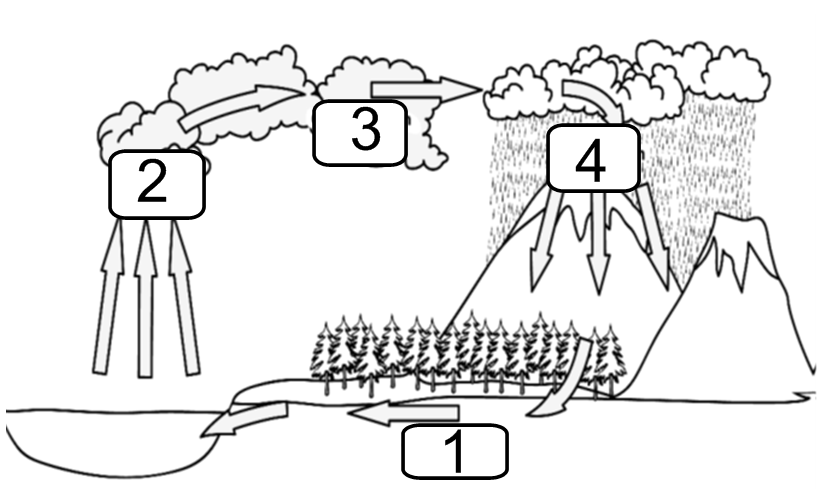
Which stage does the #2 show in the diagram?
a)
condensation
b)
evaporation
c)
precipitation
d)
run off
8.

Which stage does the #3 show in the diagram?
a)
condensation
b)
evaporation
c)
precipitation
d)
run off
9.

what does the #4 show in the diagram?
a)
condensation
b)
evaporation
c)
precipitation
d)
run off
10.
97% of the Earth's water is located in....
a)
ground wat
b)
the ocean
c)
lakes, rivers, and streams
d)
glaciers
11.
The energy source that allows the water cycle to occur
a)
batteries
b)
the sun
c)
solar panels
d)
gasoline
12.
Liquid precipitation that is not absorbed into the ground
a)
groundwater
b)
condenstaion
c)
infiltration
d)
runoff
13.
The first step in the water cycle
a)
evaporation
b)
condensation
c)
precipitation
d)
there is no first step
14.
Clouds form through
a)
precipitation
b)
condensation
c)
evaporation
d)
infiltration
15.
What is the correct term for moisture that falls to the ground from clouds?
a)
condensation
b)
precipitation
c)
hibernation
d)
evaporation
Reset

