wayground logo

Free Printable Worksheets

Font size

S
M
L
XL
Worksheets

Precalc Midterm Review

Total questions: 96

Worksheet time: 7hrs 39mins

Name
Class
Date
1.
Find the domain of the rational function f(x) = x / (x2-25)
a)
(- infinity, -5) , (5, infinity)
b)
(-infinity, -5), (-5, 5) , (5, infinity)
c)
(- infinity, 5) , (5, infinity)
d)
(- infinity, 25) , (25, infinity)
2.
Which sketch is -295°?
a)
A
b)
B
c)
C
d)
D
3.
What is m(4) if:    
a)
-3
b)
0.5
c)
0
d)
-3.5
4.
Using the pictured graph, what is f(1)? 
a)
-3
b)
-1
c)
1
d)
3
5.
The horizontal asymptote equals zero when:
a)
the exponents in the numerator and denominator are equal
b)
the exponents in the numerator are less than the denominator
c)
the exponents in the numerator are greater than the denominator
d)
the numerator equals zero
6.
What is/are the x-intercepts of this graph?
a)
(-2,0) and (2,0)
b)
(-2,0)
c)
(3,0)
d)
(2,0) and (3,0
7.
What is the horizontal asymptote?
a)
y=0
b)
y=1
c)
y=-1/9
d)
This graph does not have a horizontal asymptote.
8.
What is the phase shift?
y=-2sin(x-π)
a)
π left
b)
π right
c)
none
d)
2π right
9.
What is the RANGE of the function?
a)
(-∞, +∞)
b)
(-∞, 4]
c)
(-∞, 4)
d)
[0, 4]
10.
Find the slant asymptote of the function.
a)
y = 3x - 12
b)
y = x + 5
c)
y = 3x - 5
d)
y = 3x - 7
11.
What do you know about the slant asymptote(s) of this function?
a)
It does not have an slant asymptote.
b)
It has a slant asymptote; you would find it by setting the numerator equal to 0. 
c)
It has an slant asymptote; you would find it by using division to divide the numerator by the denomenator. 
d)
It has an slant asymptote; you would find it by finding the values of x that make the denomenator zero. 
12.
State the vertical asymptote:
f(x)=(x-2)/(x+5).
a)
x = -2/5
b)
x = -5/2
c)
x = -5
d)
x = 2
13.
Graph:
f(x)=(x2-x-2)/(-4x-8)
a)
A
b)
B
c)
C
d)
D
14.
Graph:
f(x)=(-x-2)/(x-4)
a)
A
b)
B
c)
C
d)
D
15.
Which piecewise function corresponds to this graph?
a)
f(x) = { x  if x < 4;   
               -x+1  if x ≥ 4
b)
f(x) = { x  if x ≤ 4; 
               -x+1  if x > 4
c)
f(x) = { -x+1  if x < 4; 
       x  if x ≥ 4
d)
f(x) = { -x+1  if x ≤ 4; 
      x if x > 4
16.
Over the interval (−1, 2), the graph of the polynomial shown could be described as
a)
decreasing
b)
increasing
c)
quadratic
d)
complex
17.
Which function is graphed?
a)
tan β
b)
cot β
c)
sin β
d)
cos β
18.
What is the equation of this graph?
a)
y=cos2β
b)
y=2sin2β
c)
y=2cos2β
d)
y=2sinβ
19.
Which sketch is -70°?
a)
A
b)
B
c)
C
d)
D
20.
Which angle has a terminal side that intersects the unit circle at this point?
a)
π/4
b)
3π/2
c)
5π/4
d)
7π/3
21.
Write a polynomial function, of least degree, having integer coefficients that has the given roots.
x= 1(double root)
x= 2 – 3i
HINT:  Write in factored form then multiply out to get an answer below.
a)
f(x) = –x3+5x2–17x+13
b)
f(x) = x3–5x2+17x–13
c)
f(x) = x4–6x3+22x2–30x+13
d)
f(x) = x4+6x3+22x2+30x+13
22.
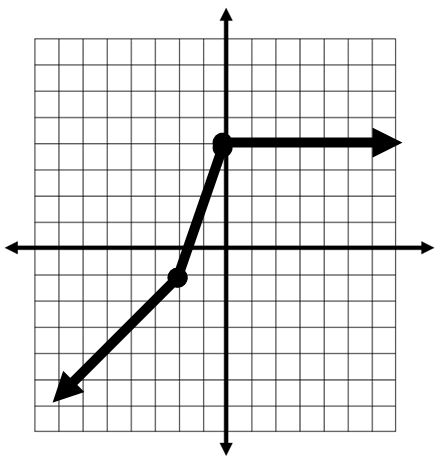
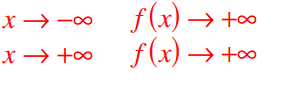
Which function has this end behavior?
a)
f(x)= –x4–3x3+3
b)
f(x)= –2x7+2x4+4
c)
f(x)= 3x8+3x5–4x+7
d)
f(x)= 4x5–4x4+2x3–9
23.
Which function has this end behavior?
a)
f(x)= –x2–3x+1
b)
f(x)= –x3+2x2+3
c)
f(x)= x4+3x3–4x+1
d)
f(x)= x5–4x4+2x2-1
24.
Identify the degree of the polynomial and the sign of the leading coefficient 
a)
Leading Coefficient Positive
Degree - Even
b)
Leading Coefficient Positive
Degree - Odd
c)
Leading Coefficient Negative
Degree - Even
d)
Leading Coefficient Negative
Degree - Odd
25.
Which function has this end behavior?
a)
–x2–3x+1
b)
–x3+2x2+3
c)
x4+3x3–4x+1
d)
x5–4x4+2x2–1
26.
Based on the end behavior which option best describes the leading term?
a)
negative coefficient, even degree
b)
negative coefficient, odd degree
c)
negative degree, odd coefficient
d)
negative degree, even coefficient
27.
Which of the following could be the function of the graph?
a)
y= -x5+4x-1
b)
y=x
c)
f(x)= -x2
d)
y= x5+4x-1
28.
Where do you find relative minimums and relative maximums?
a)
zeros
b)
y-intercepts
c)
turning points
d)
by degree
29.
How many extrema (maxes and mins) are in the picture?
a)
2
b)
3
c)
4
d)
5
30.
What is the relative max?
a)
y = 36 at
x = 0
b)
y = -6.55 at
x= -2.55
c)
(-∞, ∞)
d)
None
31.
What is the relative max of this function?
a)
x = 5
b)
infinity
c)
there is no relative maximum
d)
2.5 and it occurs at x = 5
32.
Fill in the blank:  The maximum number of turning points is ____ less than the degree of the polynomial.
a)
0
b)
1
c)
2
d)
3
33.
What are the x-intercept(s) for the function
f(x) = (4x + 12)/(x - 6)
a)
(-3,0)
b)
(6,0)
c)
(0,-2)
d)
(4,0)
34.
What is the y-intercept for
f(x) = (2x - 18)/(2x + 6)
a)
(-9,0)
b)
(-3,0)
c)
(0,-3)
d)
(0,1)
35.
Find the vertical asymptote.
f(x)=(x2-2x-8)/(3x-2)
a)
y=2/3
b)
x=3/2
c)
x= 2/3
d)
x=1/3
36.
Find both asymptotes.
f(x)=(x+2)/(2x-6)
a)
x=-3 and y=1/2
b)
x=1/2 and y=3
c)
x=3 and y =-1/2
d)
x=3 and y=1/2
37.
Which asymptotes are determined by looking at the denominator of a function? 
a)
vertical
b)
horizontal
c)
slant
d)
none
38.
Which asymptotes are determined by looking at the coefficients of the highest power in a function? 
a)
vertical
b)
horizontal
c)
slant
d)
none
39.
What are the asymptotes?
a)
x=-3, y=1
b)
x=3, y =1
c)
x=-3, y =-1
d)
x=3 y=-1
40.
Name any holes of the function.
a)
x=0
b)
none
c)
x=1
41.
Determine the coordinates of the hole on the graph of 
f(x)= (x2-2x + 1)/(x2+2x - 3)
a)
(1, 1/3)
b)
(-1, -1/3)
c)
(1, 0)
d)
(1, -3)
42.
What is the DOMAIN of the function?
a)
(-∞, +∞)
b)
(-∞, -3) U (-3, +∞)
c)
(-∞, 2] U [3, +∞)
d)
(-∞, 3] U [3, +∞)
43.

What is the RANGE of the function?

a)

(-∞, +∞)

b)

(-∞, -3) U (-3, +∞)

c)

(-∞, 2] U [4, +∞)

d)

(-∞, 3] U [3, +∞)

44.
Which of the 3 piecewise equations is depicted by the graph? 
a)
f(x)
b)
g(x)
c)
h(x)
45.
TRUE or FALSE:  The functions are inverses of each other...
a)
True
b)
False
46.
If f(x) and g(x) are inverse of each other what does f(g(x)) simplify to?
a)
x
b)
f(x)
c)
1
d)
0
47.

TRUE or FALSE: The inverse of the function was found correctly.

a)

True

b)

False

48.
Which equation below is a quadratic function translated left 4 units?
a)
y = x2 + 4
b)
y = (x + 4)2
c)
y = (x - 4)2
d)
y = 4x2
49.
Which equation below is a quadratic function translated up 5 units?
a)
y = x2 + 5
b)
y = (x + 5)2
c)
y = 5x2
d)
y = -x2 - 5
50.
Which equation is an absolute value graph shifted right 5 units?
a)
y = |x - 5|
b)
y = |x + 5|
c)
y = |x| + 5
d)
y = -5|x|
51.
Describe the transformations that have occured to the parent function, f(x).
a)
horizontal shift to the right 2 and vertical shift up 4
b)
horizontal shift to the right 2 and vertical shift down 4
c)
horizontal shift to the left 2 and vertical shift up 2
d)
horizontal shift to the left 2 and vertical shift down 2
52.
What is the equation of the graph?
a)
 y = 2 cos x
b)
y = sin x
c)
y = 2 sin x
d)
y = sin 2x 
53.
What is the equation of graph? 
a)
y = sin 5x
b)
y =  cos 5x
c)
y = 5 sin x
d)
y = 5 cos x 
54.
What is the amplitude of the graph? 
a)
1
b)
3
c)
6
d)
9
55.
Convert 100⁰ to radians
a)
5π/9
b)
π/2
c)
5π/8
d)
5π/6
56.
Which parameter represents the number of periods that occur within 360°:
y = asin(b(x-h)) + k
a)
a
b)
b
c)
h
d)
k
57.
Which parameter represents the phase shift:
y = asin(b(x-h)) + k
a)
a
b)
b
c)
h
d)
k
58.
What is the domain and range of y=sinθ?
a)
D: (-∞, ∞)
R: [-1, 1]
b)
D: (-∞, ∞)
R: [-
π, π]
c)
D: (∞, -∞)
R: [-1, 1]
d)
D: (-∞, ∞)
R: [-
∞, ∞]
59.
What is the period of
y= -3sinβ
a)
π
b)
c)
d)
60.
Which parameter represents amplitude:
y = asin(b(x-h)) + k
a)
a
b)
b
c)
h
d)
k
61.
What is the period of the graph?
a)
π/4
b)
π/2
c)
3π/4
d)
π
62.
What is the period of y=4cos(5β)
a)
2π/5
b)
π
c)
5
d)
5π
63.
The __________ represents HALF the distance between the max and min of a sine or cosine graph. 
a)
Period
b)
Frequency
c)
Centerline
d)
Amplitude
64.
Convert 90° to radians.
a)
π/4
b)
π/2
c)
π/6
d)
3π/2
65.
Convert 45° to radians.
a)
π/2
b)
π/6
c)
π/4
d)
3π/4
66.
The unit circle...
a)
Has center at (1,1)
b)
Has a circumference of 1
c)
Has a diameter of 1
d)
Has a radius of 1
67.
NO CALCULATOR:
cos(30o)=
a)
1
b)
1/2
c)
sqt3/2
d)
sqt2/2
68.

Tangent can be calculated by...

a)

a. Opposite/hypotenuse

b)

b. sine/cosine

c)

c. neither a or b

d)

d. both a and b

69.
For what angles are sine and cosine equal?
a)
b)
45° and 135°
c)
45° and 225°
d)
45° and 315°
70.
NO CALCULATOR:
cos 4π/3 = 
a)
-√3/2
b)
√3/2
c)
1/2
d)
-1/2
71.
NO CALCULATOR:
cos 5π/6 = 
a)
-1/2
b)
1/2
c)
√3/2
d)
-√3/2
72.
Evaluate without a calculator!
a)
√3
b)
√3/3
c)
√3/2
d)
1
73.
Evaluate without a calculator!
a)
-1
b)
1
c)
-√2/2
d)
√2/2
74.
Evaluate without a calculator!
cot π/2 = 
a)
undefined
b)
0
c)
1
d)
1/2
75.
What are the x and y coordinates for the angle shown?
a)
(√2/2,-1/2)
b)
(√2/2,-√2/2)
c)
(√3/2,-1/2)
d)
(1/2,-√3/2)
76.
Evaluate without a calculator!
sec (-3π/4) = 
a)
- √2
b)
√2
c)
√2/2
d)
-√2/2
77.
Evaluate without a calculator!
tan π/2 = 
a)
0
b)
1
c)
-1
d)
undefined″
78.
Evaluate without a calculator!
csc (-5π/3) = 
a)
2√3/3
b)
-2√3/3
c)
√3
d)
-√3
79.
Reciprocal of sine...
a)
cos x
b)
csc x
c)
sec x
d)
cot x
80.
Reciprocal of cosine...
a)
csc x
b)
sec x
c)
cot x
d)
tan x
81.
What are negative and positive coterminal angles of 240°?
a)
540°, -120°
b)
600°, -120°
c)
425°, -240°
d)
120°, -135°
82.

Solve algebraically (no calculator):

sinβ = ½ for 0≤β<2π.

a)

β = π / 6

β = 7π / 6

b)

β = π / 6

β = 5π / 6

c)

β = 5π / 6

β = 7π / 6

d)

β = 7π / 6

β = 11π / 6

83.

Find ALL solutions algebraically (no calculator):

a)

A

b)

B

c)

C

d)

D

84.

Find ALL solutions algebraically (no calculator):

a)

No solution

b)

x= π/3 ± 2πn

x= 5π/3 ± 2πn

c)

x=π/6 ± 2πn

x=11π/6 ± 2πn

d)

x=2π/3 ± 2πn

x=4π/3 ± 2πn

85.

Find ALL solutions algebraically (no calculator):

(This is LT#33.2)

a)

x= 5π∕6 ± 2πn

x= 7π/6 ± 2πn

b)

x= π/3 ± 2πn

x= 2π/3 ± 2πn

c)

x= 5π/12 ± πn

x= 7π/12 ± πn

d)

x= 2π/3 ± πn

x=4π/3 ± πn

86.

Solve algebraically (no calculator):

cos2β = ½ for 0≤β<2π.

a)

β = π /4, 7π /4

b)

β = π /4, 3π /4

c)

β = 3π /4, 5π /4

d)

β = π /4, 3π /4, 5π /4, 7π /4

87.

Solve algebraically (no calculator):

cos β = -1 for 0≤β<2π.

a)

β = π /2, 3π /2

b)

β = π /2

c)

β = 3π /2

d)

β = π

88.

Which of these is NOT a solution to

tan β = 0 ?

a)

θ = 0

b)

β = π /2

c)

β = π

d)

β = 2π

89.

Solve algebraically (no calculator):

cosβ = - √(3)/2 for 0≤β<2π.

a)

β = π /3, 2π /3

b)

β = 2π /3, 4π /3

c)

β = π /6, 5π /6

d)

β = 5π /6, 7π /6

90.

Find ALL solutions algebraically (no calculator):

2cos(2θ)= -√2

a)

θ=67.5°±180°n

θ=112.5°±180°n

b)

θ=135°±360°n

θ=225+360°n

c)

θ=45°±360°n

θ=135°±360°n

d)

θ=135°±180°n

θ=225°±180°n

91.

Solve algebraically (no calculator): sin(6θ)=1 for 0°≤θ<360°.

a)

θ=15°, 75°, 135°, 195°, 255°, 315°

b)

θ=15°±60°n

c)

θ=90°±360°n

d)

θ=15°, 75°, 125°, 185°, 245°, 305°

92.

Find ALL solutions graphically:

√3cos(3θ)+1=0

(For a challenge, also solve algebraically)

a)

θ=41.75°±120°n

θ=78.25°±120°n

b)

θ=41.75°±360°n

θ=78.25°±360°n

c)

θ=125.26°±120°n

θ=234.74°±120°n

d)

θ=125.26°±360°n θ=234.74°±360°n

93.
Factor Completely.
6x3– 61x2+10x
a)
x(x – 2)(6x – 5)
b)
(6x – 1)(x –10)
c)
x(6x – 1)(x – 10)
d)
(x – 2)(6x – 5)
94.
Use the given zero to find all the remaining zeros of the function.
f(x)=2x4-x3+7x2-4x-4
x = 2i
a)
x=1, –1/2
b)
x=2i, –2i, 1, 1/2
c)
x=2i, –2i, 1, –1/2 
d)
x=2i, –2i, 2, -1/2
95.
Write a polynomial function, of least degree, having integer coefficients that has the given roots.
x=5, –3, 2
a)
f(x) = (x+5)(x-3)(x+2)
b)
f(x) = (x-5)(x+3)(x-2)
c)
f(x)=x5+x-3+x2
96.
Find ALL the zeros of the function 
HINT:  What are the factors of 72?  Find one that is a zero of the function and use it to factor the function completely.
h(x)=2x5+3x4+69x3+106x2-108x-72

a)
x= 2, 1/2, 1, 6i, –6i
b)
x= 2, 1/3, –1, 2i, -2i
c)
x=  –2, –1/2, 1, 6i, –6i