
 Worksheets
Mass, Weight, Gravity, & Planetary Motion
Total questions: 65
Worksheet time: 46mins
Name
Class
Date
1.
A measure of how much matter an object has is--
a)
weight
b)
gravity
c)
mass
d)
volume
2.
What is the definition of "weight"?
a)
measure of the force of gravity on your body
b)
the time it takes to get on a ride
c)
the amount of matter in an object
d)
the size of an object
3.
If the mass of an object is 1000kg on Earth, what is it's mass on the moon?
a)
10kg
b)
100kg
c)
1000kg
d)
10,000kg
4.
This is the amount of "stuff" in an object
a)
weight
b)
gravity
c)
mass
d)
volume
5.
which of the following would you use to measure weight?
a)
spring scale
b)
triple beam balance
c)
meter stick
d)
seismograph
6.
which of the following tools would you use to measure mass?
a)
spring scale
b)
triple beam balance
c)
meter stick
d)
seismograph
7.
Which of the following is a measure of the pull of gravity?
a)
mass
b)
weight
c)
force
d)
all of the above
8.
Weight is measured in what units?
a)
newtons or pounds
b)
grams or kilograms
c)
milliters
d)
centimeters
9.
Mass is measured in
a)
kilograms, grams, or milligrams
b)
kiloliters, liters, or milliliters
c)
newtons
10.
What is the definition of "weight"?
a)
the force in which gravity pulls on an object
b)
the time it takes to get on a ride
c)
the amount of matter in an object
d)
the size of an object
11.
The scientific unit of weight is
a)
Kg
b)
N
c)
pounds
d)
Kgm/s
12.
The amount of matter in an object is
a)
pressure
b)
weight
c)
mass
d)
force
13.
The scientific unit for mass is
a)
Kg
b)
N
c)
pounds
d)
ounces
14.
Two factors effecting the magnitude of the force of gravity between 2 objects are...
a)
mass and distance
b)
mass and matter
c)
distance and weight
d)
weight and mass
15.
Which of the following never changes no matter where in the universe?
a)
weight
b)
force
c)
mass
d)
pounds
16.
When the mass of an object increases, it's weight _______________.
a)
Increases
b)
decreases
c)
Stay the same
17.
A person would weigh less on on the Moon than on the Earth because . . .
a)
Moon has more mass, and therefore more gravity
b)
Moon has less mass, and therefore more gravity
c)
Moon has more mass, and therefore less gravity
d)
Moon has less mass and therefore less gravity
18.
If Earth's mass was cut in half, what would happen to your mass?
a)
increase because gravitational force increases
b)
decrease because gravitational force decreases
c)
decrease because gravitational force increases
d)
nothing, mass is not affected by gravitational force
19.

A bowling ball, golf ball and a marble are dropped from the top of a 10-story building. Which of the following statements is true about when they reach the ground?
a)
The bowling ball reaches the ground first.
b)
The golf ball reaches the ground first.
c)
The glass marble reaches the ground first.
d)
All three reach the ground at the same time.
20.
What is gravity?
a)
a force between objects that pushes them apart
b)
a force between any two objects that pulls them together
c)
a force that causes objects to remain at rest
d)
potato salad
21.
Gravity is responsible for the . . .
a)
sun rotating around the planets
b)
sun revolving around the planets
c)
planets revolving around the sun
d)
planets rotating of a planet around the sun
22.
What is rotation?
a)
the tilt of earth on its axis
b)
to go around another object.
c)
to spin on an axis and causes day and night
d)
potato chips
23.
What is revolution?
a)
to go around another object
b)
to spin on an axis
c)
a fundamental change in political power
d)
baked potato
24.
The ___________ the planet is from the sun, the ____________ it takes to go around the sun.
a)
closer, shorter
b)
farther, shorter
c)
farther, longer
d)
closer, longer
25.
How does the mass of an object effect the gravitational attraction of an object?
a)
The smaller the mass of the object the greater the gravitational force.
b)
The mass of the object has no effect on the gravitational force
c)
The greater the mass of the object the less the gravitational force.
d)
The greater the mass of the object the greater the gravitational force.
26.
How does proximity (closeness) of a planet effect the gravitational attraction of an object?
a)
The farther away the objects are to each other the greater the gravitational effect.
b)
It doesn't matter how close the objects are to each other.
c)
Mashed Potatoes
d)
The closer the objects are to each other the greater the gravitational effect.
27.
You travel to the moon, why might you weight less than you do on Earth?
a)
You didn't eat anything on your trip to the moon.
b)
The moon has less gravitational force than Earth.
c)
The moon has more gravitational force.
d)
Earth has four times the gravitational of Mars.
28.
Why do the planets continue to orbit the sun and not travel in a straight line?
a)
The gravitational force of the planets is greater than the sun's.
b)
A magnetic field that surrounds the sun.
c)
The sun's gravitational attraction on the planet.
d)
cheesy potato casserole
29.

a)
The above picture is an example of rotation.
b)
The above picture is an example of revolution.
30.

a)
The above picture is an example of revolution on your solar system
b)
The above picture is an example of rotation in our solar system
c)
The above picture is an example of the moon going around the earth.
d)
french fried potatoes
31.

a)
The above picture is a model of the Earth rotating around the sun and the moon rotation around Earth.
b)
The above picture is a model of the sun revolving around the Earth and the moon rotating
c)
The above picture is an example of moon revolving around the sun and the Earth rotating around the moon
d)
The above picture is a model of the moon revolving around the Earth and the Earth revolving around the sun.
32.
How does changing the distance between objects affect the force of gravity?
a)
Decreasing distance increases gravity
b)
Increasing distance increases gravity
c)
Mr. Silvio knows, but he's not telling
d)
Distance does not affect gravity
33.
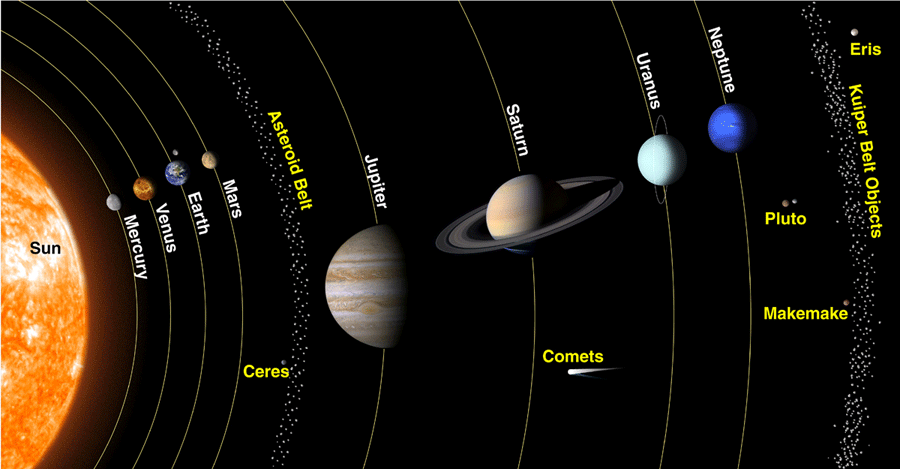
Which planet would have the largest gravitational pull?
a)
Venus
b)
Mars
c)
Jupiter
d)
Neptune
34.
What is the force that is most responsible for the observed motion of objects in our galaxy?
a)
Electro-magnetic Force
b)
Gravity
c)
Seismic Waves
d)
Tidal Force
35.
The force of gravity between any two objects is greatest if their masses are...
a)
small and distance is small.
b)
smalls and distance is great.
c)
large and distance is small.
d)
large and distance is great.
36.

The Mars Rover Opportunity had a Weight on Mars of 650 Newtons. Mars is a less massive planet than Earth. Predict what would have been its weight on Earth?
a)
1340 N
b)
4360 N
c)
470 N
d)
800 N
37.
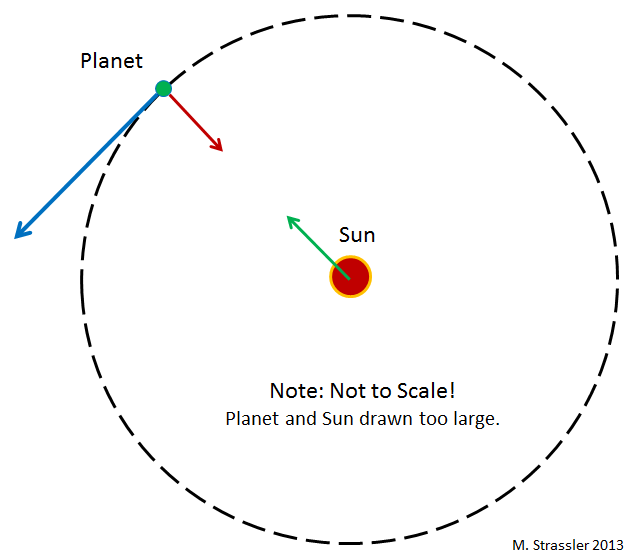
Which 2 factors keep a planet in its orbit around the sun?
a)
mass and distance
b)
inertia and gravity
c)
eccentricity and velocity
d)
force and speed
38.

Day and night is caused by the _____________ of earth on its axis.
a)
revolution
b)
orbit
c)
rotation
d)
dance moves
39.

If Earth rotated slower, we would have...
a)
shorter days.
b)
longer days.
c)
shorter years.
d)
longer years.
40.
Day and night is caused by the _____________ of earth on its axis.
a)
revolution
b)
orbit
c)
rotation
d)
dance moves
41.
If Earth rotated slower, we would have...
a)
shorter days.
b)
longer days.
c)
shorter years.
d)
longer years.
42.
The force of gravity between any two objects is greatest if their masses are
a)
small and distance is small
b)
smalls and distance is great
c)
large and distance is small
d)
large and distance is great
43.
The force of attraction between objects that have mass.
a)
Force
b)
Gravity
c)
Weight
d)
Density
44.
How does changing the distance between objects affect the force of gravity?
a)
Decreasing distance increases gravity
b)
increasing distance increases gravity
c)
Distance does not affect gravity
45.

From the choices below. Which of the following would you have the MOST WEIGHT?
a)
Europa
b)
Saturn
c)
Earth
d)
Ganymede
46.
The further a planet is from the sun the faster it revolves around the sun.
a)
True
b)
False
47.
As distance between two objects increase the pull of gravity
a)
Increases
b)
Decreases
c)
Stays the same
48.

The amount of matter in an object is _______________?
a)
Mass
b)
Weight
c)
Gravity
d)
Force
49.

An object's mass coupled with the gravitational force is ____________________________________.
a)
Mass
b)
Weight
c)
Density
d)
Acceleration
50.

The triple beam balance measures _____________________________________?
a)
Volume
b)
Weight
c)
Speed
d)
Mass
51.

The spring scales used in lab are used to measure __________________?
a)
Density
b)
Weight
c)
Length
d)
Mass
53.

Which is the only true statement?
a)
Your weight on the moon will be less
b)
Your mass on the moon is more
c)
Mass is dependent on gravity
d)
Weight is independent of gravity
53.
Which is the only true statement?
a)
Your weight on the moon will be less
b)
Your mass on the moon is more
c)
Mass is dependent on gravity
d)
Weight is independent of gravity
54.

What is the volume of the liquid in the pictured graduated cylinder?
a)
2000 mL
b)
100 mL
c)
1500 mL
d)
1400 mL
55.
If you start with a water level at 150 milliliters in a graduated cylinder & you drop in a stone and the level raises to 157 milliliters. How much water was displaced by the stone?
a)
6 ml
b)
7 ml
c)
157 ml
d)
150ml
56.
Suppose an astronaut were to visit a planet where the gravity is half that of Earth. His MASS on that planet would be ______________.
a)
half his Earth mass
b)
the same as his Earth mass
c)
twice his Earth mass
d)
the same as his weight
57.
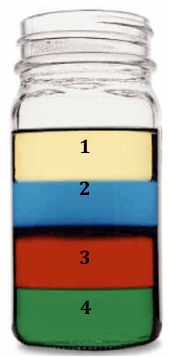
Put the liquids in order from most dense to least dense?
a)
4, 3, 2, 1
b)
1, 2, 3, 4
c)
3, 4, 2, 1,
d)
4, 3, 1, 2
58.
John measures a rock and finds it to be 16 grams. What does John know about the rock?
a)
its density
b)
its mass
c)
its volume
d)
its weight
59.
Mass is expressed in what type of units?
a)
meters and kilometers
b)
grams and kilograms
c)
liters and milliliters
d)
Newtons and pounds
60.

Calculate the density of the cube.
a)
2 g/cm3
b)
4 g/cm3
c)
6 g/cm3
d)
8 g/cm3
61.

What is the volume of this prism?
a)
24 cubic cm
b)
600 cubic cm
c)
60 cubic cm
d)
240 cubic cm
62.
If you have an object with a Length of 15 cm, a Width of 3 cm, and a Height of 10 cm. What is the volume
a)
450 cm3
b)
358 cm3
c)
454 cm3
d)
405 cm3
63.
Density is...
a)
the amount of mass in an object
b)
the amount of space an object takes up
c)
the amount of matter in a given space
d)
the weight of an object
64.
Jack has a rock. The rock has a mass of 14g and a volume of 2cm3. What is the density of the rock?
a)
7 mL
b)
7 g/cm3
c)
28 g/cm3
d)
1/7 g/cm3
65.
What is the volume of the liquid in the pictured graduated cylinder?
a)
2000 mL
b)
100 mL
c)
1500 mL
d)
1400 mL
100 %

