
 Worksheets
Geometry Sem 1 Final Review
Total questions: 190
Worksheet time: 3hrs 7mins
Name
Class
Date
1.
Part of a line. Has two endpoints and includes all of the points in between.
a)
Point
b)
Angle
c)
Line
d)
Line Segment
3.
An exact location in space with no length or width.
a)
Ray
b)
Point
Point
Point
c)
Line
d)
Line segment
3.
An exact location in space with no length or width.
a)
Ray
b)
Point
Point
Point
c)
Line
d)
Line segment
4.
Part of a line. Has one endpoint and continues on forever in one direction.
a)
Line Segment
b)
Line
c)
Ray
d)
Point
5.
What is the term for a part of a line with two endpoints?
a)
point
b)
ray
c)
angle
d)
line segment
6.
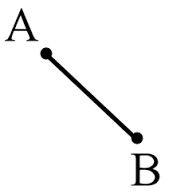
What is a line segment?
a)
Part of a line with 2 endpoints
b)
Part of a line that has 1 endpoint
c)
Part of a line with 0 endpoints
d)
Part of a line with 5 endpoints
7.
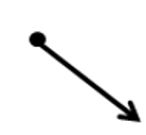
Name the image
a)
Line
b)
Ray
c)
Line segment
d)
Angle
8.

Name the image
a)
Line segment
b)
Line
Ray
Ray
c)
Point
Point
Point
d)
Ray
Line Segment
Line Segment
9.

Name the Image.
a)
Ray
b)
Point
c)
Line
d)
Line segment
10.

Name the Image
a)
Angle
b)
Line
c)
Line Segment
d)
Ray
11.
A line is named by...
a)
Any 2 points on the line, or a lowercase script letter.
b)
Any 3 points on the line.
c)
Any 1 point on the line.
d)
Any 3 points on the line, or a uppercase script letter.
12.
A plane is named by...
a)
Any 1 point on the plane.
b)
Any 3 collinear points on the plane or a lowercase script letter.
c)
Any 3 non-collinear points on the plane or an uppercase script letter.
d)
All points on the plane that aren't part of a line.
13.
Two lines intersect at a ....
a)
angle
b)
point
c)
line
d)
intersection
14.
Two planes intersect at a...
a)
line
b)
point
c)
plane
d)
letter
15.

Name 4 collinear points
a)
HMNO
b)
IKNO
c)
MJOL
d)
HNKI
16.

A line that contains point M.
a)
Line q
b)
Line p
c)
Line r
d)
Line NH
17.

An example of coplaner points
a)
D, E, B
b)
C, B, A
c)
M, E, C
d)
A, F, E
18.
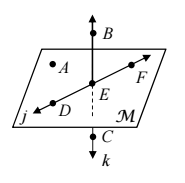
Give another name for line k.
a)
Line BC
b)
Line BCE
c)
Line ED
d)
Line k is the only name, there isn't another name.
19.

A plane containing point A.
a)
Plane DEA
b)
Plane k
c)
Plane CDF
d)
Plane F
20.

How would you describe points I, L, C?
a)
collinear
b)
non-coplanar
c)
symmetric
d)
coplanar
21.
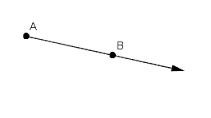
What is the name of this ray?
a)
Ray AB
b)
Ray BA
c)
Ray ABC
d)
Ray AC
22.
An exact location in space with no length or width.
a)
Ray
b)
Point
c)
Line
d)
Line segment
23.

Name the image
a)
Line
b)
Ray
c)
Line segment
d)
Angle
24.

Name the Image
a)
Angle
b)
Line
c)
Line Segment
d)
Ray
25.
A line is named by...
a)
Any 2 points on the line, or a lowercase script letter.
b)
Any 3 points on the line.
c)
Any 1 point on the line.
d)
Any 3 points on the line, or a uppercase script letter.
26.
A plane is named by...
a)
Any 1 point on the plane.
b)
Any 3 collinear points on the plane or a lowercase script letter.
c)
Any 3 non-collinear points on the plane or an uppercase script letter.
d)
All points on the plane that aren't part of a line.
27.
Two lines intersect at a ....
a)
angle
b)
point
c)
line
d)
intersection
28.
Two planes intersect at a...
a)
line
b)
point
c)
plane
d)
letter
29.

A line that contains point M.
a)
Line q
b)
Line p
c)
Line r
d)
Line NH
30.

An example of 2 non-collinear points.
a)
D, E
b)
C, B
c)
M, E
d)
F, B
31.

Are points D and E collinear or coplanar?
a)
Collinear
b)
Coplanar
32.

A plane containing point A.
a)
Plane DEA
b)
Plane k
c)
Plane CDF
d)
Plane F
33.

Give another name for line k.
a)
Line BC
b)
Line BCE
c)
Line ED
d)
Line k is the only name, there isn't another name.
34.

Name two points collinear to Point K
a)
H & M
b)
J & L
c)
N & J
d)
M & L
35.

Name the intersection of Plane ADE and Plane W
a)
Point E
b)
Point A
c)
Line AD
d)
Line EA
36.

Name the intersection of Line c and Plane R
a)
Point J
b)
Line HK
c)
Point K
d)
Line MN
37.

If I wanted to name ∠KGL which colored angle am I talking about?
a)
light blue
b)
yellow
c)
blue
d)
green
38.

If I named ∠LGH, what angle am I talking about?
a)
red
b)
pink
c)
yello
d)
green
39.
How many letters do you need to name an angle? (if more than one angle is stemmed from the vertex)
a)
0
b)
2
c)
3
d)
4
40.

Name the blue angle
a)
∠GLK
b)
∠L
c)
∠HGL
d)
∠KLH
41.

Which angle is ∠H?
a)
green
b)
pink
c)
red
d)
light blue
42.
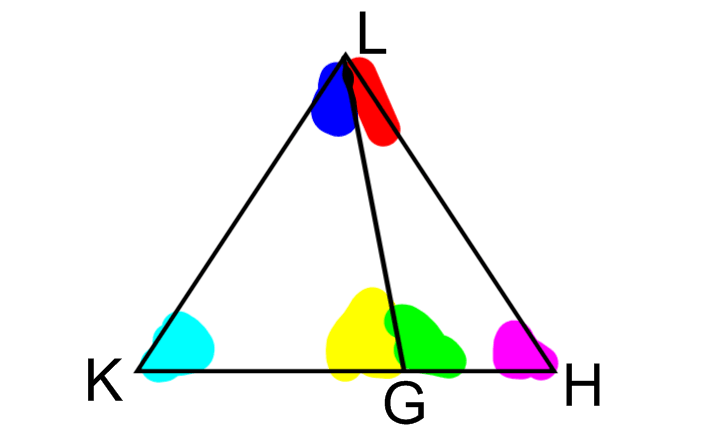
I I wanted to name the blue+red angle, which of these names would be acceptable?
a)
∠L
b)
∠LHG
c)
∠HLK
d)
∠GKL
43.

Angle PTQ is
a)
obtuse
b)
acute
c)
right
d)
straight
44.

Angle PTS is
a)
acute
b)
obtuse
c)
right
d)
straight
45.

Angle STQ is
a)
obtuse
b)
acute
c)
right
d)
straight
46.

Angle PTQ can also be named
a)
Angle QTP
b)
Angle TPQ
c)
Angle TPQ
47.

Angle RTS can also be named
a)
Angle STR
b)
Angle SRT
c)
Angle RST
48.

Angle WZU is a
a)
right angle
b)
straight angle
c)
obtuse angle
d)
acute angle
49.

Angle XZU is a
a)
straight angle
b)
obtuse angle
c)
right angle
d)
acute angle
50.

Angle YZW is an
a)
obtuse angle
b)
right angle
c)
acute angle
d)
straight angle
51.
Another name for angle UZV is
a)
angle VZU
b)
angle ZUV
c)
angle ZUV
52.
Another name for angle WZY is
a)
angle YZW
b)
angle WYZ
c)
angle YWZ
53.
There are two right angles shown in this figure. They are
a)
angle WZU and angle XZW
b)
angle WZU and angle YZX
c)
angle XZU and angle WZU
54.
If an angle measure is 94 degrees, then the angle is
a)
a right angle
b)
an obtuse angle
c)
an acute angle
d)
a straight angle
55.
If an angle measure is 24 degrees, then the angle is
a)
a right angle
b)
an obtuse angle
c)
an acute angle
d)
a straight angle
56.
If an angle measure is 180 degrees, then the angle is
a)
a right angle
b)
an obtuse angle
c)
an acute angle
d)
a straight angle
57.
A right angle is shown on a drawing with a
a)
small rectangle
b)
small square
c)
arc marks
58.

Find the missing angle.
a)
28
b)
18
c)
38
d)
22
59.

Find the missing angle.
a)
16
b)
17
c)
27
d)
37
60.

Find the value of x.
a)
14
b)
60
c)
35
d)
180
61.
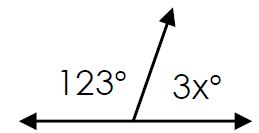
Find the value of x.
a)
15
b)
16
c)
18
d)
19
62.

∠1 and ∠3 can best be described as -
a)
complementary angles
b)
supplementary angles
c)
vertical angles
d)
adjacent angles
63.
What is an example of a pair of complementary angles?
a)
13° and 45°
b)
10° and 170°
c)
81° and 9°
d)
90° and 3°
64.

Tell whether the angles are complementary or supplementary. Then find the value of x.
a)
Complementary; x=25
b)
Complementary; x=5
c)
Supplementary; x=25
d)
Supplementary; x=5
65.
What are supplementary angles?
a)
Angles that add up to 180°
b)
Angles that add up to 90°
c)
Angles that are equal to each other
d)
Angles that are opposite of each other when lines intersect
66.
What are complementary angles?
a)
Angles that add up to 180°
b)
Angles that add up to 90°
c)
Angles that are equal to each other
d)
Angles that are opposite of each other when lines intersect.
67.
What are vertical angles?
a)
Angles that add up to 180°
b)
Angles that add up to 90°
c)
Angles that add up to 360°
d)
Angles that are opposite of each other when lines intersect and are equal
68.

Solve for x
a)
5
b)
90
c)
25
d)
10
69.

Solve for x
a)
6
b)
140
c)
20
d)
90
70.

FInd the pair of Supplementary Angles
a)
Angle AKB and Angle BKG
b)
Angle AKB and Angle KGC
c)
Angle FGE and Angle DGE
d)
Angle FGE and Angle FGI
72.

Find the pair of Complementary angles
a)
Angle FGE and Angle DGE
b)
Angle FGE and Angle KGC
c)
Angle CGD and Angle IGF
d)
Angle IJH and Angle HJG
72.
Find the pair of Complementary angles
a)
Angle FGE and Angle DGE
b)
Angle FGE and Angle KGC
c)
Angle CGD and Angle IGF
d)
Angle IJH and Angle HJG
73.

Find a pair of Vertical Angles
a)
Angle FGE and Angle DGE
b)
Angle KGC and Angle CGE
c)
Angle AKB and Angle FGE
d)
Angle IJH and Angle KJG
74.

Find m∠ABC
a)
45o
b)
60o
c)
105o
d)
15o
75.

Find the value of ∠A.
a)
39 degrees
b)
49 degrees
c)
51 degrees
d)
59 degrees
76.

What is the measure of the following angle?
a)
120 degrees.
b)
171 degrees.
c)
60 degres.
d)
10 degrees.
77.

Name all the angles that have V as a vertex.
a)
A
b)
B
c)
C
d)
D
78.

Find HG.
a)
8
b)
9
c)
10
d)
11
79.
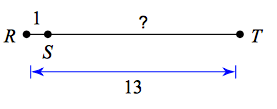
Find ST.
a)
11
b)
12
c)
13
d)
14
80.

Let B be between A and C.
a)
28
b)
4
c)
16
d)
12
81.

Find KL.
a)
18
b)
15
c)
6
d)
20
82.

Find the length of segment EC
a)
33
b)
36
c)
40
d)
35
83.
Q is the midpoint of PR.
PQ = 6x – 7 and QR = 5x + 1.
Find the length of PR.
PQ = 6x – 7 and QR = 5x + 1.
Find the length of PR.
a)
8
b)
16
c)
41
d)
82
84.

What is the measure of the following angle?
a)
21 degrees.
b)
34 degrees.
c)
70 degrees.
d)
172 degrees.
85.
Bisector
a)
A point, line or line segment that divides a segment or angle into two equal parts
b)
A part of a line between two points on the line
c)
A figure before a transformation has taken place
86.

Given ray EF is the angle bisector of <TEA. Which is FALSE?
a)
m<TEF = 87
b)
m<TEA = 87
c)
m<FEA = 43.5
d)
m<TEF = m<FEA
87.
Find HG.
a)
8
b)
9
c)
10
d)
11
88.
Find ST.
a)
11
b)
12
c)
13
d)
14
89.
Let B be between A and C.
a)
28
b)
4
c)
16
d)
12
90.
Find KL.
a)
18
b)
15
c)
6
d)
20
91.
A collection of points going on and on forever in both directions.
a)
Ray
b)
Angle
c)
Line segment
d)
Line
92.
What does the word BISECT mean?
a)
To cut something into more than five pieces.
b)
It is a plane with two sets of wings.
c)
A shape that has three sides.
d)
To cut something into two congruent pieces or in half.
93.
This point divides a line segment into 2 equal parts.
a)
point
b)
vertex
c)
midpoint
d)
segment
94.

a)
RM=6, MS=6
b)
RM=3, MS=3
c)
RM=3, MS=6
d)
RM=6, MS=3
95.

a)
MQ=4, PQ=8
b)
MQ=4, PQ=4
c)
MQ=8, PQ=4
d)
MQ=8, PQ=8
96.
What is the inverse operation of addition?
a)
addition
b)
subtraction
c)
multiplication
d)
division
97.
What is the inverse operation of subtraction?
a)
addition
b)
subtraction
c)
multiplication
d)
division
98.
What is Addition property of equality
a)
a. If a=b, then a+c=b+c
b)
b. If a=b, then a-c=b-c
c)
c. If a=b, then ac=bc
d)
d. If a=b, then a/c=b/c
99.
What is Subtraction property of equality
a)
a. If a=b, then a+c=b+c
b)
b. If a=b, then a-c=b-c
c)
c. If a=b, then ac=bc
d)
d. If a=b, then a/c=b/c
100.

Identify the property of equality used & the solution.
a)
addition: 26
b)
addition: 2
c)
subtraction: 26
d)
subtraction: 2
101.

Identify the property of equality used & the solution.
a)
addition: 13
b)
addition: 3
c)
subtraction: 19
d)
subtraction: 13
102.
What is the inverse operation of division?
a)
addition
b)
subtraction
c)
multiplication
d)
division
103.
What is the inverse operation of multiplication?
a)
addition
b)
subtraction
c)
multiplication
d)
division
104.
What is multiplication property of equality
a)
a. If a=b, then a+c=b+c
b)
b. If a=b, then a-c=b-c
c)
c. If a=b, then ac=bc
d)
d. If a=b, then a/c=b/c
105.
What is division property of equality
a)
a. If a=b, then a+c=b+c
b)
b. If a=b, then a-c=b-c
c)
c. If a=b, then ac=bc
d)
d. If a=b, then a/c=b/c
106.

Identify the property of equality used & the solution.
a)
division: 7
b)
addition: - 40
c)
multiplication: - 30
d)
division: - 7
107.

Identify the property of equality used & the solution.
a)
division: 50
b)
multiplication: 50
c)
multiplication: -50
d)
addition: -5
108.
Simplify the expression with the distributive property
6(x + 3)
6(x + 3)
a)
6x + 3
b)
6x + 18
c)
x + 3
d)
9x
109.
What is the Substitution property of equality
a)
a. If a=b, then a can be substituted for b in any equation or expression
b)
b. a(b+c)=ab+ac
c)
c For any real number a, a=a .
d)
d. If a=b, then b=a
110.
What is the Distributive property of equality
a)
a. If a=b, then a can be substituted for b in any equation or expression
b)
b. a(b+c)=ab+ac
c)
c For any real number a, a=a .
d)
d. If a=b, then b=a
111.

Step 1 is what
a)
addition property of equality
b)
given
c)
subtraction property of equality
d)
prove
112.

Step 2 is what
a)
Substitution property (simplify)
b)
Multiplication property of equality
c)
Division property of equality
d)
Distributive Property
113.

What is step 3
a)
Addition property of equality
b)
Substitution property (simplify)
c)
Subtraction property of equality
114.

What is step 4
a)
Substitution property (simplify)
b)
Addition property of equality
c)
Subtraction property of equality
115.

What is step 5
a)
Substitution property (simplify)
b)
Addition property of equality
c)
Division property of equality
116.

What is step 6
a)
Subtraction property of equality
b)
Addition property of equality
c)
Division property of equality
117.

What is step 7
a)
Addition property of equality
b)
Division property of equality
c)
Substitution Property
d)
Prove
118.

What is reason 1?
a)
Subtraction Property of Equality
b)
Transitive Property of Equality
c)
Given
d)
Prove
119.

What is reason 2?
a)
Given
b)
Addition Property of Equality
c)
Subtraction Property of Equality
d)
Substitution Property of Equality
120.

What is reason 3?
a)
Addition Property of Equality
b)
Subtraction Property of Equality
c)
Multiplication Property of Equality
d)
Division Property of Equality
121.

What is reason 4?
a)
Addition Property of Equality
b)
Subtraction Property of Equality
c)
Multiplication Property of Equality
d)
Division Property of Equality
122.

What is reason 5?
a)
Transitive Property
b)
Reflexive Property
c)
Symmetric Property
d)
Prove
123.

What is reason 1?
a)
Symmetric Property of Equality
b)
Given
c)
Prove
d)
Subtraction Property of Equality
124.

What is reason 2?
a)
Addition Property of Equality
b)
Subtraction Property of Equality
c)
Multiplication Property of Equality
d)
Division Property of Equality
125.
What is reason 3?
a)
Addition Property of Equality
b)
Subtraction Property of Equality
c)
Multiplication Property of Equality
d)
Division Property of Equality
126.

Fill in the statement for number 3.
a)
HA = AY
b)
HA = AP
c)
A is the midpoint of HP
127.

Fill in the reason for number 3.
a)
Reflexive property
b)
Symmetric Property
c)
Transitive property
d)
Substitution property
128.
Fill in the statement for number 4.
a)
RA=RE +AE
b)
EL = EA + AL
c)
RE +EA= EA +AL
d)
RA = EL
129.

Fill in the reason for 5.
a)
Addition Postulate
b)
Substitution property
c)
Definition of midpoint
d)
Segment Addition Postulate
130.

Find the value of x.
a)
52
b)
63
c)
53
d)
58
131.

Find the value of x.
a)
22
b)
28
c)
23
d)
30
132.

Find the value of x.
a)
19
b)
15
c)
14
d)
11
133.

What property justifies this statement?
a)
Addition Property
b)
Definition of Midpoint
c)
Segment Addition Postulate
d)
Definition of Congruent Segments
134.

What property justifies this statement?
a)
Substitution Property
b)
Transitive Property
c)
Reflexive Property
d)
Symmetric Property
135.

What is the reason?
a)
Angle Addition
b)
Segment Addition
c)
Definition of Congruence
d)
Definition of Between
136.

What is the reason?
a)
Reflexive
b)
Symmetric
c)
Definition of congruence
d)
Definition of equal
137.

What is the reason?
a)
Definition of congrucent
b)
Definition of midpoint
c)
Definition of segment
d)
Segment Addition
138.

What is the reason?
a)
Angle Addition
b)
Segment Addition Postulate
c)
Definition of Congruence
d)
Definition of Between
139.

What is the reason?
a)
Transitive
b)
Substitution
c)
Middle Man
d)
Replacing
140.
What is reason 1?
a)
Subtraction Property of Equality
b)
Transitive Property of Equality
c)
Given
d)
Prove
141.
What is reason 2?
a)
Given
b)
Addition Property of Equality
c)
Subtraction Property of Equality
d)
Substitution Property of Equality
142.
What is reason 3?
a)
Addition Property of Equality
b)
Subtraction Property of Equality
c)
Multiplication Property of Equality
d)
Division Property of Equality
143.
What is reason 4?
a)
Addition Property of Equality
b)
Subtraction Property of Equality
c)
Multiplication Property of Equality
d)
Division Property of Equality
144.
What is reason 5?
a)
Transitive Property
b)
Reflexive Property
c)
Symmetric Property
d)
Prove
145.
What is reason 1?
a)
Symmetric Property of Equality
b)
Given
c)
Prove
d)
Subtraction Property of Equality
146.
What is reason 2?
a)
Addition Property of Equality
b)
Subtraction Property of Equality
c)
Multiplication Property of Equality
d)
Division Property of Equality
147.
What is reason 3?
a)
Addition Property of Equality
b)
Subtraction Property of Equality
c)
Multiplication Property of Equality
d)
Division Property of Equality
148.
What is always the 1st statement in reason column of a proof?
a)
Prove
b)
Given
c)
Reason
d)
Statement
149.
If a=b, then 8a=8b. What property justifies this?
a)
Multiplication POE
b)
Division POE
c)
Reflexive POE
d)
Addition POE
150.
If x = y, then x + 5 = y + 5. What property justifies this?
a)
Addition POE
b)
Subtraction POE
c)
Reflexive POE
d)
Transitive POE
151.
What is step 4?
a)
Substitution property (simplify)
b)
Addition property of equality
c)
Subtraction property of equality
152.
What is step 7?
a)
Addition property of equality
b)
Division property of equality
c)
Substitution Property
d)
Prove
153.

Classify the relationship between angles 1 and 5?
a)
Alternate Interior
b)
Alternate Exterior
c)
Corresponding
d)
Interior
154.

True or false:
E and D are corresponding angles.
E and D are corresponding angles.
a)
True
b)
False
155.

m<d = 70 degrees
What is the m<h?
What is the m<h?
a)
70
b)
65
c)
140
d)
110
156.

m<b = 110
What is the m<f?
(More than one answer is technically correct; choose the most mathematically correct answer)
What is the m<f?
(More than one answer is technically correct; choose the most mathematically correct answer)
a)
70
b)
110
c)
65
d)
Mr. Collins is cool?
157.
m<b = 110
What is the m<f?
(More than one answer is technically correct; choose the most mathematically correct answer)
What is the m<f?
(More than one answer is technically correct; choose the most mathematically correct answer)
a)
70
b)
110
c)
65
d)
Mr. Collins is cool?
158.

What is measure of angle 1?
a)
88
b)
100
c)
180
d)
94
159.

Name the alternate interior angle to angle 3.
a)
4
b)
5
c)
6
d)
8
160.
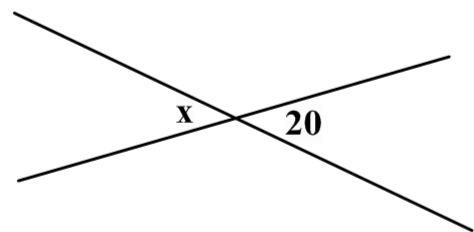
Find the missing angle. Find x.
a)
20o
b)
70o
c)
160o
d)
180o
161.
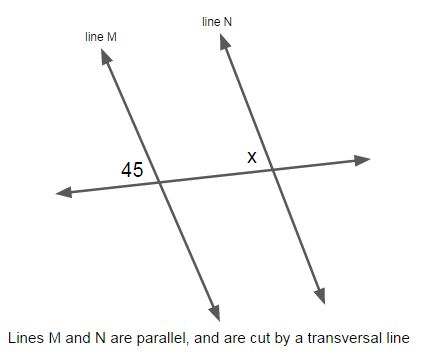
What is the value of x?
a)
45
b)
54
c)
126
d)
135
162.
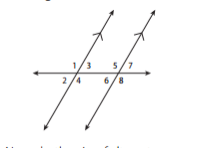
Name the relationship between ∠4 and ∠6.
a)
corresponding angles
b)
alternate interior angles
c)
alternate exterior angles
d)
consecutive interior angles
163.
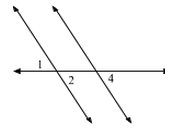
Angle 1 = 27o
Find the measure of angle 2
Find the measure of angle 2
a)
27o
b)
153o
c)
63o
d)
90o
164.
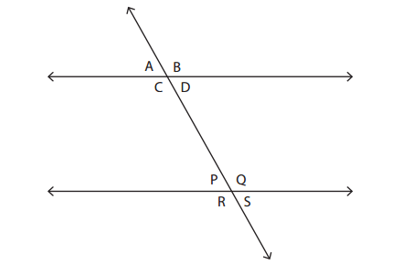
If angle P measures 60 degrees, what is the measure of angle C?
a)
60 degrees
b)
30 degrees
c)
120 degrees
165.

Identify the correct statement.
a)
∠C=116°
b)
∠C=64°
c)
∠C=180°
d)
∠C=26°
166.

State the angle relationship and find the measure of angle 1
a)
Corresponding
110
110
b)
Alternate Exterior
110
110
c)
Corresponding
70
70
d)
Alternate Exterior
70
70
167.

State the angle relationship and find the measure of angle 2
a)
Alternate Interior
90
90
b)
Alternate Exterior
90
90
c)
Corresponding
90
90
d)
Same Side Interior
90
90
168.

State the angle relationship and find the measure of angle 3
a)
Alternate Interior
50
50
b)
Alternate Interior
130
130
c)
Corresponding
130
130
d)
Corresponding
50
50
169.

State the angle relationship and find the measure of angle 1
a)
Alternate Interior
37
37
b)
Alternate Interior
143
143
c)
Corresponding
143
143
d)
Corresponding
37
37
170.

State the angle relationship and find the measure of angle 2
a)
Alternate Exterior
127
127
b)
Alternate Exterior
52
52
c)
Alternate Interior
127
127
d)
Alternate Interior
52
52
171.

State the angle relationship and find the measure of angle 3
a)
Alternate Exterior
94
94
b)
Alternate Exterior
86
86
c)
Alternate Interior
86
86
d)
Alternate Interior
94
94
172.

Find the measure of angle 1.
a)
28o
b)
136o
c)
44o
d)
6o
173.
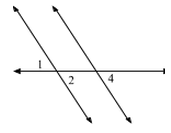
Angle 1 = 27o
Find the measure of angle 4
Find the measure of angle 4
a)
27o
b)
153o
c)
63o
d)
90o
174.

Lines r and s are cut by a transversal. What value of x proves r ∥ s?
a)
43
b)
37
c)
143
d)
37
175.

Solve for y.
a)
y = 20
b)
y = 120
c)
y = 60
d)
y = 10
176.

What is the relationship of the angles?
a)
Corresponding angles
b)
Same Side Interior
c)
Alternate Interior
d)
Alternate Exterior
177.

Which pair of angles are alternate exterior angles?
a)
Angle 7 and Angle 4
b)
Angle 2 and Angle 6
c)
Angle 8 and Angle 1
d)
Angle 2 and Angle 8
178.
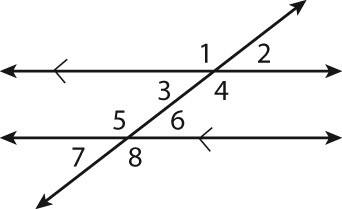
Which of these angles is NOT congruent to angle 5?
a)
Angle 6
b)
Angle 8
c)
Angle 1
d)
Angle 4
179.

What is the value of x?
a)
22
b)
26
c)
24
d)
23
180.

What is the value of x?
a)
-6
b)
22
c)
16
d)
21
181.

Name the angle relationship.
a)
Alternate Interior
b)
Alternate Exterior
c)
Corresponding
d)
Vertical Angles
182.

Name the angle relationship.
a)
Alternate Interior
b)
Alternate Exterior
c)
Corresponding
d)
Vertical Angles
183.

Name the angle relationship.
a)
Alternate Interior
b)
Alternate Exterior
c)
Corresponding
d)
Vertical Angles
184.

Name the angle relationship.
a)
Alternate Interior
b)
Alternate Exterior
c)
Corresponding
d)
Vertical Angles
185.

Name the angle relationship.
a)
Alternate Interior
b)
Alternate Exterior
c)
Correpsonding
d)
Vertical Angles
186.

Name the angle relationship.
a)
Alternate Exteriors
b)
Alternate Interiors
c)
Corresponding
d)
Same Side Interior
187.

Name the angle relationship.
a)
Same Side Interior
b)
Alternate Interior
c)
Corresponding
d)
Vertical Angles
188.

Name the angle relationship.
a)
Same Side Interior
b)
Alternate Interior
c)
Vertical Angles
d)
Linear Pairs
189.

Name the angle relationship.
a)
Same Side Interior
b)
Corresponding
c)
Alternate Interiors
d)
Linear Pairs
190.

Name the angle relationship.
a)
Alternate Exteriors
b)
Alternate Interiors
c)
Corresponding
d)
Same Side Interiors
100 %

