
 Worksheets
Spheres and Cycles
Total questions: 40
Worksheet time: 33mins
Name
Class
Date
1.
This system relates to weather, clouds, or aerosols (particles in the air). It includes an ever‐changing mixture of gas and small particles located above the Earth’s surface.
a)
Atmosphere
b)
Lithosphere
c)
Biosphere
d)
Hydrosphere
2.
This system is associated with water in solid (ice) and liquid states.
a)
Atmosphere
b)
Biosphere
c)
Hydrosphere
d)
Lithosphere
3.
Geosphere is another name for...
a)
Atmosphere
b)
Biosphere
c)
Lithosphere
d)
Hydrosphere
4.
This system is associated with living systems such as biomes or ecosystems. This includes life on land, in the oceans and rivers, and even life we cannot see with the naked eye.
a)
Atmosphere
b)
Biosphere
c)
Lithosphere
d)
Hydrosphere
5.
Each Sphere is independent and not affected by things that happen in other spheres.
a)
True
b)
False
6.

What part of the water cycle does this picture show?
a)
condensation
b)
precipitation
c)
evaporation
7.
The Earth is composed of a complex set of cycles, parts and processes that all work together as a _____________?
a)
Planet
b)
Unit
c)
System
d)
Factory
8.
Ships encounter surface currents and waves as they travel across the ocean. Surface currents and waves form when energy from the sun causes 2 of Earth’s spheres to interact. Which 2 spheres interact to produce these waves and currents?
a)
The atmosphere and hydrosphere
b)
The biosphere and hydrosphere
c)
The geosphere and biosphere
d)
None of these are correct. Currents and waves are caused by whales and other animals moving in the water.
9.
Which of these parts of the Earth system are interacting when Florida’s orange trees grow?
a)
Cryosphere, atmosphere and hydrosphere
b)
Biosphere, hydrosphere and cryosphere
c)
Geosphere, cryosphere and atmosphere
d)
Biosphere, hydrosphere, and atmosphere
10.
Water evaporating from the surface of a lake moves from the...
a)
Atmosphere to the hydrosphere
b)
Hydrosphere to the atmosphere
c)
Atmosphere to the geosphere
d)
Geosphere to the hydrosphere
11.
When a plants takes carbon dioxide from the air which two spheres are interacting?
a)
Atmosphere and atmosphere
b)
Geosphere and atmosphere
c)
Hydrosphere and atmosphere
d)
Biosphere and atmosphere
12.

What does this depict?
a)
The Ozone Layer
b)
Greenhouse Effect
c)
The Car's Heater
d)
Blue/Geen Car Effect
13.
Water evaporating from the surface of a lake moves from the...
a)
Atmosphere to the geosphere
b)
Geosphere to the hydrosphere
c)
Hydrosphere to the atmosphere
d)
Atmosphere to the hydrosphere
14.
Fire would most affect the
a)
geosphere
b)
atmosphere
c)
cryosphere
d)
hydroshpere
15.

What sphere does the earths core belong too?
a)
Hydrosphere
b)
Biosphere
c)
Geosphere
d)
Atmosphere
16.
What part of the water cycle does this picture show?
a)
condensation
b)
precipitation
c)
evaporation
17.
Which of these is an example of precipitation?
a)
snow
b)
air
c)
clouds
d)
vapor
18.
Which is the opposite of condensation?
a)
runoff
b)
evaporation
c)
precipitation
d)
transpiration
19.

What is it called when WATER is FORMED from an LIQUID to a WATER VAPOR Oor an [GAS]?
a)
EVAPORATION
b)
PRECIPITATION
c)
TRANSPIRATION
20.

What is it called when plants give off water vapor as a waste product?
a)
condensation
b)
evaporation
c)
sublimation
d)
transpiration
21.
When water _________, dew forms.
a)
Melts
b)
Evaporates
c)
Condenses
d)
Precipitates
22.
What is the water cycle?
a)
the 3 forms of water
b)
the movement of water on, above, or below the surface of the Earth
c)
when water melts
d)
when clouds form
23.
What is the energy source for the water cycle?
a)
the sun
b)
the earth
c)
water
d)
the moon
24.
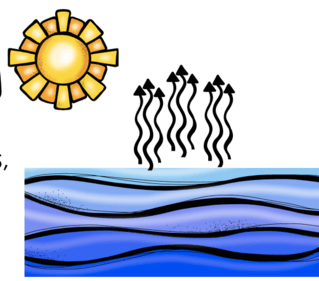
What part of the water cycle does this picture show?
a)
condensation
b)
precipitation
c)
evaporation
25.
When water condenses, the liquid water forms ______________.
a)
water vapor
b)
steam
c)
air
d)
clouds
26.
When humans burn fossil fuels, most of the carbon quickly enters the as carbon dioxide.
a)
Water
b)
Atmosphere
c)
Sun
d)
Air
27.
Which one of these does not add CO2 to the atmosphere?
a)
cooking with gas
b)
planting trees
c)
burning wood
d)
riding in a bus
28.
Combustion is another word for _______________.
a)
a train
b)
a bus
c)
a dog
d)
burning
29.
Which of the following is not a carbon sink?
a)
The ocean soaks up carbon
b)
Human activities create more carbon dioxide
c)
The Earth's Crust locks up carbon for long periods of time
d)
Green trees during photosynthesis
30.
True or false. Carbon is found in every living thing
a)
false
b)
true
31.
If the plant population decreased, the amount of carbon would _________.
a)
Stay the same
b)
Increase
c)
Decrease
32.
All of the carbon in existence is continually recycled in the carbon cycle
a)
True
b)
False
33.
Why is the ocean important to the carbon cycle?
a)
It keeps sediment containing carbon underwater for millions of years
b)
The ocean gives out more carbon then it takes in (increases global warming)
c)
The ocean isn't important to the carbon cycle.
34.
Carbon can be found in...?
a)
The atmosphere
b)
Inside of the Earth
c)
Fossil fuels
d)
All of the above!
35.
carbon is moved from rocks and soil on land to rivers and oceans by a process called
a)
weathering
b)
erosion
c)
runoff
d)
all of these
36.
Carbon compounds move from plants to animals via the process of _______?
a)
Respiration
b)
Photosynthesis
c)
Ingestion (eating)
d)
Diffusion
37.
oxygen is a gas produced by _____ and used by ________
a)
plants and animals
b)
photosynthesis and carbon dioxide
c)
animals and plants
d)
carbon dioxide and photosynthesis
38.
The water cycle transports
a)
Matter and energy
b)
Living things
c)
Ships
d)
Metal
39.
The water in our water cycle is
a)
millions of years old
b)
about the same amount as it was millions of years ago
c)
part of a closed system
d)
all of these are correct
40.
True or false. Carbon dioxide is reducing the effect of the Greenhouse Effect on Earth.
a)
true
b)
false
100 %

