
 Worksheets
UCEA - Year 10 - B1a
Total questions: 39
Worksheet time: 23mins
Name
Class
Date
1.

What type of cell is this?
a)
animal
b)
plant
c)
bacteria
d)
algae
2.

Which of these would you not find in an animal cell?
a)
cell membrane
b)
cell wall
c)
nucleus
d)
ribosome
3.

Which of these would you not expect to find in a bacterial cell?
a)
cell wall
b)
cell membrane
c)
nucleus
d)
cytoplasm
4.
What term is used to describe a single celled organism without a true nucleus?
a)
prokaryote
b)
virus
c)
protoctista
d)
eukaryote
5.
Where in a cell does respiration take place?
a)
ribosome
b)
nucleus
c)
mitochondria
d)
cytoplasm
6.
What is the function of the cell membrane?
a)
respiration
b)
protein synthesis
c)
control of substances in/out of the cell
d)
reproduction
7.
What is the function of the ribosomes?
a)
respiration
b)
protein synthesis
c)
cell replication
d)
DNA replication
8.

When cells become specialised for a particular role, it is known as ...?
a)
cell differentiation
b)
cell replication
c)
cell reproduction
d)
cell mitosis
9.
Which of the following is the correct statement?
a)
Both plant and animal cells differentiate at an early stage.
b)
Animal cells differentiate early, whilst many plant cells can differentiate throughout life.
c)
Plant cells differentiate early, many animal cells can differentiate throughout life.
d)
The majority of both plant and animals cells can differentiate later in life.
10.
Unspecialised cells that can differentiate to form many different types of cell are known as...?
a)
Stem cells
b)
Specialised cells
c)
Differential cells
d)
Special cells
11.
Which type of human stem cell would be able to differentiate into the most type of specialised cells?
a)
Embryonic stem cells
b)
Adult bone marrow stem cell
12.
Cells with a membrane, nucleus and cytoplasm, such as those found in animals and plants, are known as ...?
a)
prokaryotes
b)
eukaryotes
13.
Which type of cell would be the smallest?
a)
Eukaryote
b)
Prokaryote
14.

When using a microscope, how do you work out the real size of an image?
a)
image size ÷ magnification
b)
magnification ÷ image size
c)
image size × magnification
d)
image size + magnification
15.
If an image measured 3.5 mm and the magnification was x 1,000, how big would the actual object be?
use: real size = image size ÷ magnication
use: real size = image size ÷ magnication
a)
0.0035 mm
b)
0.035 mm
c)
3500 mm
d)
0.35 mm
16.
1 μm (micro-metre) is equal to how many metres?
a)
0.000 1
b)
0.000 01
c)
0.000 001
d)
0.000 000 1
17.
15 mm would be equal to how many μm?
a)
150
b)
1 500
c)
15 000
d)
150 000
18.
What is the name of the technique that should be used to prepare bacterial plates?
a)
septic
b)
aseptic
c)
sterile
d)
uncontaminated
19.
a microscope that uses a stream of electrons to form magnified images of objects
a)
Optical Microscope
b)
Electron Microscope
c)
Compound Microscope
d)
Simple Microscope
20.
This is where the slide is placed.
a)
stage
b)
arm
c)
base
d)
diaphragm
21.
These are varying magnifications: 20x, 40x...
a)
objective
b)
eyepiece
c)
diaphragm
d)
nosepiece
22.
What is the difference between embryonic stem cells and adult stem cells?
a)
Embryonic stem cells can differentiate into more cell types than adult stem cells
b)
Adult stem cells are pluripotent, just like embryonic stem cells
c)
Adult stem cells can differentiate into more cell types than embryonic stem cells
d)
Adult stem cells grow bigger than embryonic stem cells
23.

This type of cell sends messages throughout the body in the form of electrical impulse.
a)
nerve cell
b)
sperm cell
c)
muscle cell
d)
skin cell
24.

This type of cell is found in males and is responsible for reproduction.
a)
sperm cell
b)
egg cell
c)
muscle cell
d)
nerve cell
25.
Which is true about Adult Stem Cells.
a)
They no longer do mitosis, their cell type is set and can not change
b)
They are limited to the type of cell they can become.
c)
They can become any cell type in the body
d)
They are found in embryos
26.
Which is true about Embryonic Stem Cells.
a)
They no longer do mitosis, their cell type is set and can not change
b)
They are limited to the type of cell they can become
c)
They can become any cell type in the body
d)
They are found in adults
27.
What is the function of the vacuole?
a)
Site of metabolic reactions
b)
Controls the cell's activity
c)
Stores dissolved sugars and other solutes as sap
d)
Controls what enters and leaves the cell
28.
What describes a group of specialised cells that perform the same function in the body?
a)
Organ system
b)
Organelle
c)
Organ
d)
Tissue
29.
From what type of cell do all our tissues come from?
a)
Myocytes
b)
Tissue cells
c)
Adipose cells
d)
Stem cells
30.
The site of photosynthesis
a)
ribosome
b)
mitochondria
c)
chloroplast
d)
nucleus
31.

Directs all cell activities through the DNA located there.
a)
Lysosomes
b)
Nucleus
c)
ribosomes
d)
Mitochondria
32.

I am the outer most layer of an animal cell. What am I?
a)
cell wall
b)
nucleus
c)
cell membrane
d)
cell skin
33.
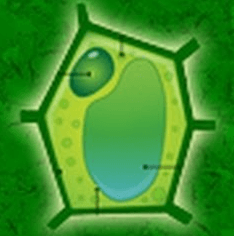
A rigid layer that lies outside the cell's membrane is...
a)
Cytoskeleton
b)
Cilia
c)
Cell Wall
d)
Flagella
34.
All our cells, except sex cells like eggs or sperm, have ___________ DNA
a)
different
b)
similar
c)
exactly the same
d)
half the amount of
35.

The diagram shows the process of cell specialization from a single stem cell. Which of the following statements is true about the process of specialization.
a)
Specilized cells (blood, skin, nervous etc) cannot be produced from a single stem cell
b)
Specilized cells are produced immediately following fertilization
c)
Even though all the cells in an organism come from one single cell, they can specialize into different cell types
d)
Sincce all the cells in an organism come from one single cell, they must all have the same structure and function
36.
What is cell specialization or differentiation?
a)
The process where unspecialized cells become different in structure and function.
b)
When DNA controls the cell cycle.
c)
The ability of cells to make more cells.
d)
The ability of cells to maintain homeostasis.
37.

Which of the following correctly represents the aseptic technique?
a)
When you no longer need the petri dish, it can be left open
b)
all equipment must be sterilized before culturing
c)
Clean work space upon entering-not leaving; that is the next person's job
d)
hand washing is not a part of aseptic technique - just universal precautions
38.
All precautions taken to prevent contamination and ultimately infection.
a)
Aseptic Technique
b)
Electrocautery
c)
Nociception
d)
Nosocomial Infection
39.
A sterilization unit that creates high-temperature pressurized steam
a)
breathing circuit
b)
flow meter
c)
autoclave
d)
mayo stand
100 %

