
 Worksheets
Hydrology Review
Total questions: 25
Worksheet time: 18mins
Name
Class
Date
1.
When evaporation occurs, what happens to the water?
a)
It cools
b)
It heats up
c)
It freezes
d)
It stays the same temperature
2.

What part of the water cycle does this picture show?
a)
condensation
b)
precipitation
c)
evaporation
d)
transpiration
3.
Which of these is an example of precipitation?
a)
snow
b)
air
c)
clouds
d)
vapor
4.
Which is the opposite of condensation?
a)
runoff
b)
evaporation
c)
precipitation
d)
transpiration
5.

Does evaporation happen before or after condensation?
a)
before
b)
after
c)
during
6.
Snow, sleet, hail, and rain are all examples of ________________.
a)
evaporation
b)
condensation
c)
accumulation
d)
precipitation
7.

What is it called when plants give off water vapor as a waste product?
a)
condensation
b)
evaporation
c)
sublimation
d)
transpiration
8.
What is the water cycle?
a)
the 3 forms of water
b)
the movement of water on, above, or below the surface of the Earth
c)
when water melts
d)
when clouds form
9.
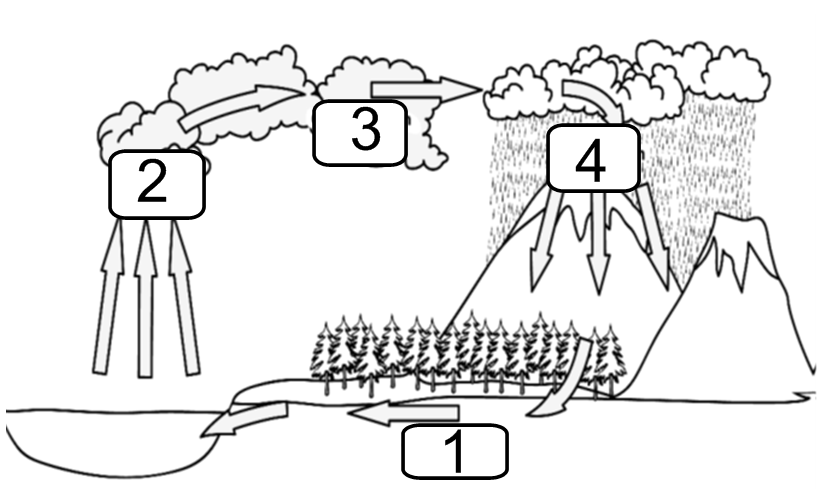
Which stage does the #2 show in the diagram?
a)
condensation
b)
evaporation
c)
precipitation
d)
run off
10.

Which stage does the #3 show in the diagram?
a)
condensation
b)
evaporation
c)
precipitation
d)
run off
11.

what does the #4 show in the diagram?
a)
condensation
b)
evaporation
c)
precipitation
d)
run off
12.
The water cycle has no start or end
a)
true
b)
false
13.
What percent of Earth's water is fresh?
a)
3
b)
29
c)
71
d)
97
14.
What percent of Earth's water is salty?
a)
3
b)
29
c)
71
d)
97
15.
Where is most of earth's freshwater found?
a)
in lakes and rivers
b)
in the ground
c)
in the clouds
d)
in polar ice caps and glaciers
16.
What makes water move through the water cycle?
a)
geothermal energy
b)
rain
c)
the sun
d)
gravity
17.
The process where rain water soaks into the ground through soil and rocks is called __________.
a)
precipitation
b)
infiltration
c)
evaporation
d)
condensation
18.
__________ is the study of water in the atmosphere, on Earth's surface, and underground.
a)
meteorology
b)
geology
c)
biology
d)
hydrology
19.
What is the most abundant salt found in the ocean?
a)
magnesium chloride
b)
sodium chloride
c)
potassium chloride
d)
calcium chloride
20.
Where do the salts in the sea come from?
a)
animals that live in the sea
b)
acid rain
c)
plants
d)
weathering and erosion of rocks
21.
Some seas have a high rate of evaporation. Because of this, the water in those seas will have higher _____________.
a)
temperatures
b)
waves
c)
salt concentrations
d)
amounts of animals
22.
Ocean water is different than freshwater because ________________.
a)
ocean water has higher temperatures
b)
ocean water has lower temperatures
c)
ocean water has lower salt concentrations
d)
ocean water has higher salt concentrations
23.
As you descend into the ocean, _________________________.
a)
temperature and pressure increase
b)
pressure decreases, temperature increases
c)
temperature decreases, pressure increases
d)
pressure and temperature decrease
24.
Which activity would most likely pollute a source of fresh drinking water?
a)
using too much groundwater
b)
dumping sewage
c)
watering plants
d)
taking showers
25.
When condensation occurs, what happens to the water vapor?
a)
It cools
b)
It heats up
c)
It stays the same temperature
d)
It melts
100 %
![FINAL EXAMS | [HARD] Grammar Practice Quiz](https://cf.quizizz.com/image/image-loader.svg)
