
 Worksheets
Mixed Midterm Review
Total questions: 29
Worksheet time: 15mins
Name
Class
Date
1.
ESRT turn to page 3
At which city in New York State would an observer view Polaris at an angle of 45 degrees?
At which city in New York State would an observer view Polaris at an angle of 45 degrees?
a)
Ithaca
b)
Albany
c)
Watertown
d)
Massena
2.

If it is 3pm in New York what time is it in California?
a)
3pm
b)
12pm
c)
3am
d)
2pm
3.
The Coriolis Effect curves winds on the Earth's surface and proves that the Earth
a)
rotates on its axis
b)
revolves around the Sun
c)
is tilted on its axis
d)
is made of hydrogen and helium
4.
What causes many surface winds to deflect to the right in the Northern Hemisphere?
a)
Coriolis effect (rotation of the Earth)
b)
Revolution of Earth around the Sun
c)
Rotation of the Milky Way galaxy
d)
Expansion of the Universe
5.
ESRT turn to page 3
At which city in New York State would an observer view Polaris at an angle of 42 degrees?
At which city in New York State would an observer view Polaris at an angle of 42 degrees?
a)
Binghamton
b)
Buffalo
c)
Syracuse
d)
Oswego
6.

Inside of this box energy is transferred by the movement of a fluid, air. Which type of energy transfer is shown?
a)
convection
b)
conduction
c)
radiation
d)
transmutation
7.
Which type of surface would absorb the MOST electromagnetic radiation?
a)
black and smooth
b)
black and rough
c)
white and smooth
d)
white and rough
8.
In Earth Science we use the term insolation when discussing the Seasons. Which of the following is the best definition of insolation?
a)
the circumference of the Earth
b)
Incoming Solar Radiation
c)
the distance to the Sun
d)
the speed of Earth in its orbit
9.

On May 1st which latitude would have both the greatest angle and intensity of insolation?
a)
75 degrees N
b)
15 degrees S
c)
15 degrees N
d)
60 degrees N
10.

What direction is the stream flowing?
a)
North
b)
South
c)
East
d)
West
11.
A sample of material found on Mars has a mass of 45 grams. The sample takes up a space or volume of 9 cm3. What is the density of the sample?
a)
45 g/cm3
b)
5 g/cm3
c)
9 g/cm3
d)
30 g/cm3
12.
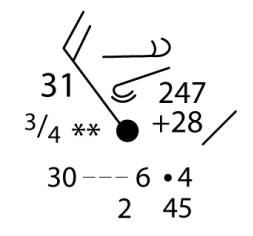
What is the barometric pressure at this station?
a)
247 millibars
b)
924.7 millibars
c)
1024.7 millibars
d)
31 millibars
13.

What is the gradient of the path from point A to point B? Point A has an elevation of 400 meters. Point B has an elevation of 300 meters. The distance between points is 5 miles.
a)
25 m/mi
b)
100 m/mi
c)
300 m/mi
d)
20 m/mi
14.

The star that appears above Earth's North Pole and can be found by following the pointer stars in the Big Dipper is
a)
Vega
b)
Polaris
c)
Sirius
d)
Alpha Centauri
15.

What direction is a person observing Polaris facing?
a)
South
b)
East
c)
West
d)
North
16.

What is the wind direction at this station
a)
Wind is blowing to the Northeast
b)
Wind is blowing out of the Northeast
c)
Wind is blowing to the Northwest
d)
Wind is blowing out of the Northwest
17.
Why does warm air rise up along a front?
a)
The heavier warmer air mass begins to rise above the other cooler denser air mass
b)
The lighter warmer air mass begins to rise above the other cooler denser air mass
18.
It is summer in New York state when the Sun is
a)
closer to the Earth
b)
at a high angle of incidence
c)
in the sky for a fewer number of hours
d)
at Solar Maximum
19.
We live in the ______ galaxy.
a)
Andromeda
b)
Solar
c)
Milky Way
d)
Canis Major
20.
How do winds move around a hurricane?
a)
clockwise and inward
b)
clockwise and outward
c)
counterclockwise and inward
d)
counterclockwise and outward
21.
The density of Pyrite is 5 g/cm3. If a piece of pyrite has a mass of 25 g what is the volume of the sample?
a)
5 cm3
b)
75 cm3
c)
3 cm3
d)
25 g
22.
Which type of air mass can form hurricanes?
a)
cP
b)
mP
c)
cT
d)
mT
23.
Clouds form because air
a)
rises, compresses and warms
b)
rises, expands and cools
c)
sinks, compresses and warms
d)
sinks, expands and cools
24.

Due to sinking air the climate at 30 N is best describe as
a)
rainforest
b)
desert
c)
arctic
d)
maritime
25.

Polaris is the "circumpolar" star. What do the other constellations appear to do with Polaris in the evening sky?
a)
decrease in size
b)
expand towards Polaris
c)
rotate around Polaris
d)
blue shift
26.
What is one possible step humans could take to reduce the amount of greenhouse gases in the atmosphere?
a)
use renewable energy instead of oil and gas
b)
reduce the amount of water vapor in the atmosphere
c)
increase the size of the ozone layer hole
d)
burn more gas than oil
27.
Which part of the day is the hottest?
a)
8 pm
b)
noon
c)
8 am
d)
around 1pm
28.
Carbon dioxide is a
a)
good absorber of IR radiation
b)
poor reflector of UV radiation
c)
poor absorber of IR radiation
d)
good reflector of UV radiation
29.
How many hours of daylight do all locations on Earth on March 21st?
a)
24 hours
b)
12 hours
c)
8 hours
d)
16 hours
100 %

