
 Worksheets
Forces of Nature CGF3MO: 4.3 Earthquakes
Total questions: 25
Worksheet time: 14mins
Name
Class
Date
1.

Where is the point at which the first movement occurs during an earthquake?
a)
Epicenter
b)
Focus
c)
Fault
d)
Plate
2.

Where is the point on the Earth’s surface directly above the focus of an earthquake?
a)
Epicenter
b)
Fault
c)
Hypocenter
d)
Tremor
3.

Which type of wave is the first to arrive after an earthquake occurs?
a)
P Wave
b)
Rayleigh Wave
c)
S Wave
d)
Shear Wave
4.

Which body wave squeezes and stretches rock materials as they pass through the Earth?
a)
Body Waves
b)
P Waves
c)
S Waves
d)
Surface Waves
5.

Which body waves cause particles of rock material to move at right angles to the direction in which the waves are traveling?
a)
Body Waves
b)
P Waves
c)
S Waves
d)
Surface Waves
6.
P Waves can move through which of the following?
a)
Gas
b)
Liquid
c)
Solid
d)
All of these
7.
S Waves can move through which of the following?
a)
Gas
b)
Liquid
c)
Solid
d)
All of these
8.

What is the measure of the amount of energy released in an earthquake?
a)
Earthquake
b)
Epicenter
c)
Magnitude
d)
Seismogram
9.

Which scale rates earthquakes based on the amount of damage done?
a)
Mercalli Scale
b)
Richter Scale
c)
Seismogram Scale
d)
Bernoulli Scale
10.

What is the temporary state in which loose soil and rock materials take on the property of a liquid?
a)
Aftershock
b)
Liquefaction
c)
Seismic Gap
d)
Tsunami
11.

What is a smaller earthquake that follows a larger earthquake?
a)
Aftershock
b)
Liquefaction
c)
Seismic Gap
d)
Tsunami
12.

How much bigger is a magnitude 8 earthquake compared to magnitude 7 one on the Richter Scale?
a)
1 time bigger
b)
10 times bigger
c)
100 times bigger
d)
1000 times bigger
13.

Which travels fastest, always being the first detected by seismic stations?
a)
P waves
b)
S waves
14.

Earthquakes happen every day. Most are too small for humans to notice.
a)
True
b)
False
15.

The record of a seismic wave is the
a)
Seismogram
b)
Seismometer
c)
Seismologist
d)
Richter scale
16.

The instrument used to detect and record of seismic waves is the
a)
Seismogram
b)
Seismologist
c)
seismometer
d)
Richter scale
17.

Which seismogram represents a city that is far from the epicenter of an earthquake?
a)
New York, NY
b)
Nome, Alaska
c)
Guadalajara, Mexico
18.

What are the two types of earthquake waves?
a)
P and S waves
b)
Surface and Underground waves
c)
Fast and Slow waves
19.
What is the vocabulary word for the line where two tectonic plates move past each other?
a)
Plate Line
b)
Fault Line
c)
Puzzle Line
20.
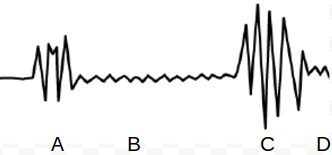
Where are the P-waves located on this seismogram?
a)
A
b)
B
c)
C
d)
D
21.
In what direction does an earthquake's seismic waves carry energy?
a)
away from focus
b)
toward focus
c)
from surface to interior
d)
through the mantle only
22.

When did the Cascadia Earthquake occur?
a)
1700
b)
1984
c)
2004
d)
2011
23.

Vancouver and Victoria are at risk of an earthquake and possible tsunami to occur because the Juan de Fuca plate is ____________
a)
subducting under the North American Plate
b)
moving past the North American Plate
c)
subducting under the Pacific Plate
d)
moving past the Pacific Plate
24.

Which Canadian province is least likely to experience an earthquake?
a)
Yukon
b)
British Collumiba
c)
Quebec
d)
Saskachewan
25.

The city in which a famous building is using a mass damper system to counteract the swaying caused by earthquake shaking (see image)
a)
Shanghi
b)
Tokyo
c)
Seoul
d)
Taipei
100 %

