
 Worksheets
Biochemistry Review
Total questions: 19
Worksheet time: 15mins
Name
Class
Date
1.

Proteins are made of smaller units called:
a)
Glucose
b)
Cellulose
c)
Fatty acids
d)
Amino acids
2.

Organic compounds are always based on what two elements?
a)
hydrogen and oxygen
b)
nitrogen and oxygen
c)
hydrogen and carbon
d)
nitrogen and carbon
3.

The four organic compounds found in living things are?
a)
Carbohydrates, Lipids, Nucleic Acids, and Oxygen
b)
Carbohydrates, Lipids, Proteins, and Carbon
c)
Carbohydrates, Lipids, Proteins, Nucleic Acids
d)
Carbon, Lipids, Proteins, Nucleic Acids
4.

Enzymes are examples of this organic compound...
a)
Carbohydrate
b)
Lipid
c)
Protein
d)
Nucleic Acid
5.

Oils are examples of this type of organic compound...
a)
Carbohydrate (Sugars)
b)
Lipid (Fats)
c)
Protein
d)
Nucleic Acid
6.

This is an example of
a)
Lipid
b)
Carbohydrate
c)
Protein
d)
Nucleic Acid
7.

Proteins are tested for by using....
a)
Benedict's solution
b)
Biuret solution
c)
Iodine solution
d)
Sudan III solution
8.
What is an Enzyme?
a)
energy needed to get a reaction started
b)
large compound formed from combinations of many monomers
c)
proteins that act as biological catalyst to speed up reactions
9.

The effect of temperature on the relative rate of action of an enzyme is represented in the graph below.
The optimum temperature for the action of this enzyme is approximately
The optimum temperature for the action of this enzyme is approximately
a)
15⁰C
b)
22⁰C
c)
37⁰C
d)
50⁰C
10.

Which statement best describes the enzyme represented in the graphs below?
a)
This enzyme works best at a temperature of 35⁰C and a pH of 8
b)
This enzyme works best at a temperature of 50⁰C and a pH of 12
c)
This enzyme works best at a temperature of 35⁰C and a pH of 12
11.
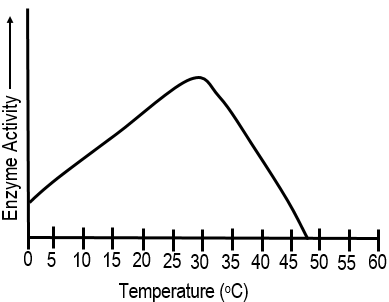
Based on the graph, what is the optimal temperature for this enzyme?
a)
15oC
b)
40oC
c)
30oC
d)
45oC
12.
Which compound below is Organic?
a)
C6H12O6
b)
CO₂
c)
NH3
d)
O2
13.

3 Long Chains of Fatty Acids
a)
nucleic acids
b)
carbohydrates
c)
proteins
d)
lipids
14.

In a molecule of DNA the sub-units are called
a)
nucleotides
b)
simple sugars
c)
lipids
d)
proteins
15.
Which are INORGANIC substances?
a)
Lipid and Salt (NaCl)
b)
Nitrogen and Carbohydrate
c)
Water and Salt (NaCl)
d)
Water and Lipid
16.
Which statement describes Enzymes:
a)
control transport of materials within the cell
b)
speed up the rate of chemical reactions
c)
provide energy for chemical reactions
d)
absorb oxygen from the environment
17.
Proteins are made by...
a)
Ribosomes
b)
Nucleus
c)
Cytoplasm
d)
Mitochondria
18.
Which of the following is NOT a function of proteins
a)
Assist in blood clotting
b)
Fight infections and diseases
c)
Assist in the processing of glucose
d)
None of the above
19.
Which of the following is NOT a function of proteins
a)
Acts as a catalyst to speed up reactions
b)
Fight infections and diseases (Immunity)
c)
carries oxygen within red blood cells
d)
Store genetic Information
100 %

