
NEW
Font size
S
M
L
XL
 Worksheets
Plate Tectonic Flexbook Assignment
Total questions: 20
Worksheet time: 14mins
Name
Class
Date
1.

Increasing in depth, the Earth's layers in the book are described as _?_.
a)
crust (oceanic and continental), upper mantle, lower mantle, outer core, and inner core
b)
crust (ocean and continental), upper mantle, lower mantle, inner core, and outer core
c)
crust (ocean and continental), lower mantle, upper mantle, outer core, and inner core
d)
outer core, inner core, lower mantle, upper mantle, and crust (oceanic and continental)
2.
The lithosphere and asthenosphere differ in how they act physically. Which is solid, but it can flow and bend like silly putty?
a)
lithosphere
b)
asthenosphere
3.

This is a picture of glacier scars found in Africa. What are these evidence for?
a)
Africa has always been near the equator.
b)
Africa was once in an area of the Earth that had a very cold climate.
c)
The continents have not moved.
d)
Sea floor spreading
4.
What two specific continents fit together most noticeably?
a)
Africa and North America
b)
South America and Europe
c)
South America and Africa
d)
Antartica and Africa
5.
One of the key pieces of evidence that supports the theory of continental drift is the puzzle fit of the continents. The theory was weakened by areas which lacked an exact fit. Later, scientists realized that the continental shelf should be included in the theory. Which statement explains why the continental shelf should be included?
a)
Coastlines of continents have not changed over time.
b)
Coastlines have been weathered and eroded over time, but the continental shelf is less affected by erosion and thus allows a better fit.
c)
Coastlines changed as the continents broke apart and the continental shelf remained unchanged.
d)
The continental shelf has grown over time and fills in the gaps, allowing for a better puzzle fit.
6.
True or false. Coal found in colder climates indicate that the land used to be in a warmer climate.
a)
True
b)
False
7.
Compare the process that occurs at a mid-ocean ridges to the process that occurs at a deep ocean trench?
a)
Older rock is formed at the mid-ocean ridge and newer rock is subducted at a deep ocean trench.
b)
New rock is being created at a mid-ocean ridge and old rock is being subducted at a deep ocean trench.
c)
Old rock returns to the mantle at the mid-ocean ridge and volcanoes are created at a deep ocean trench.
d)
Rocks move towards each other at a mid-ocean ridge and move away from each other at a deep ocean trench
8.
The farther from a mid-ocean ridge a rock sample is taken the ______________ the rock is.
a)
hotter
b)
softer
c)
younger
d)
older
9.
Sea-floor spreading states that new ocean crust is being formed constantly. Which of the following is also true?
a)
The oceans are constantly getting bigger.
b)
The amount of land on Earth is constantly increasing.
c)
The amount of land on Earth remains the same due to subduction.
d)
When the size of the crust reaches a certain amount, sea-floor spreading will stop.
10.
Why was sea-floor spreading such important discovery?
a)
It provided a way for the continents to be moved that Wegener could not explain in his original theory.
b)
It explained why the abyssal was not completely flat as scientist first thought.
c)
It provided an explanation as to why ocean crust is always so much younger than continental crust.
d)
It provided a way for the Earth to move material from the mantle up onto the crust.
11.

What type of boundary does this picture represent?
a)
divergent boundary
b)
convergent boundary
c)
transform boundary
12.

What type of boundary does this picture represent?
a)
divergent boundary
b)
convergent boundary
c)
transform boundary
13.

What type of boundary does this picture represent?
a)
divergent boundary
b)
convergent boundary
c)
transform boundary
14.
At which type of boundary do two plates move away from each other?
a)
divergent boundary
b)
convergent boundary
c)
transform boundary
15.
At which type of boundary do two plates collide?
a)
divergent boundary
b)
convergent boundary
c)
transform boundary
16.
At which type of boundary do plates move past each other horizontally?
a)
divergent boundary
b)
convergent boundary
c)
transform boundary
17.
The average density of one of the continental crusts is 2.8 g/cm3 and the average density of one of the oceanic crusts is 3.2 g/cm3. If these two plates came together, what could be expected to happen?
a)
The two plates would push apart and form a rift zone.
b)
The oceanic plate would rise up over the continental plate.
c)
The oceanic plate would be pushed under the continental plate.
d)
The two plates would meet head on and rise up to form mountains.
18.
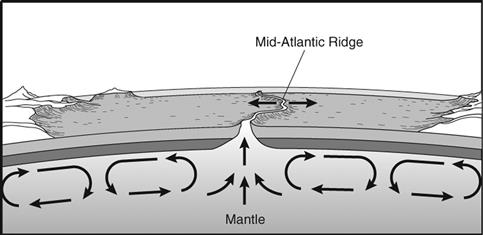
The diagram represents the movement of the mantle under the Earth's crust. Which process is represented by the diagram?
a)
subduction
b)
conduction
c)
radiation
d)
convection
19.
Where does the heat source for convection come from?
a)
the lithosphere
b)
the mantle
c)
the core
d)
the asthenosphere
20.
What fate awaits the Pacific and Atlantic Oceans?
a)
The Pacific will continue to shrink and be destroyed as the Atlantic expands.
b)
The Atlantic will continue to shrink and be destroyed as the Pacific expands.
c)
Both will continue to expand as all other oceans are destroyed.
d)
They will continue at relatively their current size.
Reset

