
NEW
Font size
S
M
L
XL
 Worksheets
Ancient Civilizations Mesopotamia and Egypt
Total questions: 70
Worksheet time: 42mins
Name
Class
Date
1.

What is the other name for Mesopotamia
a)
London
b)
Fertile Crescent
c)
Tigris
d)
Jordan
2.
The first civilizations arose in__________ because the conditions for farming were good.
a)
mountains
b)
deserts
c)
river valleys
d)
none of the above
3.
River valleys were also ideal locations for __________ to develop.
a)
trade and travel
b)
water skiing
c)
mining
d)
forestry
4.
The flooding of the Mesopotamia river valley could be described as __________.
a)
predictable
b)
unpredictable
c)
gentle
d)
calm
5.
How did the river valley peoples control flooding?
a)
they built homes on stilts
b)
they left during flood season
c)
they built dams and channels
d)
they could not control flooding
6.
How did city-states irrigate their crops?
a)
they built walls, waterways , and ditches
b)
they built underground irrigation systems
c)
they used sprinklers
d)
they relied on rain
7.
Which of the following is not a common characteristic of a river valley?
a)
cities
b)
mountains
c)
art
d)
religion
8.
What type of products were developed in the Sumerian city-state?
a)
cloth and pottery products
b)
wheat and barley
c)
metal products
d)
all of the above
9.
What was the name of the Sumerian system of writing?
a)
hieroglyphics
b)
cuneiform
c)
Sanskrit
d)
pictographs
10.
Most city-states of Mesopotamia used ________ as their primary building material.
a)
mud-brick
b)
concrete
c)
limestone
d)
granite
11.
If you were to describe the religion of most Sumerian city-states they would be ________.
a)
monotheistic
b)
theocratic
c)
polytheistic
d)
atheistic
12.
Which group of people were highest in the social class system of early Mesopotamia?
a)
priests
b)
farmers
c)
slaves
d)
artisans
13.
Which of the following statements most closely defines Mesopotamia's division of labor?
a)
The lower class were largely made up of artisans
b)
the upper class of priests and kings ruled
c)
The middle class were slaves who performed hard labor
d)
The middle class had more rights and privileges than the upper class
14.
If theKing rules, the type of government is a/an
a)
oligarchy
b)
dictatorship
c)
monarchy
d)
theocracy
15.
If a religious leader rules a nation, the type of government is a/an
a)
oligarchy
b)
dictatorship
c)
monarchy
d)
theocracy
16.
Where did most trade routes develop in early civilizations?
a)
mountain ranges
b)
along rivers
c)
through deserts
d)
in ziggurats
17.
What agricultural techniques encouraged surplus production?
a)
plows
b)
canals
c)
levees
d)
all of the above
18.
As villages grew and supported larger and more permanent populations______emerged.
a)
cities
b)
dictators
c)
religion
d)
irrigation
19.
Someone who is a skilled laborer and part of the middle class is a/an ____.
a)
slave
b)
priest
c)
artisan
d)
government official
20.
The Mesopotamia River Valley was located between the ________and________ Rivers.
a)
Nile and Euphrates
b)
Nile and Tigres
c)
Tigres and Euphrates
d)
Euphrates and Huang He
21.
_____________ was the king who created the first empire in Mesopotamia.
a)
Hammurabbi
b)
Nebudchadnezzar
c)
David
d)
Sargon
22.
_________________ was the king responsible for his written set of laws.
a)
Sargon
b)
Hammurabi
c)
Nebuchadnezzar
d)
David
23.
Besides goods, people living in Mesopotamia exchanged ideas about _________ with others.
a)
culture
b)
pottery
c)
money
d)
none of the above
24.
Who united upper and lower Egypt and is considered to be the first pharaoh?
a)
Menes
b)
Ahmose
c)
Hatshepsut
d)
queen Nefertiti
25.
How does the Nile River flow?
a)
starting in the south to the north
b)
starting in the north to the south
c)
starting in the middle to the north
d)
starting in the middle to the south
26.
What is a Pharaoh?
a)
emperor
b)
King only
c)
God only
d)
God and king
27.
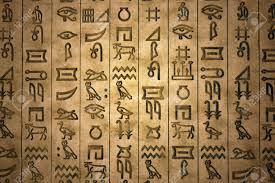
What is this system of writing called?
a)
calligraphy
b)
Hieroglyphs
c)
Cuneiform
d)
Alphabet
28.
What happened to wealthy Egyptians after they died?
a)
They were mummifed
b)
They were buried in a casket
c)
They floated down the Nile River
d)
They were burned
29.
Egypt is in
a)
Antrartica
b)
Asia
c)
Africa
d)
Europe
30.
How often did the Nile River flood?
a)
Every now and then
b)
Every 3 months
c)
Every year at some time
d)
Every year at about the same time
31.
How did the Egyptians feel about Nile River flooding?
a)
They were sad because the flood caused great problems
b)
They were happy because the flood caused crops to grow
32.
an ancient writing paper
a)
perfume
b)
papyrus
c)
hieroglyphics
d)
stone
33.
Which describes a technique that the ancient Egyptians used to adapt to their environment?
a)
They built underground sewer systems.
b)
They were able to irrigate water from the Red Sea for their crops.
c)
They farmed on land that had been flooded by the Nile River.
d)
They built walls around their city to keep out invaders.
34.
Which of the following beliefs was central to Egyptian religion?
a)
the afterlife
b)
the pyramids
c)
the pharaohs
d)
the heavens
35.
Why were tombs filled with art, jewelry, and other treasures?
a)
The tombs served as museums.
b)
The tombs were the private storage rooms fo the pharaoh.
c)
Egyptians believed tombs to be the safest places in the kingdom.
d)
Egyptians believed the dead (ka) enjoyed such materials in the afterlife.
36.

In the Egyptian social order, which class was a part of the bureaucracy which helped the pharaoh run the government and temples?
a)
nobles
b)
scribes
c)
craftspeople
d)
servants
37.
The Nile River flows through two important regions in Egypt called...
a)
Upper Egypt and Lower Egypt.
b)
Mesopotamia and the Fertile Crescent.
c)
Eastern Egypt and Western Egypt.
d)
Nubia and Cairo.
38.
What effect did a surplus of food have on the people of the Nile River valley?
a)
Egyptians could specialize in jobs other than farming.
b)
Egyptian trade decreased.
c)
The population of Egypt decreased.
d)
Egyptian specialization in jobs other than farming decreased.
39.

Given that the Nile generally flows in a northward direction, which statement is MOST accurate?
a)
It flows into the Red Sea.
b)
It flows into Lake Victoria.
c)
It flows into the Suez Canal.
d)
It flows into the Mediterranean Sea.
40.
What is a dynasty?
a)
ruler of Egypt
b)
a series of rulers from the same family
c)
a type of government ruled by priests or gods
d)
a system of offices and officials who handle governmental business
41.
The ruler of Egypt is called a...
a)
bureaucracy.
b)
theocracy.
c)
dynasty.
d)
pharaoh.
42.
In Egypt, pyramids were built of all sizes and used for
a)
storing food
b)
tombs for pharaohs
c)
protection against invaders
d)
market places
43.
One of Egypt’s most important defenses against enemy invaders was
a)
the large city walls
b)
its natural envioronment
c)
their superior weapons
d)
the protection of gods
44.
Ancient Egyptians had
a)
1 god
b)
many gods
45.
What is the name of the important river found in Egypt?
a)
Tigris
b)
Amazon
c)
Nile
d)
Euphrates
46.
Method of bring water to a field is called ______________
a)
Irrigation
b)
Agriculture
c)
Domestication
47.

What is a cataract?
a)
strong rapids
b)
waterfalls
c)
strong animals
d)
Strong mountains
48.

What is a Delta?
a)
A triangle shaped area of land
b)
food
c)
A multitude
d)
Money
49.
The Middle Kingdom came to an end when
a)
Ramses was defeated by the Sumerians
b)
The Nobles challenged the power of the pharaoh and the Hyksos invaded
50.
Which country does Dr. Otengho come from?
a)
Africa
b)
Kenya
c)
Alabama
d)
Atlanta
51.
What is the correct definition for empire?
a)
A group of territories and people brought together under one supreme ruler
b)
a belief in many gods or goddesses
c)
Having little rainfall and warm temperatures
d)
An ancient Sumarian or Babylonian temple that rose in a series of step like levels
52.
Why was the invention of the wheel so important?
a)
They used the wheels to make cards
b)
They were used on wagons to help transport goods and the potter's wheel made pottery faster
c)
They broke up the soil which made it easier to plant
d)
They allowed people to keep track of crops and goods
53.
What was religion like in ancient Mesopotamia?
a)
It was polytheistic, they believed in many different gods
b)
They did not have religion
c)
They only believed in goverment
d)
They believed in one god, the sun god
54.
The few Sumerians who learned how to write often held high positions in society as what?
a)
artisans
b)
scribes
c)
heads of households
d)
merchants
55.
What is cuneiform?
a)
a political unit that includes a city and its nearby farmlands
b)
a set of written rules for people to obey
c)
person who specializes in writing and serves as a record keeper
d)
an ancient writing system developed by the Sumerians, made up of wedge-shaped markings
56.
Who was Hammurabi?
a)
An amount produced in excess of what is needed
b)
The ruler of Babylonian Empire from 1792-1750 BC
c)
An area of rich soil in the Middle East, stretching from the Mediterranean Sea to the Persian Gulf
d)
fair treatment of people, in keeping with the law
57.
Which of the following is a reason why the Tigris and Euphrates rivers important in Mesopotamia?
a)
Provided water to irrigate the crops
b)
Silt was deposited on the floodplain - made the area fertile
c)
Travel by boats was faster and easier
d)
All of the above
58.
How would you describe the climate of the Fertile Crescent?
a)
Arctic- cold with a lot of snow
b)
Semiarid- hot summers with a lot of rainfall
c)
Semiarid - hot summers with very little rainfall
d)
Drought- No rain for a long period of time
59.

This picture shows an area known as the..
a)
Farming Curve
b)
Fertile Crescent
c)
Green C
d)
Fertile Curve
60.
Which of the following was NOT an inventions of ancient Sumer?
a)
wheel
b)
writing
c)
fire
d)
plow
61.
Why was Hammurabi's code so important?
a)
The laws were agreed upon by everyone
b)
For the first time, laws were written down so everyone knew them and their punishments
c)
Because these laws are still followed in today's goverment
d)
The laws allowed for new inventions to take place
62.
Who was Nebuchadnezzar?
a)
Leader of the Chaldean Empire who seized Jerusalem
b)
He rebuilt the city of Babylon
c)
He built the hanging Gardens of Babylon for his wife
d)
All of the above
63.
The fine soil deposited by rivers is called...
a)
bronze
b)
grass
c)
magma
d)
silt
64.

What river is the arrow pointing to?
a)
Tigris
b)
Euphrates
c)
Western Desert
d)
Nile River
65.

The Sumerians invented something that made it possible for their armies to use chariots. What was it?
a)
harnesses
b)
domesticated animals
c)
wheels
d)
horseshoes
66.

An independent city and farm land like the ones found in Sumer was a
a)
City-State
b)
Country
c)
Villiage
d)
Culture
67.

What modern day country is Mesopotamia mostly in?
a)
Iran
b)
Israel
c)
Syria
d)
Iraq
68.

A Sumerian temple to honor their god was called a
a)
scribe
b)
cradle
c)
Gilgamesh
d)
ziggurat
69.
The word "Mesopotamia" means
a)
middle of the fertile crescent
b)
land in the middle of the desert
c)
land between the rivers
d)
land north of the sea
70.
This is the tool that makes life easier through inventions and other uses of knowledge to solve complex problems.
a)
Agriculture
b)
Social Structure
c)
Technology
d)
Specialized Labor
Reset

