
 Worksheets
Solar System
Total questions: 31
Worksheet time: 29mins
Name
Class
Date
1.
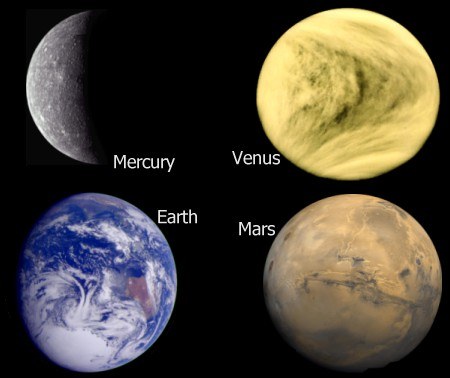
Earth and the other planets closest to the Sun are made mostly of _______
a)
gas
b)
metal
c)
water
d)
rock
2.

Earth's ________ on its axis causes day and night.
a)
rotation
b)
revolution
c)
phase
d)
comet
3.

The moon is a natural ______ of Earth.
a)
comet
b)
axis
c)
satellite
d)
space probe
4.

One full orbit of an object around another object is called a ________.
a)
axis
b)
rotation
c)
revolution
d)
satellite
5.
Where is the asteroid belt found?
a)
between earth and mars
b)
Between Uranus and Neptune
c)
Between Mercury and Venus
d)
Between Mars and Jupiter
6.
Day and night is caused by the _____________ of earth on its axis.
a)
revolution
b)
orbit
c)
rotation
7.
Why does Earth have different seasons?
a)
because of the distance between Earth and the sun
b)
because of the speed of Earth as it rotates on its axis
c)
because of the amount of light blocked by the moon on its axis
d)
because of the tilt of Earth on its axis as it moves around the sun
8.
As the Earth travels around the sun, this tilt causes different areas of the Earth’s surface to get different amounts of daylight at different times of the year. The angle of the Sun’s rays to the surface also causes areas to have more or less of the Sun’s energy. This causes the ________.
a)
months
b)
day and night
c)
seasons
d)
years
9.

a pattern of stars that form an imaginary picture or design in the sky
a)
Orbit
b)
Rotate
c)
constellation
d)
Milky Way
10.
A ball of ice and dust with a tail of gas and dust pointing away from the sun.
a)
Asteroid
b)
Comet
c)
Moon
d)
Meteor
11.
Which planet is farthest from the sun?
a)
Neptune
b)
Pluto
c)
Earth
d)
Uranus
12.
Which planet is seventh from the sun?
a)
Saturn
b)
Earth
c)
Venus
d)
Uranus
13.
Which is the fourth planet from the sun?
a)
Mars
b)
Saturn
c)
Earth
d)
Jupiter
14.
Which planet is fifth from the sun?
a)
Saturn
b)
Jupiter
c)
Mars
d)
Earth
15.
Which is the sixth planet from the sun?
a)
Earth
b)
Uranus
c)
Saturn
d)
Neptune
16.
Which is the largest object in our solar system?
a)
Sun
b)
Jupiter
c)
Earth
d)
Pluto
17.
What are the inner planets called?
a)
Jovian
b)
Gas Giants
c)
Terrestrial
d)
Ice Giants
18.
Which is not a terrestrial planet?
a)
Earth
b)
Mars
c)
Neptune
d)
Venus
19.
What is the largest planet in the solar system?
a)
Venus
b)
Jupiter
c)
Saturn
d)
Mars
20.
How many days does it take the Earth to revolve around the Sun?
a)
30 days
b)
365 days
c)
100 days
d)
40 days
21.
A ball of ice and dust with a tail of gas and dust pointing away from the sun.
a)
Asteroid
b)
Comet
c)
Moon
d)
Meteor
22.

The __________ has planets, moons, comets, and asteroids.
a)
solar system
b)
earth
c)
rotation
d)
United States
23.
Which of the following is an accurate model of how the Sun, Earth, and Moon move?
a)
Sun and moon orbit Earth
b)
Earth and moon orbit Sun
c)
Earth orbit's the Sun and the moon orbits Earth
d)
Earth and sun orbit moon
24.
The farther from the sun the _____________ the revolution (year)
a)
shorter
b)
longer
25.

Which season is taking place in the Northern Hemisphere in Position 3?
a)
Winter
b)
Spring
c)
Summer
d)
Fall
26.
What holds the moon, the planets, and all other objects in orbit around the sun?
a)
ocean tides
b)
magnetism
c)
gravity
d)
the sun's heat and light
27.
The inner planets are:
a)
Jupiter, Earth, Mars, Mercury
b)
Saturn, Uranus, Mars, Earth
c)
Earth, Pluto, Neptune, Mars
d)
Mercury, Venus, Earth, Mars
28.
The GAS GIANTS or Outer planets are:
a)
Mercury, Earth, Jupiter, Saturn
b)
Saturn, Neptune, Pluto, Mars
c)
Saturn, Jupiter, Uranus, Neptune
d)
Earth, Mars, Saturn, Neptune
29.

Which letter or letters represent daytime on Earth?
a)
B
b)
C
c)
B and C
d)
A and B
30.
1. If it is summer in the Northern Hemisphere, then it will be _____________ in the Southern Hemisphere.
a)
Fall
b)
Summer
c)
Winter
31.
How many Earths could fit inside the Sun?
a)
About 1 million
b)
About 2 million
c)
About 1.5 million
d)
About 2.5 million
100 %

