
 Worksheets
Ecology Review SB5d,e: Human Impacts
Total questions: 20
Worksheet time: 12mins
Name
Class
Date
1.
Global warming has been linked to a decrease in
a)
the size of the polar ice caps
b)
the temperature of Earth
c)
the rate of species extinction
d)
the rate of carbon dioxide production
2.
Which human activity would preserve nonrenewable resources?
a)
deforestation
b)
removing carnivores from a forest
c)
recycling
d)
heating homes with fossil fuels
3.
Which human activity is correctly paired with its likely future consequence?
a)
overfishing in the Atlantic — increase in supply of flounder and salmon as food for people
b)
development of electric cars or hybrid vehicles — increased rate of global warming
c)
use of fossil fuels — depletion of fossil-fuel based resources and increased CO2 in atmosphere
d)
genetically engineering animals — less food available to feed the world’s population
4.
Which human activity would most likely deplete nonrenewable resources?
a)
use of natural enemies to eliminate insect pests
b)
development of wildlife refuges
c)
governmental restriction of industrial pollution
d)
increased use of fossil fuels
5.
Approximately 75 percent of the Earth's surface is covered in water. So why is water considered such a precious resource?
a)
The greenhouse effect is causing most of the world's freshwater to be trapped in the atmosphere
b)
Only a small fraction of the Earth's water is freshwater available for drinking and irrigation
c)
Each year, more freshwater is being trapped in icecaps located at the North and South Poles
d)
Global warming caused by greenhouse gas emissions will likely cause Earth's oceans to evaporate
6.
When fertilizers run off farmland into streams and ponds, the nitrogen content of the water increases. This can lead to rapid growth of algae in a process called eutrophication. How can this process affect other organisms in the water?
a)
Oxygen is used up as algae is decomposed, reducing the amount available to other organisms.
b)
The water becomes better able to support aerobic organisms.
c)
The algae provide food for fishes and other organisms, leading to decreased algae populations.
d)
The extra nitrogen provides additional food for the other organisms, increasing their population.
7.
What is deforestation?
a)
throwing someone out of a window
b)
selectively cutting trees for lumber, making sure the forest remains healthy
c)
allowing more animals to graze on the land than it can support
d)
cutting and removal of large tracts of forest to make land available for other uses
8.
What are some consequences of deforestation?
a)
increased population in cities
b)
building of more infrastructure
c)
soil erosion, loss of biodiversity, loss of ability to remove CO2 from the atmosphere
d)
more mercury and cyanide released into rivers
9.
The acidity of a local stream would most likely be affected by
a)
a change in the percentage of decomposers living in the stream
b)
a new source of air pollution
c)
a new predator species being introduced to the ecosystem
d)
a decrease in the amount of sunlight that reaches the stream
10.
In lakes in New York State that are exposed to acid rain, fish populations are declining. This is primarily due to changes in which lake condition?
a)
Biotic
Factors
b)
ozone
levels
c)
increased
sunlight (optional)
d)
pH
11.
A large tract of land is purchased by a commercial agricultural company. The land is cleared of its native flora (plants), and a single crop is planted instead. What is the effect of this action?
a)
There is an increase in the variety of foods.
b)
The biodiversity of the area is reduced.
c)
There
is a reduction in the size of the land
d)
The
cost of the planted crop increases
12.
What may happen when a lake ecosystem becomes polluted with fertilizers or pesticides?
a)
increase in dissolved oxygen
b)
eutrophication
c)
. increased rate of decomposition by detritivores
d)
increase in carrying capacity of the ecosystem
13.
Which of the following activities contributes the most to carbon emissions globally?
a)
Deforestation
b)
Agriculture
c)
Burning fossil fuels
d)
Respiration
14.
Melting of glaciers and polar ice caps....
a)
will result in cooler temperatures in the Arctic
b)
will result in sea-levels rising
c)
Will have no effect on ecosystems
d)
None of the above
15.
How can people reduce the amount of natural resources they use?
a)
make more landfills and garbage dumps
b)
buy products with lots of packaging
c)
use water, electricity, and gas conservatively and recycle metal, paper, and glass
d)
Think only about what you need right now and don’t worry about the future
16.
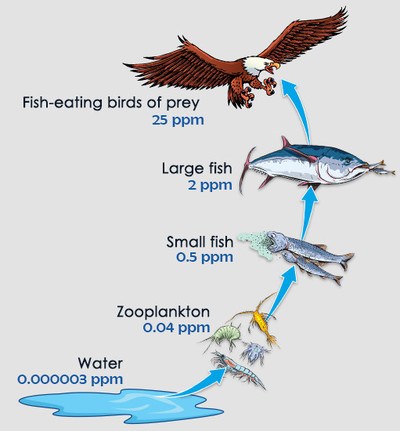
Which organism would have the greatest concentration of pollution because of biomagnification?
a)
zooplankton
b)
large fish
c)
fish-eating birds of prey
d)
small fish
17.
Why is biodiversity important?
a)
It removes mercury and other pollutants
b)
It stops acid rain
c)
It creates more fossil fuels
d)
Biodiversity helps an ecosystem survive impacts such as natural disasters or human impact
18.
The climate of a place is colder than it used to be. Which animal is most likely to survive the colder climate?
a)
a mammal with thick fur
b)
a cold-blooded reptile
c)
an animal that lays eggs
d)
an animal that runs fast
19.
When change occurs, organisms will:
a)
only adapt.
b)
adapt, migrate, or die.
c)
migrate or die.
20.

A drought has hit this grassland biome. How will this effect the rabbit population?
a)
The rabbits will increase in number.
b)
The rabbit population will stay the same.
c)
The rabbit population will decrease.
d)
The rabbit population will become extinct immediately.
100 %

