
 Worksheets
Plate Tectonics Part 1
Total questions: 24
Worksheet time: 14mins
Name
Class
Date
1.

What does the theory of continental drift state?
a)
The continents were once joined in a super-continent and have moved over time
b)
Continents are stationary and do not move
c)
The Earth is broken into lithospheric plates that move due to convection currents
d)
none of the above
2.

What evidence did Wegener use in his theory of Continental Drift?
a)
Continents and fossils fitting together/matching-up like puzzle pieces
b)
glacier scars and evidence from temperature
c)
mountain ranges and coal deposits line up across continents
d)
all of the above
3.
Why did no one believe Wegener's theory?
a)
He could not explain HOW the continents moved
b)
He didn't have evidence
c)
His data was wrong
d)
He didn't use the right technology to gather data
4.
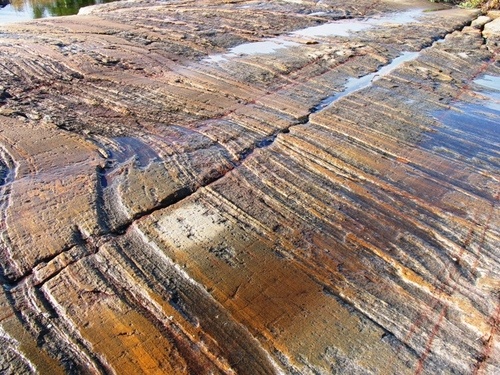
This is a picture of glacier striations found in Africa. What are these evidence for?
a)
Africa has always been near the equator
b)
Africa was once in an area of the Earth that had a very cold climate
c)
The continents have not moved
d)
sea floor spreading
5.
What is the currently accepted theory of why the continents move?
a)
Alfred Wegener's Theory of Continental Drift
b)
Harry Hess's Theory of Sea Floor Spreading (Other Scientists helped too)
6.
True or False : Sea-floor Spreading adds new material to the ocean floor?
a)
True
b)
False
7.
The OLDEST seafloor is located?
a)
Closest to the mid-ocean ridge
b)
Farthest from the mid-ocean ridge
8.
The YOUNGEST seafloor is located?
a)
Closest to the mid-ocean ridge
b)
Farthest from the mid-ocean ridge
9.

On either side of the ridge, the magnetic polarity stripes are:
a)
very different
b)
opposite
c)
a similar pattern
d)
younger
10.
Between 3.5 - 4 million years ago the magnetic polarity was:
a)
Normal
b)
Reversed
11.

Scientists were surprised to find mountain chains and trenches on the ocean floor because they thought it was flat. Scientists were able to make a topographic map of the ocean floor using a(n):
a)
Seismometer
b)
Barmoeter
c)
Caliper
d)
Echo Sounder
12.
Where are rocks on the ocean floor most dense?
a)
near mid-ocean ridges
b)
near trenches
c)
equally dense everywhere
13.
Old oceanic crust is more dense than new oceanic crust because it is:
a)
conduction
b)
hotter
c)
cooler
d)
moving toward a deep-ocean trench
14.
Which of the following processes usually takes the longest amount of time?
a)
An ocean basin forms between two land masses.
b)
A storm system to move across the country
c)
Hot lava to form new rock
d)
Water vapor condenses on the outside of a can
15.
Earth's Outermost Layer is:
a)
The hydrosphere
b)
The crust
c)
The asthenosphere
d)
The mantle
16.
What are the two types of crust?
a)
continental and oceanic
b)
ocean and basin
c)
lower and upper
d)
thick and thin
17.

Earth's oceanic crust is ______ than continental crust.
a)
thinner and less dense
b)
thicker and denser
c)
thicker but less dense
d)
thinner but denser
18.

If we compare the temperature and pressure of Earth's mantle to the core, what differences can we expect as we move downward into Earth?
a)
Both temperature and pressure increase.
b)
Both temperature and pressure decrease.
c)
Temperature decreases and pressure increases.
d)
Temperature increases and pressure decreases.
19.

Earth's inner core is under an enormous amount of pressure. This causes it to be:
a)
A Gas
b)
A Liquid
c)
A Solid
d)
Plastic-like
20.
Which of the following is NOT a source of heat in Earth's Core.
a)
The Sun
b)
Radioactive Decay
c)
Leftover heat from the Earth’s formation
21.

A layer of solid brittle rock, the Lithosphere contains:
a)
The Crust
b)
Both the crust and the UPPER mantle
c)
Both the crust and the WHOLE mantle
d)
Both the crust and the Asthenosphere
22.

The Crust and the Inner Core are both:
a)
Plastic-like
b)
Soild
c)
Liquid
d)
Gas
23.

This layer is described as plastic-like because it is a part of the mantle that can flow slowly:
a)
Lithosphere
b)
Biosphere
c)
Asthenosphere
d)
Magnetosphere
24.

Which of these layers is a Liquid?
a)
Asthenosphere
b)
Crust
c)
Inner Core
d)
Outer Core
100 %

