
 Worksheets
Climate Zones and Weather Maps
Total questions: 25
Worksheet time: 50mins
Name
Class
Date
1.
_________ fronts are associated with more violent weather
a)
cold
b)
warm
c)
stationary
d)
occluded
2.
What type of weather does a low pressure system bring?
a)
stormy, cloudy weather
b)
clear skies
3.
What type of weather does a high pressure system bring?
a)
Stormy weather
b)
Clear skies, little rain
4.

What conditions can lead to the formation of a hurricane?
a)
low-pressure over warm tropical ocean
b)
low-pressure system over artic tundra
c)
high-pressure over warm tropical ocean
d)
high-pressure system over hot, dry land
5.

Which weather system is characterized by counter-clockwise movement of air and generally poor weather?
a)
cold front
b)
low pressure
c)
high pressure
d)
warm front
6.

What does this image show?
a)
A flag banner
b)
Blue alligator teeth
c)
Warm Front
d)
Cold Front
7.

What does this image represent?
a)
Cold front
b)
Red bulbous things
c)
Warm front
d)
Sarah Ju
8.

What type of front is this?
a)
Occluded
b)
stationary
c)
cold
d)
Warm
9.

This symbol represents
a)
a cold front
b)
an occluded front
c)
a stationary front
d)
a warm front
10.

What does this symbol on a weather map indicate?
a)
High pressure system
b)
Low pressure system
c)
Cold Front
d)
Warm Front
11.

What does this symbol on a weather map indicate?
a)
High pressure system
b)
Low pressure system
c)
Cold front
d)
Warm front
12.
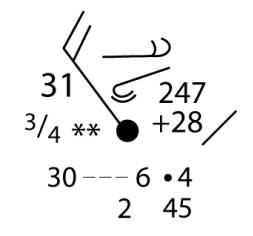
What is the cloud coverage at this station?
a)
Not cloudy
b)
Partially cloudy
c)
Overcast
d)
Stormy
13.

What is the wind direction at this station?
a)
Wind is blowing from the north
b)
Wind is blowing to the East
c)
Wind is blowing from the East
d)
Wind is blowing to the North
14.
What affects climate?
a)
The distance from the equator.
b)
The distance from the planets.
c)
The distance from the moon.
15.
This climate that is characterized by average temperature that are near or below freezing
a)
middle latitude
b)
polar
c)
tropical
d)
none of them
16.
What are the 3 major climate zones in order from equator to the poles?
a)
polar, temperate, tropical
b)
tropical, temperate, polar
c)
temperate, polar, tropical
d)
temperate, tropical, polar
17.
What is the difference between climate and weather?
a)
Climate averages the weather conditions in a specific place over a long period of time, while weather describes the state of the atmosphere at a specific moment in time.
b)
Weather averages the weather conditions in a specific place over a long period of time, while Climate describes the state of the atmosphere at a specific moment in time.
c)
Climate describes the weather conditions at night, while weather describes the conditions during the daytime.
d)
There is not a difference between climate and weather.
18.
Climates are classified according to which two major factors?
a)
elevation & precipitation
b)
latitude & temperature
c)
elevation & latitude
d)
precipitation & temperature
19.
What causes winds to form on Earth?
a)
solar energy
b)
ocean currents
c)
elevation differences
d)
uneven heating of the Earth by the sun
20.
Which BEST describes why latitudes closest to the equator have warmer climates?
a)
they are at lower elevations
b)
they receive more solar energy
c)
they are nearer to ocean currents
d)
they get more winds that carry energy in the form of heat
21.
What is the measure of distance in degrees north and south from the equator?
a)
latitude
b)
longitude
c)
elevation
d)
topography
22.
If I wanted to live where it is warm year round which climate would I choose?
a)
temperate
b)
tropical
c)
polar
23.
Lands near water will usually be a little bit __________ in the summer and ________ in the winter.
a)
cooler, warmer
b)
warmer, cooler
c)
warmer, warmer
d)
cooler, cooler
24.
____________ air sinks/falls because it is ____________dense.
a)
Cold, More
b)
Warm, Less
c)
Cold, Less
d)
Warm, More
25.
____________ air rises because it is ____________dense.
a)
Cool, Less
b)
Warm, Less
c)
Cold, More
d)
Warm, More
100 %

