wayground logo

Free Printable Worksheets

NEW

Font size

S
M
L
XL
Worksheets

WWI-Great Depression Test Review

Total questions: 75

Worksheet time: 44mins

Name
Class
Date
1.
Which world power was the last to join WWI? 
a)
Germany
b)
Russia
c)
United States
d)
China
2.
What impact did the Treaty of Versailles have on the borders of Europe?
a)
No impact, all borders remained the same.
b)
France gave land to Germany.
c)
The Soviet Union was given more land to keep them from invading the rest of Europe.
d)
All of the empires of Europe were split up, and many new countries were created.
3.
Who am I?
a)
Ivan the Great
b)
Vladimir Lenin
c)
Czar Nicholas II
d)
Peter the Great
4.
Which of the following was NOT a slogan or idea of the Bolsheviks?
a)
PEACE, LAND, BREAD
b)
ALL POWER TO THE SOVIETS
c)
KEEP FIGHTING THE WAR
d)
STOP FIGHTING THE WAR
5.
Who won WWI?
a)
Allied powers
b)
Central Powers
6.
Germany, Austria-Hungary, and the Ottoman Empire were all a part of the
a)
Central Powers
b)
Allied Powers
c)
Axis Powers
d)
Neutral Powers
7.
Which of the following dynasties ruled Russia for over 300 years?
a)
Windsors
b)
Hapsburgs
c)
Westminsters
d)
Romanovs
8.
How quickly did America join the League of Nations?
a)
Never
b)
Immediately
c)
At the start of WWII
d)
1918
9.
Which of the following is NOT one of the new technologies in World War I?
a)
poison gas
b)
airplanes
c)
submarines
d)
rifles
10.
This word means support for different sides during war; there were the Allied and Central powers during WWI.
a)
Nationalism
b)
Imperialism
c)
Alliances
d)
Militarism
11.
World War I began in ____ and ended in _____ with the Armistice.
a)
1914, 1917
b)
1917, 1918
c)
1914, 1918
12.
The United States entered WWI in what year?
a)
1914
b)
1915
c)
1916
d)
1917
13.
What holiday do Americans celebrate on the date the Armistice to end WWI was signed? 
a)
Memorial Day
b)
Veteran's  Day
c)
Remembrance Day
d)
President's Day
14.

Germany had to pay $30 billion dollars in _______________ to France and Great Britain as part of the Treaty of Versailles.

a)

land

b)

military

c)

reparations

d)

colonies

15.
Germany also lost millions of square miles of ______ due to the Treaty of Versailles. 
a)
money
b)
land
c)
colonies
d)
ocean territory 
16.
Germany also had to accept total ______ for the war due to the Treaty of Versailles. 
a)
pride 
b)
responsibility
c)
costs 
d)
losses
17.
Information designed to influence opinion is called
a)
Militarism
b)
Nationalism 
c)
Propaganda
d)
Isolationism 
18.
Russia, Great Britain, and France were all part of the
a)
Allied Powers
b)
Central Powers
c)
Axis Powers
d)
Neutral Powers
19.
What country was neutral at the beginning of the war?
a)
France
b)
United States
c)
Russia
d)
Germany
20.
What new technology sank allied and neutral supply ships?
a)
Machine Guns 
b)
Submarines 
c)
Airplanes
d)
Flame throwers
21.
Which 14 Point did Wilson create to prevent future wars?
a)
League of Nations
b)
No secret alliances
c)
Removal of economic barriers
d)
Absolute freedom of seas
22.
What nation did not sign the Treaty of Versailles?
a)
France
b)
Great Britain
c)
United States 
d)
Germany
23.
Who was president of the United States during this time? 
a)
Teddy Roosevelt 
b)
Woodrow Wilson
c)
George V
d)
Wilhelm II 
24.
What did Woodrow Wilson NOT want in his 14 points speech?
a)
Forgiveness 
b)
End to alliances
c)
REVENGE 
d)
Peace
25.
What was the goal of Woodrow Wilson's 14 points?
a)
to achieve world peace
b)
to punish Germany
c)
to start WWII 
d)
to reward Russia
26.
What was the point of the League of Nations according to Wilson?
a)
to grant independence to nations
b)
to resolve international disagreements
c)
to sue Germany
d)
establish new governments
27.
Because militarism had been a major cause of the war, the framers of the Treaty of Versailles
a)
made Germany pay reparations.
b)
stripped Germany of its colonies.
c)
forced Germany to sign a war-guilt clause
d)
barred Germany from maintaining a strong military
28.
What did France, Great Britain, and Italy want to use the Treaty of Versailles for?
a)
Increase USA involvement in Europe  
b)
To end imperialism in an attempt to prevent future conflict  
c)
To severely punish Germany  
d)
To ensure that WWI ended peaceful in an attempt to prevent future conflict
29.
Which group of countries allied themselves to form the Triple Entente in the early years of World War I?
a)
Britain, France, and Austria-Hungary
b)
Germany, Austria-Hungary, and the Ottoman Empire
c)
Russia, Germany, and Italy
d)
Britain, France, and Russia
30.
What were the first two countries involved in WWI?
a)
Russia and Austria-Hungary
b)
Germany and Russia
c)
Serbia and the Ottoman Empire
d)
Austria-Hungary and Serbia
31.
COUNTRY PLACED UNDER THE CONTROL OF ANOTHER POWER (FRANCE OR GREAT BRITAIN) BY INTERNATIONAL AGREEMENT AFTER WWI. 
a)
Partition
b)
Mandate
c)
Colony
d)
Vassal State
32.
The Ottomans joined WWI on the side of:
a)
Britain, France, and the U.S.
b)
Germany and the Austro Hungarian Empire
c)
Japan and Italy
d)
France and Germany
33.

WWI might have involved only two nations, if not for

a)

imperialism.

b)

propaganda.

c)

the alliance system.

d)

Germany.

34.
Which of the following answers is the correct chronological order of events during the Russian Revolution?
a)
A.  Bloody Sunday, World War I, Tsar Nicholas’s abdication, assassination of the Romanov family 
b)
A.  World War I, Bloody Sunday, assassination of the Romanov family, Tsar Nicholas’s abdication
c)
A.  World War I, Tsar Nicholas’s abdication, Bloody Sunday, assassination of the Romanov family
d)
A.  February Revolution, Tsar Nicholas’s abdication, assassination of the Romanov family, World War I
35.

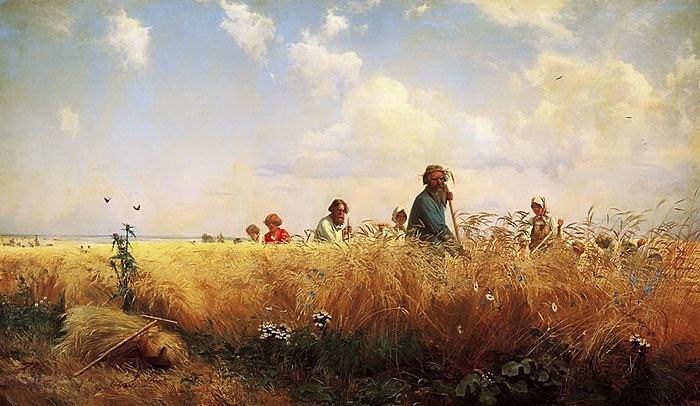
This image displays 90% of Russia's population who are enslaved farmers. These farmers are called ...........................

a)

serfs

b)

doughboys

c)

roundheads

d)

cavaliars

36.
When Lenin finally realized the true state of the Russian Economy, he implemented the __________ in order to gain more money for the average farmer and worker within Russia.
a)
Lenin's Communism
b)
Marx's Communism
c)
"War Communism"
d)
New Economic Policy
37.
What was the major consequence of the February Revolution of 1917?
a)
It forced the Provisional Government to surrender to the Bolsheviks. 
b)
It secured Stalin as leader of Russia. 
c)
It allowed Russia to negotiate peace with Germany. 
d)
It forced Tsar Nicholas II to abdicate the throne.
38.
This word means strengthening a country's military; it's a cause of World War I.
a)
Nationalism
b)
Militarism
c)
Alliances
d)
Imperialism
39.
This word means seeking other colonies; it was a cause of World War I.
a)
Militarism
b)
Imperialism
c)
Alliances
d)
Nationalism
40.
Germany used their U-boats to sink ships of the Allied powers; this British passenger liner was destroyed in 1917.
a)
Lusitania
b)
USS Maine
c)
Titanic
d)
USS Arizona
41.
What was signed in 1919 to officially end WWI?
a)
Treaty of Versailles
b)
Congress of Vienna 
c)
Treaty of Paris 
d)
The 14 Points 
42.
What sparked World War I?
a)
Assassination of Archduke Franz Ferdinand
b)
Assassination of Tsar Nicholas II 
c)
Russian loss in Russo-Japanese War
d)
Assassination of Archduke Kaiser Wilhelm II
43.
What type of fighting was used on the western front in WWI? 
a)
Guerrilla Warfare
b)
Total Warfare
c)
Submarine Warfare
d)
Trench Warfare
44.
What answer is NOT a reason why America joined WWI?
a)
Zimmerman Telegram
b)
Unrestricted Submarine Warfare
c)
Convinced by Allied countries 
d)
Lusitania sinking
45.
The 11th hour of the 11th day of the 11th month 1918 is when the fighting stopped. What was that called?
a)
Peace day
b)
Treaty of Versailles
c)
Armistice Day
d)
Berlin Conference
46.
Which country left the war early because of a civil war in their own country? 
a)
United States
b)
France
c)
Russia
d)
Germany
47.
Which statement BEST describes what happened after the Ottoman Empire was defeated in World War I? 
a)
The Ottoman Empire remained intact, but was renamed Turkey.
b)
The British received Iraq, Transjordan, and Palestine as mandates.
c)
The Ottoman Empire was divided evenly between Russia, Britain, and France
d)
The League of Nations was given total control over the culturally diverse region.
48.
Which statement BEST describes what happened after the Ottoman Empire was defeated in World War I? 
a)
The Ottoman Empire remained intact, but was renamed Turkey.
b)
The French received Syria and Lebanon as mandates. 
c)
The Ottoman Empire was divided evenly between Russia, Britain, and France
d)
The League of Nations was given total control over the culturally diverse region.
49.
Who was the leader of the Bolshevik Revolution?
a)
Vladimir Lenin
b)
Karl Marx
c)
Joseph Stalin
d)
Woodrow Wilson
50.
Who was the "Mad Monk" that was an aid to Tsarina Alexandra before the Russian Revolution?
a)
Rumi
b)
Roma
c)
Rasputin
d)
Romanov
51.
Thousands of unhappy marchers gathered in front of the Tsar’s Winter Palace in 1905 to voice concerns about working conditions. They were fired on and hundreds were killed. This event was called...
a)
Lenin's Sunday Protest
b)
Bolshevik Revolution
c)
Czar's Revolution
d)
Bloody Sunday
52.
Who supported the "Red Army"?
a)
Imperialists
b)
Communists/Bolsheviks 
c)
Monarchists
d)
Anarchists
53.
The original theorist of Communism. He believed that the workers of the world would unite, seize the means of production, share the profits, create a classless society, and have no need for government. 
a)
Voltaire 
b)
Adam Smith 
c)
Locke
d)
Karl Marx
54.

Totalitarian leader of the Soviet Union following the death of Lenin. He would rule during WWII.

a)

Benito Mussolini

b)

Hideki Tojo

c)

Adolf Hitler

d)

Joseph Stalin

55.

The Great Depression was an economic slowdown in the 1920s and 1930s. Which of the following was one cause of the Great Depression in the United States?

a)

the end of the gold rush

b)

the crash of the stock market

c)

the ending of World War II

d)

the high price of oil

56.

In what year did the Great Depression begin?

a)

1942

b)

1829

c)

1929

d)

1932

57.

Which word means a tax on foreign products?

a)

import

b)

tariff

c)

export

d)

speculator

58.
This cause led many businesses to close, because they were producing more goods than consumers were willing to buy.
a)
Overproduction 
b)
Underconsumption 
c)
Buying on Credit 
d)
Stock Speculation 
59.

Which of the following is NOT a cause of the Great Depression?

a)

expansion of production

b)

high protective tariffs

c)

excessive expansion of credit

d)

bank failures

60.

Which of the following was an impact of worldwide depression?

a)

expansion of credit

b)

continued overproduction

c)

high unemployment

d)

an increase in democratic governments

61.

What happened to global agricultural prices of goods after the Stock Market Crash 1929?

a)

Increase in prices

b)

collapse of prices

c)

standardization of prices

d)

prices remain the same

62.

What type of government system suffered the most after the Great Depression?

a)

Democracy

b)

Fascism

c)

Communism

d)

Totalitarianism

63.

What type of leaders rose to power during the Great Depression?

a)

Monarchs

b)

Presidents

c)

Totalitarians

d)

Czars

64.
Mein Kampf
a)
A book about Hitler
b)
Hitler's book that describes his beliefs and goals for Germany
65.
What did Stalin call his programs that were meant to catch Russia's industry up with the rest of the world?
a)
5 Day Plans
b)
5 Month Plans
c)
5 Year Plans
d)
5 Decade Plans
66.
Large, government owned farms were called:
a)
Communist Farms
b)
Collective Farms
c)
Independent Farms
d)
Gulags
67.
The Great Purge was a campaign to eliminate
a)
communism 
b)
opposition to Stalin's power
c)
anyone who promoted industrialization and literacy
d)
shortages of food, housing and consumer goods
68.
What happens when tariffs are added to imported products?
a)
The price of the imported product is determined by demand.
b)
The price of the imported product remains the same.
c)
The price of the imported product goes down.
d)
The price of the imported products goes up.
69.
How did the economic problems in Europe after World War I impact the nations of Germany, Italy, and Japan?
a)
The situation forced the nations to sign trade deals with the United States in exchange for borrowing money.
b)
The situation led to less government control of the economies in these nations.
c)
The situation led to a rise in totalitarian dictators who came to power by promising reforms.
d)
The situation forced these nations to pledge loyalty to the League of Nations and follow all of its directives.
70.
What caused the hyperinflation in Germany after World War I?
a)
Germany printed money
b)
Industrial growth used up natural resources
c)
people stopped buying expensive items
d)
the nation's unemployment was too high
71.
During the 1920s, the United States experienced an economic boom while Europe suffered a depression. Why did the United States' economic problems start later?
a)
The U.S. government received the most money from Germany to help pay for war expenses.
b)
European nations were buying crops at high prices so U.S. farmers were making money.
c)
Since the war did not take place on U.S. soil, the country did not have the expense of rebuilding.
d)
European citizens were investing in the U.S. stock market since European markets were not doing well.  
72.

Which of the following leaders was a dictator in Germany?

a)

Franklin D. Roosevelt

b)

Adolf Hitler

c)

Benito Mussolini

d)

Joesph Stalin

73.

Which of the following leaders was a dictator in Italy?

a)

Franklin D. Roosevelt

b)

Adolf Hitler

c)

Benito Mussolini

d)

Joesph Stalin

74.
How did Mussolini increase Italy's territory and show his dissatisfaction with the Treaty of Versailles?
a)
invaded France
b)
invaded Ethiopia
c)
invaded Portugal
d)
invaded Liberia
75.

To obtain natural resources, Japan seized __________________

a)

Manchuria and north China

b)

North and South Korea

c)

Vietnam

d)

Tokyo and Beijing