
 Worksheets
THE CELL
Total questions: 30
Worksheet time: 32mins
Name
Class
Date
1.
___________ occurs when energy is used to move a substance from an area of low concentration to an area of high concentration.
a)
Diffusion
b)
Facilitated diffusion
c)
Active transport
d)
Passive transport
2.
The function of the plasma membrane is....
a)
regulate what enters and leaves the cell.
b)
fight bacteria and viruses that enter the cell.
c)
make sure each cell reproduces
d)
make sure each cell can move
3.
diffusion is the movement of
a)
water from low to high concentration
b)
particles from low to high concentration
c)
water from high to low concentration
d)
particles from high to lowconcentration
4.
which of the following terms means the movement of water from high concentration to low concentration
a)
diffusion
b)
prokaryotes
c)
osmosis
d)
concentration
5.
Which is true about active transport?
a)
It requires energy
b)
it does not require energy
c)
It moves substances down the concentration gradient
d)
it moves material from high to low concentration
6.
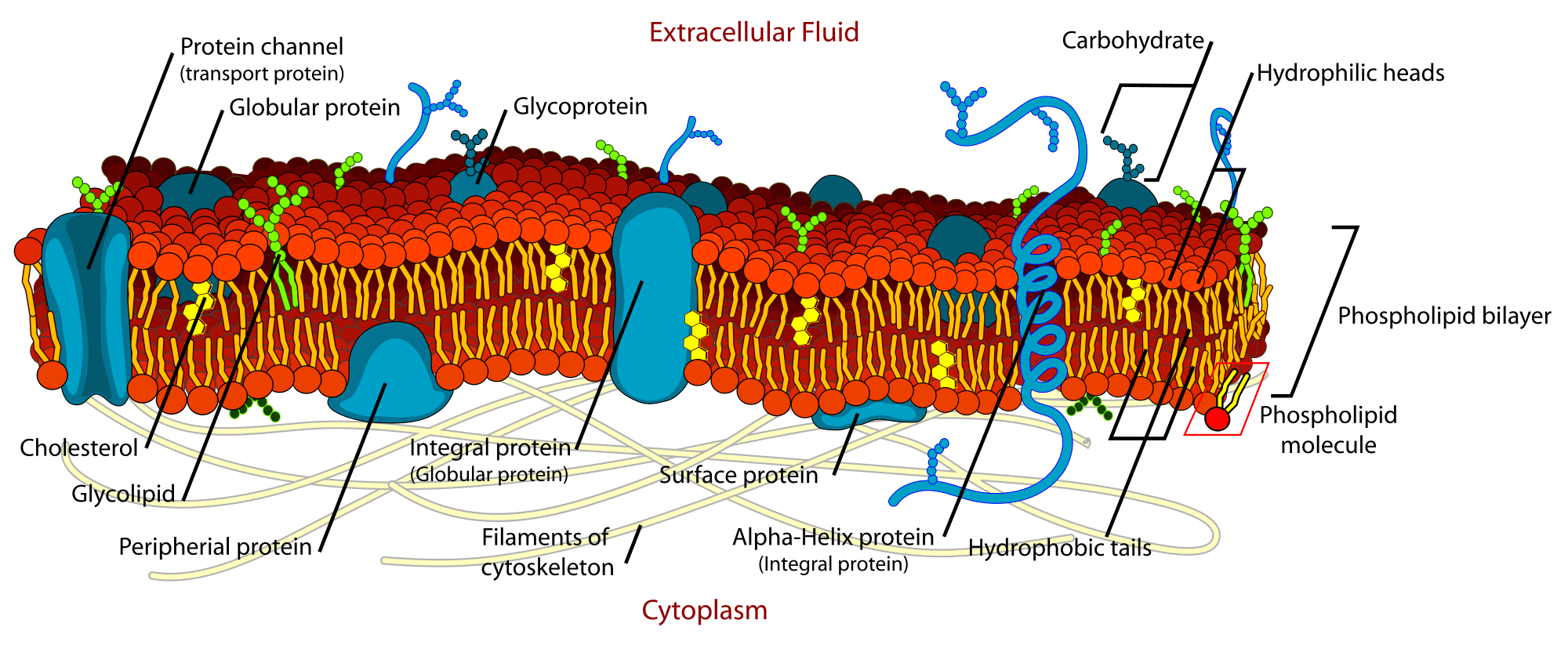
What is this image?
a)
cell membrane
b)
mitochondria
c)
golgi apparatus
d)
endoplasmic reticulum
7.

Special proteins help move particles, but NO energy is needed. This is..
a)
facilitated diffusion
b)
exocytosis
c)
active transport
d)
equilibrium
8.

ATP is a form of energy needed for.....
a)
passive transport
b)
active transport
c)
facilitated transport
d)
protein transport
9.
When looking at the cell membrane, where are the lipid tails located?
a)
Inner part of the bilayer
b)
Outer part of the bilayer
c)
At the end of the bilayer
d)
Goes through each end of the bilayer
10.
The ___ is the basic unit of sturucture and function of organisms
a)
atom
b)
cell
c)
matter
d)
all other answers are correct
11.
Which statement is a part of the cell theory?
a)
all cells come from preexisting cells
b)
bacteria are prokaryotic cells
c)
eukaryotic cells are complex
d)
humans are multicellular
12.
Which organelle is missing in prokaryotic cells?
a)
nucleus
b)
DNA
c)
ribosomes
d)
plasma membrane
13.
Who looked at cork and named the cell?
a)
Robert Hooke
b)
Van Leeuwenhoek
c)
Robert Brown
d)
Francesco Redi
14.
"All animals are made of cells". This fact was discovered by...
a)
Matthias Schleiden
b)
Theodor Schwann
c)
Robert Hooke
d)
Rudolf Virchow
15.
Organelles are ____
a)
the same as organs
b)
small specialized structures in a cell
c)
particles that make an atom
d)
not really important
16.
Who was the scientist that discovered bacteria when looking at pond water and teeth scrapings?
a)
Virchow
b)
Hooke
c)
Leeuwenhoek
d)
Schleiden
17.
Who was the scientist that claimed all cells came from other existing cells?
a)
Schwann
b)
Leeuwenhoek
c)
Hooke
d)
Virchow
18.

Prokaryotic cells have which of the following?
a)
A nucleus
b)
Ribosomes
c)
Vesicles
d)
Mitochondria
19.

D is pointing to the:
a)
Mitochondria
b)
Nucleus
c)
Golgi Apparatus
d)
Vesicle
20.
I am the structure that holds all the organelles in place within the cell. Who am I?
a)
Cell membrane
b)
Cell wall
c)
Cytoplasm
d)
Centriole
21.

Which Endoplasmic Reticulum can make proteins?
a)
Smooth ER
b)
Rough ER
c)
Both ERs can
d)
Neither ERs can
22.

The Golgi Apparatus is used primarily to:
a)
Create proteins
b)
Destroy proteins
c)
Modify and package proteins
d)
Break proteins down for energy
23.

Animal cells lack which of the following:
a)
Ribosomes
b)
Vesicles
c)
Centrioles
d)
Cell Walls
24.
I am the control center of the cell and house the DNA. Who am I?
a)
Cytoplasm
b)
Nucleus
c)
Ribosome
d)
Golgi Apparatus
25.
What is the function of the ribosomes?
a)
Transport proteins
b)
Make proteins
c)
Package and ship proteins
d)
Store water, food, and wastes
26.
What is the function of the Endoplasmic Reticulum (ER)?
a)
Package and ship proteins
b)
Transport proteins
c)
Create energy for the cell
d)
Remove waste
27.
What is the function of the mitochondria?
a)
Pack and ship proteins
b)
Make proteins
c)
Make energy (ATP)
d)
Removes waste
28.
Osmosis is the movement of _____ across a membrane.
a)
food
b)
energy
c)
oxygen
d)
water
29.
Water loss in the cell is:
a)
hypotonic solution
b)
Hypertonic solution
c)
Isotonic solution
d)
Osmosis
30.

Which part of this phospholipid is hydrophobic?
a)
fatty lipid tails
b)
head
c)
all of it is hydrophobic
d)
none of it is hydrophobic
100 %

