
 Worksheets
Unit 3 Chemistry
Total questions: 34
Worksheet time: 17mins
Name
Class
Date
1.

The number at right or bottom of the element cube representing the average number of protons & neutrons.
a)
Atomic Number
b)
Atomic Mass
c)
Number of Protons
d)
Number of Electrons
2.

The number at top or left in the element cube that tells how many protons are found in the nucleus of one atom of the element.
a)
Atomic Number
b)
Atomic Mass
c)
Number of Protons
d)
Number of Electrons
3.

A characteristic of a substance that becomes known during a chemical reaction that depends on the arrangement of the atoms in the molecule.
a)
Chemical Property
b)
Atomic Mass
c)
Reactivity
d)
Atomic Number
4.

The changes that happen in substances as the atoms rearrange themselves.
a)
Chemical Property
b)
Chemical Reaction
c)
Reactants
d)
Products
5.

Substance made up of two or more different elements that are chemically combined.
a)
Molecule
b)
Compound
c)
Mixture
d)
None of These
6.

A particle that is orbiting the nucleus of an atom and has a negative charge; its mass is almost 0 (0.0005 amu)
a)
Proton
b)
Neutron
c)
Electron
d)
All of These
7.

Substance made up of only one type of atom.
a)
Compound
b)
Element
c)
Mixture
d)
Molecule
8.

One square of the Periodic Table containing the element's name, symbol, atomic number, and atomic mass.
a)
Element Cube
b)
Family
c)
Group
d)
Period
9.

The columns (vertical) on the Periodic Table of Elements. Each family of elements have the same number of valence electrons creating the same reactivity. There are 18 families.
a)
Group/Family
b)
Period
c)
Noble Gases
d)
Metals
10.

A classification of elements where elements have properties similar to both metals and nonmetals. Metalloids are located along the dark zigzag line on the Periodic Table of elements.
a)
Metals
b)
Non-metals
c)
Metalloids
d)
All of These
11.

Any of a large group of chemical elements located on the left side of the Periodic Table of Elements. They are generally good conductors of electricity and heat, malleable, ductile, shiny (high in luster). All except mercury are solid at room temperature.
a)
Metals
b)
Non-metals
c)
Metalloids
d)
All of These
12.

A particle that is in the nucleus of the atom, does not have a charge and has a mass of 1 amu
a)
Proton
b)
Neutron
c)
Electron
d)
All of These
13.

Any of a large group of chemical elements located on the right side of the Periodic Table of Elements. They are generally poor conductors of electricity and heat, brittle (breaks easily), & dull (low luster).
a)
Metals
b)
Non-metals
c)
Metalloids
d)
None of These
14.
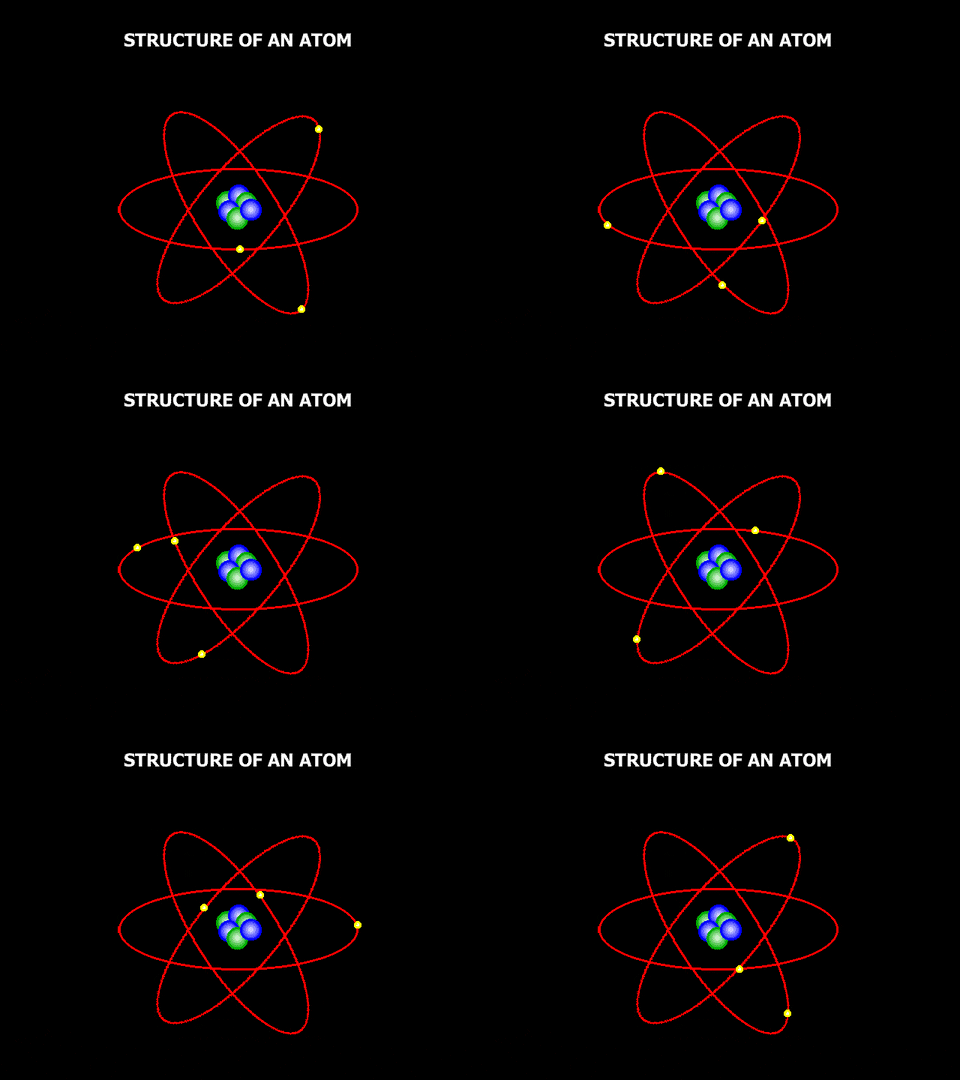
The center of an atom, made of protons and neutrons
a)
Nucleus
b)
Electron Cloud
c)
Atomic Number
d)
None of These
15.

A chart that shows all known elements arranged by atomic number
a)
Periodic Table
b)
Groups/Families
c)
Valence Electrons
d)
Periods
16.

The rows (horizontally) of the Periodic Table of Elements. Represents the number of electron orbitals (shells). There are 7 rows/periods.
a)
Groups
b)
Families
c)
Periods
d)
Valence Electrons
17.

A particle that is in the nucleus of the atom and has a positive charge with a mass of 1 amu
a)
Proton
b)
Neutron
c)
Electron
d)
All of These
18.

The metallic elements found in groups 3 through 12
a)
Noble Gases
b)
Transition Metals
c)
Alkali Earth Metals
d)
Metalloids
19.

Matter which is uniform and has a fixed composition.
a)
Compounds
b)
Elements
c)
Substances
d)
None of These
20.

The smallest particle of a substance that has all the properties of the substance
a)
Atom
b)
Electron
c)
Element
d)
Proton
21.

A symbolic representation showing the kind and amount of the starting materials (reactants) that will yield the same kind and amount of ending materials (products) in a chemical reaction.
a)
Unbalanced Equation
b)
Balanced Equation
c)
Chemical Equation
d)
None of These
22.

An equation representing the parts of a chemical reaction. The chemical equation shows the reactants combining to produce a product.
a)
Chemical Formula
b)
Chemical Equation
c)
Coefficient
d)
Subscript
23.

A set of symbols that describes the number of atoms of each element in a compound
a)
Chemical Formula
b)
Chemical Equation
c)
Product
d)
Reactant
24.

The area around the nucleus of an atom where the electrons are located
a)
Electron Cloud
b)
Valence Electrons
c)
Ions
d)
Proton Cloud
25.

A solid formed after a chemical reaction in a solution.
a)
Precipitant
b)
Photosynthesis
c)
Reactant
d)
Product
26.

Compound(s) and/or element(s) that are formed during a chemical reaction
a)
Reactant
b)
Product
c)
Coefficient
d)
Subscript
27.

Compound or element that changes during a chemical reaction
a)
Product
b)
Reactant
c)
Subscript
d)
Coefficient
28.

The ability of an atom to undergo a chemical reaction
a)
Reactivity
b)
Non-reactivity
c)
Precipitate
d)
None of These
29.

The parts of an atom including protons, neutrons, and electrons
a)
Subatomic particles
b)
Nucleus
c)
Electron Cloud
d)
Atomic particles
30.

The small number at after an element symbol representing the number of atoms of the element in a chemical formula or chemical equation
a)
Subscript
b)
Coefficient
c)
Exponent
d)
All of These
31.

The electron(s) located in the outer most shell (orbital) of an atom
a)
Valence Electrons
b)
Electron Cloud
c)
Protons
d)
Atomic Mass
32.

The large number before an element symbol or compound that represents the number of molecules present
a)
Subscript
b)
Coefficient
c)
Exponent
d)
None of These
33.

States matter cannot be created or destroyed, it can only change form; number of atoms of each element must be equal on both sides of the equation.
a)
Law of Conservation of Mass
b)
Law of Conservation of Energy
c)
Law of Conservation of Reactants
d)
Law of Conservation of Products
34.

Force of attraction that holds atoms together in a compound
a)
Chemical Bond
b)
Subatomic Particle
c)
Electron Cloud
d)
Chemical Formula
100 %

