
 Worksheets
SCI CBA 4
Total questions: 150
Worksheet time: 4hrs 20mins
Name
Class
Date
1.
Climate and weather are different concepts, though they are related. How are the concepts of weather and climate different?
a)
Weather refers to conditions nearer to the ground than climate.
b)
Climate is related to the amount of sunlight; weather is not.
c)
Weather conditions include precipitation, but climate does not.
d)
Climate covers larger areas and longer times than weather.
2.
The kinds of data that reflect climate are different from the conditions described in the weather data. Which of the following is a description of climate?
a)
Today it is hot and sunny in Phoenix, Arizona.
b)
Summers are usually mild in Lansing, Michigan.
c)
Last week it rained every day in San Antonio, Texas.
d)
Yesterday was cold and windy in Anchorage, Alaska.
3.
Weather data is different than climate data. Which of the following is an example of weather data?
a)
The average high temperature in May is 21°C in the Midwest of the United States.
b)
Central Australia usually receives less than 110 mm of rainfall all year.
c)
The relative humidity was 24% at noon on July 23 in Tempe, Arizona.
d)
On average, there is 88 mm of rain in the Gulf Coast region in July.
4.
Which of the following is a description of weather data?
a)
The Sahara desert gets very little rainfall.
b)
The average daytime high in the Amazon is 25°C.
c)
Temperatures in the Arctic are usually below freezing.
d)
It rained two inches in Miami, Florida on May 5th.
5.
Which of the following is a description of climate data?
a)
New York had a 2 inches of rainfall on Wednesday.
b)
Lima, Peru had a low temperature last night of 17°C.
c)
Winds are currently from the south in Ann Arbor, Michigan.
d)
The coast of Antarctica has very short summers.
6.
Weather is best described as which of the following?
a)
How fast the wind is blowing
b)
The amount of water in the air
c)
How much air is pressing down on a particular area
d)
The condition of the atmosphere at one particular time and place
7.
What is the difference between weather and climate?
a)
Weather can be predicted, climate cannot
b)
Weather can change, climate cannot
c)
Weather is short-term, climate is long-term
d)
Weather is long-term, climate is short-term
8.
What is the weather conditions in an area over a long period of time?
a)
climate
b)
temperature
c)
elevation
d)
precipitation
9.

What climate does a desert have?
a)
Tropical
b)
Polar
c)
Arid/Dry
d)
Temperate
10.
Winters in Maine can reach temperatures below zero.
a)
Climate
b)
Weather
11.
Changes from minute-to-minute, hour-to-hour, day-to-day
a)
Climate
b)
Weather
12.
Texas has long, hot summers.
a)
Climate
b)
Weather
13.
Meteorologists forecast this.
a)
Climate
b)
Weather
14.
It snowed for three days last week.
a)
Climate
b)
Weather
15.

a)
Jul: Month with the most rainfall
b)
Jun: Average high of about 20 degrees celsius
c)
Dec: Average low of about 9 degrees celsius
d)
Jan: Average high of about 10 degrees celsius
16.
Weather is best described as which of the following?
a)
How fast the wind is blowing
b)
The amount of water in the air
c)
How much air is pressing down on a particular area
d)
The condition of the atmosphere at one particular time and place
17.
5.8C The earth ________ on its axis creating the day/night cycle.
a)
rotates
b)
revolves
c)
reflects
d)
spins
18.
5.8C The earth's rotation lasts for _______.
a)
24 hours
b)
24 days
c)
365 days
d)
365 hours
19.
5.8B The water cycle gets its energy from the _________ heating the _______.
a)
sun; oceans
b)
sun; atmosphere
c)
sun; trees
d)
sun; water tanks
20.
5.8B Which of the following is not a step in the water cycle?
a)
transpiration
b)
condensation
c)
accumulation
d)
All are steps in the water cycle.
21.
5.8A __________ is the average weather conditions of a particular place over a long period of time
a)
weather
b)
climate
c)
radar
d)
air pressure
22.
5.8A _________ is the day-to-day conditions in a particular place that include precipitation, temperature, air pressure, and wind
a)
weather
b)
climate
c)
water cycle
d)
atmosphere
23.
How many seasons are there in the United States
a)
4
b)
5
c)
6
d)
7
24.
In what season is the northern hemisphere when the sun its the tropic of cancer?
a)
summer
b)
fall
c)
spring
d)
winter
25.
The sun revolves around the Earth
a)
true
b)
false
26.
The rotation of Earth is responsible for day and night
a)
true
b)
false
27.
The Earths tilt and revolution cause day and night
a)
true
b)
false
28.
collection of water, such as a stream, puddle, or lake
a)
groundwater
b)
surface runoff
c)
accumulation
d)
fresh water
29.
the air that surrounds Earth
a)
atmosphere
b)
evaporation
c)
accumulation
d)
water vapor
30.
the process of changing from a gas to a liquid
a)
evaporation
b)
condensation
c)
transpiration
d)
precipitation
31.
the process of changing from a liquid to a gas
a)
condensation
b)
precipitation
c)
surface runoff
d)
evaportaion
32.
water that collects underground in cracks and spaces in rock
a)
accumulation
b)
salt water
c)
groundwater
d)
fresh water
33.
water that falls to Earth's surface as rain, snow, sleet, or hail
a)
precipitation
b)
water vapor
c)
fresh water
d)
salt water
34.
the movement of water on a surface to areas of lower elevation
a)
groundwater
b)
surface runoff
c)
precipitation
d)
transpiration
35.
the release of water vapor into the air from a plant's leaves
a)
evaporation
b)
condensation
c)
water vapor
d)
transpiration
36.
the gas state of water
a)
fresh water
b)
salt water
c)
water vapor
d)
evaportaion
37.
water found in rivers, lakes, glaciers, and underground that contains low concentrations of salt
a)
salt water
b)
fresh water
c)
surface runoff
d)
atmosphere
38.
5.8D True or False. The Sun is highest in the sky at midday and casts a short shadow. In the afternoon, when the Sun is lower in the sky, the shadow is longer.
a)
True
b)
False
39.
5.8D The moon _______ light from the sun which causes it to appear bright in the night sky.
a)
reflects
b)
refracts
c)
creates
d)
bends
40.
5.8D The elapsed time between high tide and low tide is ______ hours.
a)
6
b)
12
c)
24
d)
3
41.

What part of the water cycle does this picture show?
a)
condensation
b)
precipitation
c)
evaporation
42.
Which is the opposite of condensation?
a)
runoff
b)
evaporation
c)
precipitation
d)
transpiration
43.
Snow, sleet, hail, and rain are all examples of ________________.
a)
evaporation
b)
condensation
c)
accumulation
d)
precipitation
44.

What is it called when WATER is FORMED from an LIQUID to a WATER VAPOR Oor an [GAS]?
a)
EVAPORATION
b)
PRECIPITATION
c)
TRANSPIRATION
45.

What is the next stage after EVAPORATION in the water cycle?
a)
CONDENSTATION
b)
GROUNDWATER
46.
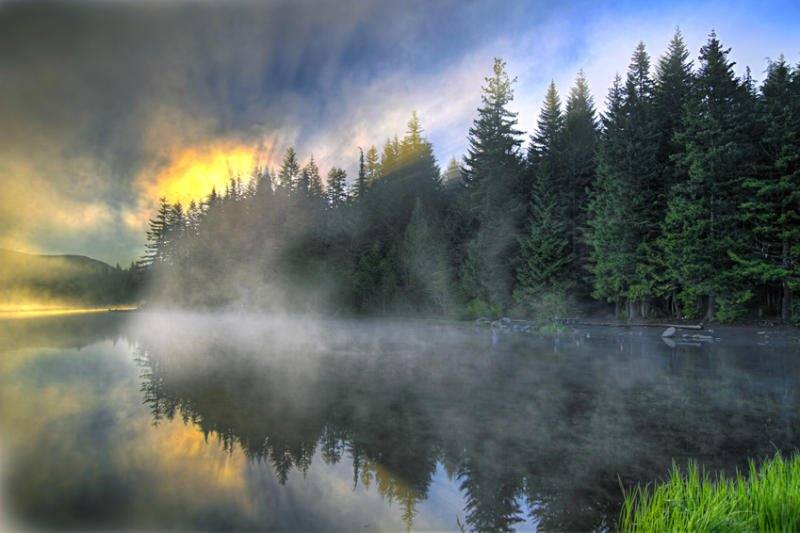
What happens after groundwater at the very end/beginning of the water cycle?
a)
Evaporation
b)
Transpiration
c)
Condensation
d)
Groundwater
47.
What follows evaporation during the water cycle? How does this occur?
a)
Water evaporates into water vapor
b)
Water vapor condenses and forms a cloud
c)
Water precipitates to the ground
d)
Water runs down into the hydrosphere
48.
What is the water cycle?
a)
the 3 forms of water
b)
the movement of water on, above, or below the surface of the Earth
c)
when water melts
d)
when clouds form
49.
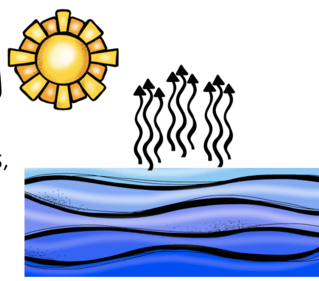
Evaporation happens when the sun ___________ water and turns it into vapor.
a)
cools
b)
heats up
c)
freezes
d)
lights up
50.
What is the relationship between the Sun, Earth and Moon?
a)
Earth revolves around the Moon, Earth revolves around the Sun.
b)
The Sun revolves around Earth as the Moon revolves around Earth.
c)
The Moon revolves around Earth as Earth revolves around the Sun.
d)
Earth revolves around the Moon as the Sun revolves around Earth.
51.
The star at the center of the Solar System that supplies heat and light to Earth; its enormous gravity keep the Solar System in orbit
a)
orbit
b)
sun
c)
crater
d)
moon
52.
To spin on an axis; a 24-hour period, or the time it takes Earth to make one complete rotation on its axis
a)
physical features
b)
rotate
c)
axis
d)
night
53.
Period during rotation when the side of the Earth facing the sun is lit
a)
crater
b)
day
c)
night
d)
axis
54.
A line, real or imaginary, around which something spins
a)
moon
b)
orbit
c)
axis
d)
crater
55.
Many cultures have different methods of telling what time of day it is. Which of the following is an ancient tool invented to determine what time of day?
a)
Watch
b)
Clock
c)
Sundial
d)
Compass
56.
Which statement correctly describes the Sun's apparent movement across the sky?
a)
As Earth spins on its axis, it makes the Sun appear to move across the sky.
b)
As the Sun spins around Earth, it moves across the sky.
c)
Earth rotates around the Sun every 24 hours, making the Sun appear to move across the sky.
d)
The Sun rotates around Earth every 12 hours, making the Sun appear to move across the sky.
57.
Which statement correctly describes the Sun and Earth?
a)
The Sun and Earth both have water.
b)
The Sun and Earth both have a surface called the crust.
c)
The Sun and Earth both have an atmosphere.
d)
The Sun and Earth both have breathable air.
58.
In what direction does the Sun appear to move across the sky?
a)
West to east
b)
North to south
c)
East to west
d)
South to north
59.
an imaginary line that passes from the North Pole to the South Pole through Earth's center
a)
equator
b)
rotate/rotation
c)
axis
d)
orbit
60.
an imaginary line that circles the Earth halfway between the North and South Poles
a)
axis
b)
equator
c)
revolve/revolution
d)
seasons
61.
the path that one object in space takes around another object in space
a)
revolve/revolution
b)
rotate/rotation
c)
orbit
d)
axis
62.
when one object orbits around another object
a)
rotate/rotation
b)
orbit
c)
revolve/revolution
d)
seasons
63.
to turn or spin on an axis
a)
revolve/revolution
b)
rotate/rotation
c)
axis
d)
equator
64.
winter, spring, summer, and fall; due to the tilt of the Earth on it's axis
a)
axis
b)
revolve/revolution
c)
orbit
d)
seasons
65.
To spin on an axis; a 24-hour period, or the time it takes Earth to make one complete rotation on its axis
a)
physical features
b)
rotate
c)
axis
d)
night
66.
Period during rotation when the side of the Earth facing the sun is lit
a)
crater
b)
day
c)
night
d)
axis
67.
Period during rotation when the side of the Earth facing away from the sun is dark
a)
night
b)
day
c)
orbit
d)
sun
68.
Which movement of Earth causes day and night?
a)
rotation
b)
revolution
69.
One rotation of Earth is equal to
a)
a day.
b)
a year.
70.
It takes the Earth _______ days to travel all the way around the Sun.
a)
28
b)
100
c)
24
d)
365
71.
It takes the Earth ___ hours to complete a rotation.
a)
12
b)
24
c)
50
d)
365
72.
The earth is the ___________ planet from the sun.
a)
1st
b)
2nd
c)
3rd
d)
4th
73.
The rotation of the Earth causes . . .
a)
day & night
b)
summer & winter
c)
fall & spring
d)
Leap Year
74.
Which shows these according to size, biggest to smallest?
a)
Earth, Moon, Sun
b)
Sun, Moon, Earth
c)
Earth, Sun, Moon
d)
Sun, Earth, Moon
75.
Which of the following is a characteristic of both the Earth and the Moon?
a)
Atmosphere containing oxygen
b)
Rocky surface covered with landforms
c)
Flowing water in oceans and rivers
d)
Fossils and fossil fuels under the surface
76.
The sun appears to move across the sky each day. What causes this?
a)
the spinning of the Earth's axis
b)
The path of the sun around the Earth
c)
the production the nuclear energy around the sun
d)
the tilt of the Earth on its axis
77.
This is the only planet in the solar system with oceans of liquid water.
a)
Mercury
b)
Mars
c)
Venus
d)
Earth
78.
What are the reasons for the seasons?
a)
Earth's tilt and rotation.
b)
Earth's rotation and revolution.
c)
Earth's tilt and revolution.
d)
Earth's tilt and resolution
79.
What causes shadows?
a)
An object blocking the light source
b)
The water cycle
c)
An object letting the light source through
d)
The moon
80.
Where does the sun rise?
a)
North
b)
South
c)
East
d)
West
81.
Where does the sun set?
a)
North
b)
South
c)
East
d)
West
82.
What time of day are shadows the shortest?
a)
Early morning
b)
Late Morning
c)
Noon
d)
Sunset
83.
Which light source causes shadows in the outdoor environment?
a)
The Sun
b)
The Lightbulb
c)
The House
d)
The School
84.
True or False: The Sun is revolving around the Earth
a)
True
b)
False
85.
True or False: The shadows are longest in the early morning and late afternoon.
a)
True
b)
False
86.
This is the period of time it takes for Earth to make a complete rotation on its axis.
a)
Day
b)
Revolution
c)
Night
d)
Rotation
87.

When the Northern Hemisphere of Earth is Leaning away from the Sun, What season is the Southern Hemisphere experiencing?
a)
Summer
b)
Winter
c)
Spring
d)
Fall
88.
How long does it take the Earth to make one REVOLUTION around the Sun?
a)
12 hours
b)
24 hours
c)
365 days
d)
29.5 days
89.

What season is letter A?
a)
Winter
b)
Summer
c)
Spring
d)
Fall
90.
When the Northern Hemisphere is pointing towards the sun, what season is the Southern Hemisphere?
a)
Winter
b)
Spring
c)
Fall
d)
Summer
91.
Refers to the spinning of our planet on its axis. This takes 24 hours and is responsible for day and night.
a)
Rotation
b)
Revolution
c)
Shadow
d)
Axis
92.
The elliptical orbit of the Earth around the sun. It takes about 365 days to complete one orbit.
a)
Revolution
b)
Rotation
c)
Shadow
d)
Axis
93.
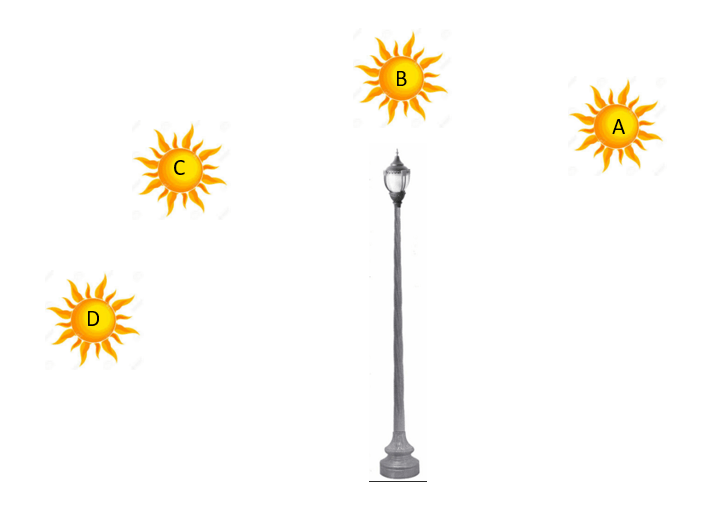
At which location of the sun would the shadow of the light pole be the longest?
a)
A at 11 a.m
b)
B at noon
c)
C at 2 p.m.
d)
D at 6 p.m.
94.
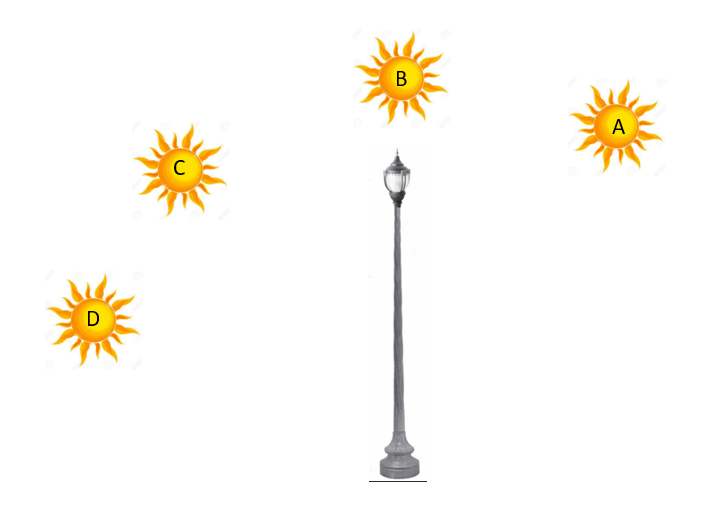
At which location of the sun would the shadow of the lamp post be the shortest?
a)
A
b)
B
c)
C
d)
D
95.

At which location of the sun would the shadow of the lamp post be pointing to the west?
a)
A
b)
B
c)
C
d)
D
96.
At ____ the length of a shadow is the shortest.
a)
8am
b)
5pm
c)
midday
97.

What is causes a shadow?
a)
turning the lights off in a room
b)
standing still with your back to the sun
c)
the sun being blocked out by an object
d)
standing in a dark room
98.

Look at the picture. Would the sun be low or high in the sky in the afternoon picture?
a)
The sun would be directly above.
b)
You would not be able to see the sun at all.
c)
The sun would be low in the sky.
d)
The sun has nothing to do with shadows.
99.
The Sun rotates around the Earth.
a)
true
b)
false
100.
Which of the following lists the Earth, Sun, and Moon in order of size, from largest to smallest?
a)
Earth, Sun, and Moon
b)
Earth, Moon, and Sun
c)
Sun, Earth, and Moon
d)
Sun, Moon, and Earth
101.
Which of the following is a characteristic of both the Earth and the Moon?
a)
Atmosphere containing oxygen
b)
Rocky surface covered with landforms
c)
Flowing water in oceans and rivers
d)
Fossils and fossil fuels under the surface
102.
The Sun and the Earth share some similarities, including their –
a)
size
b)
shape
c)
temperature
d)
composition
103.
Among the Earth, Sun, and Moon, what makes the Earth unique? Only the Earth –
a)
can generate energy
b)
lacks an atmosphere
c)
is made mostly of rock
d)
contains water in liquid form
104.
What characteristic do the Earth and Moon share that makes them different from the Sun?
a)
Spherical shape
b)
Rotate on an axis
c)
Rocky crust and surface
d)
Found in our Solar System
105.
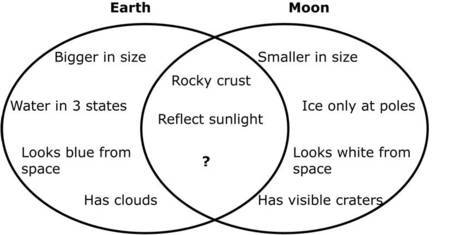
A student created a diagram to compare the characteristics of the Earth and the Moon.
Which of the following characteristics could be placed in the center part of the diagram?
Which of the following characteristics could be placed in the center part of the diagram?
a)
orbits another object
b)
strong gravitational pull
c)
rotates every 24 hours
d)
has an atmosphere
106.

This model can be used to show some relationships between the Earth, Sun, and Moon.
The model shows all of the following EXCEPT –
The model shows all of the following EXCEPT –
a)
the relative sizes of the Moon and Earth
b)
the way the Moon revolves around the Earth
c)
the composition of the Moon, Earth, and Sun
d)
how the Moon and the Earth revolve around the Sun
107.
Of the Earth, Sun, and Moon, which ones orbit another object?
a)
the Sun and the Earth
b)
the Sun and the Moon
c)
the Moon and the Sun
d)
the Moon and the Earth
108.
The moon’s surface has many more craters than the Earth’s. What best explains the difference in the number of craters on the surface of the Moon and the Earth?
a)
The Moon rarely gets impacted by meteorites.
b)
The Earth’s atmosphere protects it from impacts.
c)
The Moon’s gravity attracts more meteorites than Earth's.
d)
The Earth rotates on its axis more quickly than the Moon.
109.
What do the Earth and Moon have in common?
a)
They both have the same gases in the atmosphere.
b)
B Gravity is the force that keeps them both in their orbits.
c)
The gravity of the Earth and the Moon is the same.
d)
Earth and Moon both have one natural satellite.
110.
Which object in space produces, rather than reflects, light?
a)
Sun
b)
Moon
c)
Venus
d)
Pluto
111.
Which describes the orbital position of Earth in our solar system?
a)
the third rocky planet
b)
the third of four gas planets
c)
the third of five ringed planets
d)
the planet between a belt of asteroids and a gas giant
112.
Why does erosion happen on Earth, but not on the Moon?
a)
The Moon does not receive enough sunlight to erode.
b)
The Moon does not experience wind or rain.
c)
The rock on the Moon is too hard to erode.
d)
D Erosion occurs only where there is plant and animal life.
113.
Which of the following best describes rotation?
a)
the length of time it takes for Earth to make one turn on its axis
b)
the length of time it takes the Moon to go around the Earth
c)
the length of time it takes Halley’s Comet to go around the Sun
d)
the length of time it takes Venus to go around the Sun
114.
Ann was on a camping trip and noticed that the stars seemed to change position during the night. What explains the apparent movement of the stars?
a)
Earth’s revolution makes it appear the stars are moving.
b)
The stars are moving away from the Earth.
c)
Earth’s rotation makes it appear the stars are moving.
d)
The Milky Way is moving.
115.
A student is looking for evidence that Earth is always rotating on its axis. Which of the following would provide the best evidence?
a)
The different amount of rain that falls each day
b)
The appearance of shadows changing throughout the day
c)
The presence of other planets in the night sky
d)
The different phases of the moon in a month
116.
The moon is characterized as having
a)
little or no atmosphere
b)
large bodies of water
c)
no surface dust
d)
large amounts of oxygen
117.
Which statement is correct about the Earth, Moon, and Sun?
a)
Earth revolves around the moon
b)
The Sun revolves around Earth
c)
Moon revolves around Earth
d)
Earth revolves around the Moon
118.
One way the Moon is different from the Earth is -
a)
no craters on Earth
b)
no weather on Earth
c)
no weather on the moon
d)
more gravity on the moon
119.
All of the following are characteristics of both Earth and Moon except -
a)
solid rocks
b)
craters
c)
oceans
d)
gravity
120.
Which statement does not correctly describe the Moon and Earth?
a)
both have craters, mountains, and plains
b)
both have gravity
c)
both can sustain life
d)
both rotate and revolve
121.
Which statement correctly describes the Sun's apparent movement across the sky?
a)
As Earth spins on its axis, it makes the Sun appear to move across the sky.
b)
As the Sun spins around Earth, it moves across the sky.
c)
Earth rotates around the Sun every 24 hours, making the Sun appear to move across the sky.
d)
The Sun rotates around Earth every 12 hours, making the Sun appear to move across the sky.
122.
Which statement correctly describes the Sun and Earth?
a)
The Sun and Earth both have water.
b)
The Sun and Earth both have a surface called the crust.
c)
The Sun and Earth both have an atmosphere.
d)
The Sun and Earth both have breathable air.
123.
In what direction does the Sun appear to move across the sky?
a)
West to east
b)
North to south
c)
East to west
d)
South to north
124.
The Sun and the Earth share some similarities, including their –
a)
size
b)
shape
c)
temperature
d)
composition
125.
Which of the following is a characteristic of both the Earth and the Moon?
a)
Atmosphere containing oxygen
b)
Rocky surface covered with landforms
c)
Flowing water in oceans and rivers
d)
Fossils and fossil fuels under the surface
126.
Among the Earth, Sun, and Moon, what makes the Earth unique? Only the Earth –
a)
can generate energy
b)
lacks an atmosphere
c)
is made mostly of rock
d)
contains water in liquid form
127.
What characteristic do the Earth and Moon share that makes them different from the Sun?
a)
Spherical shape
b)
Rotate on an axis
c)
Rocky crust and surface
d)
Found in our Solar System
128.
Of the Earth, Sun, and Moon, which ones orbit another object?
a)
the Sun and the Earth
b)
the Sun and the Moon
c)
the Moon and the Sun
d)
the Moon and the Earth
129.
The moon’s surface has many more craters than the Earth’s. What best explains the difference in the number of craters on the surface of the Moon and the Earth?
a)
The Moon rarely gets impacted by meteorites.
b)
The Earth’s atmosphere protects it from impacts.
c)
The Moon’s gravity attracts more meteorites than Earth's.
d)
The Earth rotates on its axis more quickly than the Moon.
130.
Which of the following lists the Earth, Sun, and Moon in order of size, from largest to smallest?
a)
Earth, Sun, and Moon
b)
Earth, Moon, and Sun
c)
Sun, Earth, and Moon
d)
Sun, Moon, and Earth
131.
Most evaporation in the water cycle happens from oceans. This is because oceans –
a)
expose the most water to the Sun’s energy.
b)
contain water with salt dissolved in it.
c)
have currents that constantly mix them.
d)
reach the poles where sheets of ice form
132.
About how many hours are there between one sunrise and the next?
a)
8
b)
12
c)
24
d)
36
133.
Which of the following does the moon have?
a)
erosion
b)
atmosphere
c)
valleys
d)
oxygen
134.
The spinning of a planet on its axis is known as
a)
orbit
b)
revolution
c)
rotation
d)
turn
135.
The Earth and Moon both have
a)
an atmosphere
b)
gravity
c)
wind
d)
trees
136.
Describes the condition of the air outdoors, such as temperature, cloud cover, wind speed, and rainfall.
a)
Weather
b)
Humidity
c)
Precipitation
d)
Climate
137.
The set of weather conditions that prevail in a region year after year
a)
Weather
b)
Climate
c)
Precipitation
d)
Humidity
138.
Rain, snow, sleet, or hail that falls from clouds in the sky.
a)
Climate
b)
Weather
c)
Precipitation
d)
Humidity
139.
Pieces of information.
a)
Temperature
b)
Humidity
c)
Climate
d)
Data
140.
The amount of water vapor in the air.
a)
Climate
b)
Steam
c)
Humidity
d)
Temperature
141.
Common.
a)
Typical
b)
Perfect
c)
Someimes
d)
Never
142.
Water found in rivers, lakes, glaciers, ice sheets, and underground that contains low concentrations of salt.
a)
Salt Water
b)
Fresh Water
143.
The entire body of saltwater that covers about 71% of Earth.
a)
Lake
b)
River
c)
Ocean
d)
Sea
144.
Which statement correctly describes the Sun's apparent movement across the sky?
a)
As Earth spins on its axis, it makes the Sun appear to move across the sky.
b)
As the Sun spins around Earth, it moves across the sky.
c)
Earth rotates around the Sun every 24 hours, making the Sun appear to move across the sky.
d)
The Sun rotates around Earth every 12 hours, making the Sun appear to move across the sky.
145.
Which statement correctly describes the Sun and Earth?
a)
The Sun and Earth both have water.
b)
The Sun and Earth both have a surface called the crust.
c)
The Sun and Earth both have an atmosphere.
d)
The Sun and Earth both have breathable air.
146.
ROTATION is when the Earth...
a)
Spins on it's axis
b)
Travels in a path around the sun
c)
Causes the four seasons
d)
Takes 365 days
147.
ORBIT is when the Earth...
a)
Travels in a path around the Sun
b)
Spins on an axis
c)
Takes 24 hours
d)
Causes Day and Night
148.
Rotation causes ___________.
a)
Day and Night
b)
Seasons
c)
The Earth to be tilted
149.
If the earth didn't rotate on its axis. What natural cycle would this affect?
a)
seasons
b)
tides
c)
day and night
d)
moon phases
150.

What causes the seasons to change?
a)
The warming and cooling of Earth's core.
b)
The distance from the sun.
c)
Earth's revolution and tilted axis.
d)
Earth's rotation on its axis.
100 %