
 Worksheets
Natural Selection
Total questions: 25
Worksheet time: 18mins
Name
Class
Date
1.
When every organism of a given species has died
a)
Natural Selection
b)
Homeostasis
c)
Extinction
d)
Selective Breeding
2.
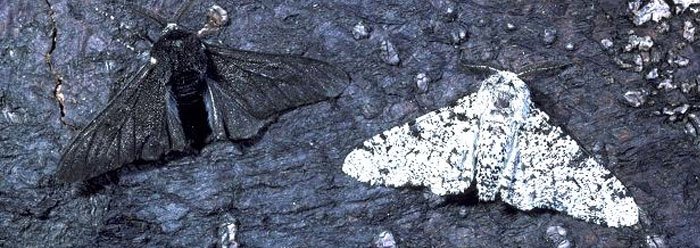
The trees these moths used to live on were white, but have been covered in soot from coal factories. Which moth will be more successful in this environment?
a)
Dark moth
b)
Light moth
c)
Both will be equally successful
d)
Neither will be successful
3.

Since the 1800s humans have stopped burning coal, and the trees have returned to their original color. Which moth will be more successful in this environment?
a)
Dark moth
b)
Light moth
c)
Both will be equally successful
d)
Neither will be successful
4.
Change over time
a)
Natural Selection
b)
Selective Breeding
c)
Homeostasis
d)
Evolution
5.
An error in DNA copying that results in a new trait
a)
Homeostasis
b)
Mutation
c)
Natural Selection
d)
Selective Breeding
6.

What process is being shown in this image?
a)
Variation
b)
Natural Selection
c)
Selective Breeding
d)
Homeostasis
7.
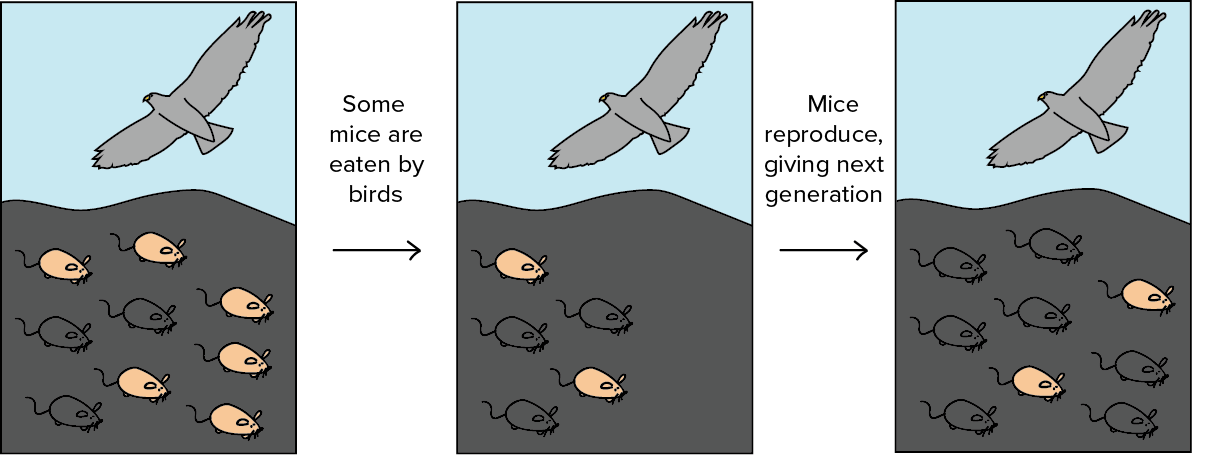
Why is the mouse population changing over time?
a)
The light mice can reproduce more successfully than the dark mice
b)
The hawks eat more dark mice than light mice because the dark mice taste better
c)
The hawks eat more light mice than dark mice because they can see the light mice more easily
d)
The hawks eat more dark mice than light mice because they can see the dark mice more easily
8.
A condition will remain stable
a)
Evolution
b)
Natural Selection
c)
Selective Breeding
d)
Homeostasis
9.
Which term describes a group of the same species that live in the same area?
a)
Population
b)
Community
c)
Biome
d)
Ecosystem
10.

Which of these statements best describes what Darwin observed on the Galapagos Islands?
a)
The finch population on each island was unique
b)
The finches on the islands ate seeds and nuts, but no insects
c)
The finches on the islands were the same as the finches in Ecuador
d)
The finches could produce offspring only with finches from other islands
11.
Where do adaptations come from?
a)
The individual organism decides to adapt
b)
Mutations that give an organism an advantage in its environment
12.
Which best describes mutations?
a)
Always helpful
b)
Always harmful
c)
Can be helpful or harmful
d)
Always neutral
13.
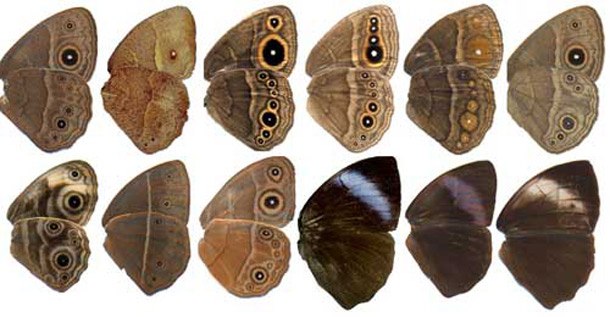
These moths are all the same species. The differences between their wings is an example of ________________
a)
Natural Selection
b)
Variation
c)
Homeostasis
d)
Extinction
14.
Organisms that are better adapted to the environment survive to pass traits to their offspring
a)
Natural Selection
b)
Homeostasis
c)
Selective Breeding
d)
Extinction
15.
Which organism has an advantage in its environment?
a)
The fastest
b)
The strongest
c)
The best adapted
d)
The most tamed
16.
Any inherited trait that gives an organism an advantage in its environment is called a _________
a)
Mutation
b)
Adaptation
c)
Homeostasis
d)
Selection
17.
Which best describes the role of mutations in natural selection?
a)
Mutations help an organism to better survive in their environment
b)
An organism may acquire a helpful mutation by interacting with the environment
c)
A mutation may result in an adaptive trait that makes an organism more likely to survive and reproduce
d)
Organisms with certain traits are more likely to win competitions for mutations
18.
Selective breeding is where ___________ decides which traits should be passed on
a)
Nature
b)
A human
c)
Mr. Holt
d)
The illuminati
19.
Natural selection is where ___________ decides which traits should be passed on
a)
Nature
b)
A human
c)
Mr. Holt
d)
The illuminati
20.

Domesticated dogs are an example of:
a)
Natural Selection
b)
Selective Breeding
21.

The adaptations of the peppered moth are an example of:
a)
Natural Selection
b)
Selective Breeding
22.

The altering of corn to produce more kernels with much more sugar is an example of:
a)
Natural Selection
b)
Selective Breeding
23.

The long and sharp beak of a woodpecker is an example of:
a)
Natural Selection
b)
Selective Breeding
24.

This species of squirrel has been separated by the Grand Canyon. Which term best describes the differences between them?
a)
Variation
b)
Extinction
c)
Population
d)
Overpopulation
25.
If the environment suddenly changed, how could a species go extinct?
a)
The environmental change means fewer predators are around
b)
There are more homes available in the newly changed environment
c)
New resources are available with less competition
d)
There aren't enough members of the species with a trait necessary to survive in the new environment
100 %

