wayground logo

Free Printable Worksheets

NEW

Font size

S
M
L
XL
Worksheets

Waves Quiz Practice

Total questions: 31

Worksheet time: 33mins
Name
Class
Date
1.
What affects the amplitude of a wave?
a)
The speed of the wave
b)
The force of the disturbance
c)
The wavelength
d)
The frequency
2.
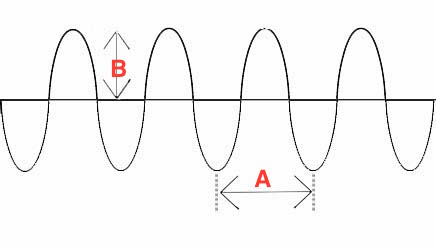
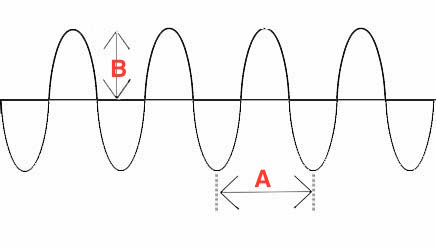
What property of this wave is represented by the letter "A"
a)
amplitude
b)
crest
c)
trough
d)
wavelength
3.
What property of the wave is represented by the letter "B"?
a)
amplitude
b)
crest
c)
trough
d)
wavelength
4.
The highest point on a wave is:
a)
the crest
b)
the trough
c)
the top
d)
the coast 
5.
The lowest point on a wave is the:
a)
Amplitude
b)
Crest
c)
Trough
d)
Wavelength
6.
All waves carry
a)
energy
b)
light 
c)
matter
d)
particles
7.
When the frequency of a wave increases, what happens to the wavelength?
a)
The wavelength is not directly affected by the frequency of a wave.
b)
The wavelength increases.
c)
The wavelength decreases.
d)
More specific information is needed to form a conclusion about the wavelength.
8.
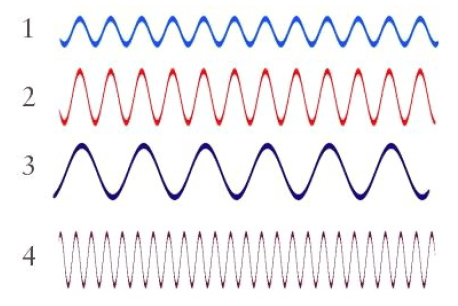
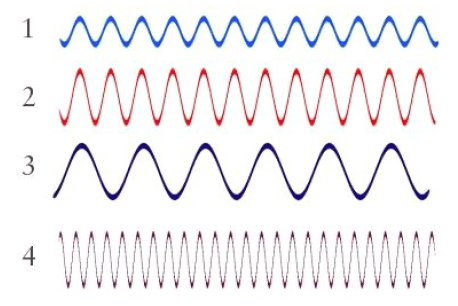
Which wave in the diagram has the greatest frequency?
a)
1
b)
2
c)
3
d)
4
9.
Which wave has the greatest amount of energy?
a)
1
b)
2
c)
3
d)
4
10.
A repeated back and forth or up and down motion. This motion is the source of the wave.
a)
compression
b)
crest
c)
wave
d)
vibration
11.
Which wave in the diagram has the greatest wavelength?
a)
1
b)
2
c)
3
d)
4
12.
Which wave has the least amount of energy?
a)
1
b)
2
c)
3
d)
4
13.
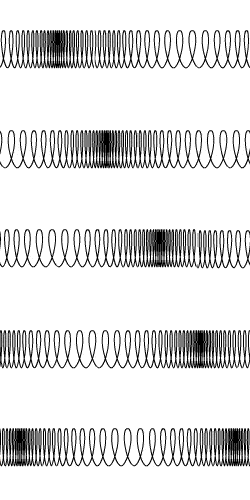
What kind of wave is this?
a)
Transverse
b)
Longitudinal
14.
What kind of wave is this?
a)
Transverse Wave
b)
Longitudinal Wave
15.
What do we call the part of a longitudinal  wave that is spread a part?
a)
compression
b)
rarefaction
c)
crest
d)
trough
16.

What is a medium?

a)

Someone who tell the future

b)

Solid, liquid or gas.

c)

Electromagnetic waves

17.
A section of a longitudinal wave where the particles are crowded together is called a
a)
rarefaction.
b)
vibration
c)
compression
d)
surface wave.
18.
Name the type of wave that moves at right angles to the direction of the wave?
a)
compressional waves
b)
mechanical waves
c)
transverse waves
d)
ultraviolet rays
19.
The material through which a wave travels like gases, liquids or solids.  
a)
Vacuum
b)
Medium
c)
Mechanical
d)
Space
20.
The higher the frequency....
a)
the longer the wavelength
b)
the higher the energy
c)
the lower the energy
21.
How is the energy of the wave proportional to its amplitude?
a)

As the amplitude increases, the amount of energy it carries decreases.

b)

As the amplitude increases, the amount of energy it carries increases.

c)

There is no relationship between amplitude and energy.

22.
A mechanical wave....
a)
Do not require a medium to travel through.
b)
require a medium to travel through.
23.

Name the type of wave that moves parallel to the direction of the wave?

a)

Mechanical waves

b)

Longitudinal waves

c)

Transverse waves

d)

Ultraviolet rays

24.

Which of these waves is NOT a mechanical wave? (They do not need a medium to travel through)

a)

Mechanical waves

b)

Longitudinal waves

c)

Transverse waves

d)

Electromagnetic waves

25.

When the amplitude of a wave increases, what happens to the energy carried?

a)

The amplitude is not directly affected by the the energy of a wave.

b)
The wavelength increases.
c)
The wavelength decreases.
d)

The more energy it carries.

26.

What happens to sound when amplitude increases?

a)

The pitch increases.

b)

The pitch decreases.

c)

The volume increases.

d)

The volume decreases.

27.

What happens to sound when frequency increases?

a)

The pitch increases.

b)

The pitch decreases.

c)

The volume increases.

d)

The volume decreases.

28.

What happens to light when frequency increases?

a)

The color changes to red.

b)

The color changes to purple.

c)

The color gets brighter.

d)

The color gets duller.

29.

Which color has the highest frequency?

a)

Green

b)

Red

c)

Blue

d)

Purple

30.

Which color has the lowest frequency?

a)

Green

b)

Red

c)

Blue

d)

Purple

31.

What happens to light when amplitude decreases?

a)

Brightness increases.

b)

Brightness decreases.

c)

The volume increases.

d)

The volume decreases.