
 Worksheets
Natural or Selective/Artificial?
Total questions: 20
Worksheet time: 10mins
Name
Class
Date
1.
Survival of the Fittest and Evolution are examples of
a)
Natural selection
b)
Selective/Artificial Breeding
2.
Where the better adapted organisms survive to pass traits along to offspring.
a)
Selective/Artificial Breeding
b)
Natural Selection
3.
What word describes the process of having the advantageous traits that helps an organism survive and reproduce?
a)
Natural selection
b)
Selective/Artificial Breeding
4.

What process is being shown in this image?
a)
Selective/Artificial Breeding
b)
Natural Selection
5.
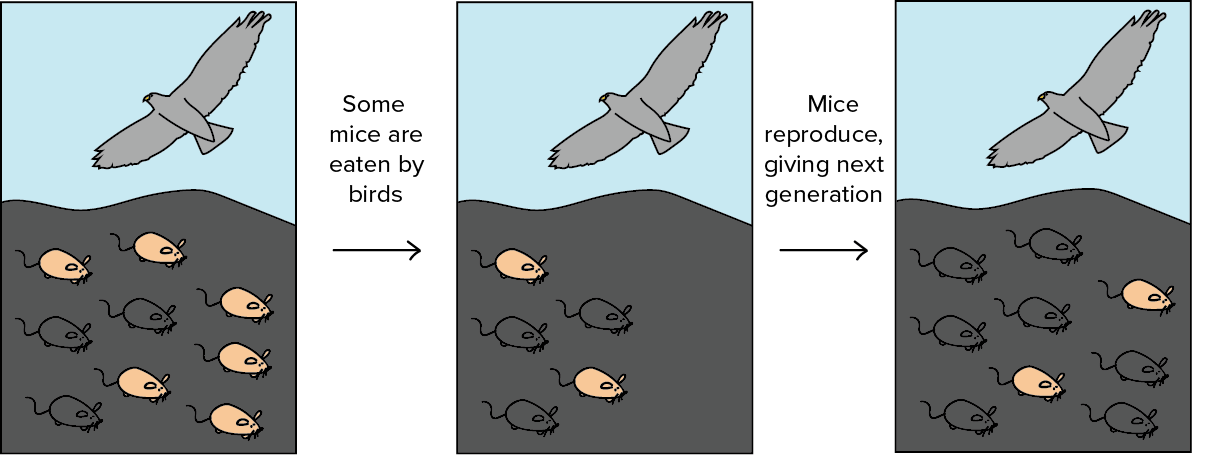
Why is the mouse population changing over time?
a)
Natural Selection, The light mice can reproduce more successfully than the dark mice
b)
Natural Selection, The hawks eat more dark mice than light mice because the dark mice taste better
c)
Natural Selection, The hawks eat more light mice than dark mice because they can see the light mice more easily
d)
Natural Selection, The hawks eat more dark mice than light mice because they can see the dark mice more easily
6.
Why is the mouse population changing over time?
a)
Natural Selection
b)
Selective/Artificial Breeding
7.

Domesticated dogs are an example of:
a)
Natural Selection
b)
Selective/Artificial Breeding
8.

The adaptations of the peppered moth are an example of:
a)
Natural Selection
b)
Selective Breeding
9.

The altering of corn to produce more kernels with much more sugar is an example of:
a)
Natural Selection, hybrid breed
b)
Selective/Artificial Breeding, hybrid breed
10.

The long and sharp beak of a woodpecker is an example of:
a)
Natural Selection, to reach food supply
b)
Selective Breeding, to make a louder noise.
11.
The environment around Manchester, England, changed during the Industrial Revolution. How did this change affect peppered moths living in the area?
a)
Natural selection favored moths with dark wings because predators could not see them on the soot-colored trees.
b)
Natural selection favored moths with white wings that were easy for predators to see.
c)
Natural selection favored moths with white wings because predators could not see them on the soot-colored trees.
d)
Natural selection caused moths with white wings to become extinct.
12.

Which process produced the two different types of beaks in the ground finch and the tree finch?
a)
Selective/Artificial Breeding
b)
Natural Selection
13.
It is very common for yellow labs to have bad hips. This is because owners want purebred yellow labs who are good hunting dogs. This is an example of
a)
Natural Selection
b)
Selective breeding
14.

Evidence shows that the wolf is the ancestor to all of the breeds of dogs shown below. How did this variation arise in a relatively short period of time?
a)
Selective/Artificial Breeding
b)
Natural selection
15.
Scientists genetically engineer corn to be immune to corn diseases. This is BENEFICIAL because
a)
Natural Selection
b)
Selective/Artificial Breeding
16.
Domesticated dogs are an example of:
a)
Natural selection
b)
Selective breeding
17.
A farmer sales his beef by the pound. How can the farmer produce cattle that have more beef, so that he can increase his profit?
a)
Natural Selection rids the herd of sick cattle.
b)
Selective breeding, choosing the largest cows to breed.
18.

“People identify the trait they want, then only allow animals with that trait to breed with one another.” Which of the following BEST matches the statement above?
a)
Selective/Artificial Breeding
b)
Natural Selection
19.

When humans breed 2 organisms with specific traits to influence the traits of the next generation, it is __________.
a)
Selective/Artificial Breeding
b)
Natural Selection
20.
Which statement best describes an advantage of selective/artificial breeding.
a)
Removing parasite and disease from the genetic pool.
b)
Genetic diversity
100 %

