
 Worksheets
chapter 7
Total questions: 26
Worksheet time: 23mins
Name
Class
Date
1.
Is the equation balanced?: 2H2O + O2 --> 4MgO + 3Fe
a)
Yes
b)
No
2.
What does the Law of Conservation of Mass state?
a)
Matter cannot be gained or lost in a chemical reaction.
b)
Matter can only be lost in a chemical reaction.
c)
Matter can only be gained in a chemical reaction.
d)
Matter can be gained and lost in a chemical reaction.
3.
Which problem is balanced?
a)
PbO2 + 2H2--> H2SO4
b)
SO2 + H20 --> H2SO4
c)
2Na + 2H2O --> 2NaOH + H2
d)
2Na + 2H2O --> 2NaOH + H
4.
What is a coefficient?
a)
The small number on the right of the chemical symbol.
b)
The large number to the left of a formula.
5.

The blue numbers in the image below represent ________
a)
Charges
b)
coefficients
c)
subscripts
d)
none of the answers are correct
6.

Is this equation balanced?
a)
yes
b)
no
c)
Not enough information
7.

Is this equation balanced?
a)
yes
b)
no
c)
Not enough information
8.
At the end of chemical reactions, what is the total mass of the reactants compared to the total mass of the products?
a)
the product is doubled
b)
the product is half the mass of the reactants
c)
the mass is the same
d)
the mass changes depending on the reaction
9.
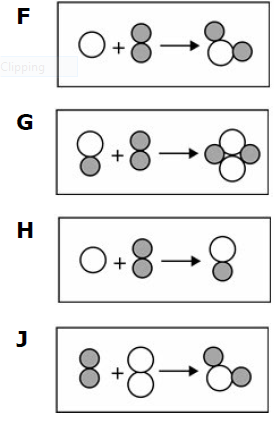
Which of the following models best demonstrates a balanced chemical equation?
a)
F
b)
G
c)
H
d)
J
10.
The reactants are on the left side of the chemical equation.
a)
True
b)
False
11.
Which of the following examples shows that a chemical reaction has occurred?
a)
A rock breaks into smaller pieces when it is struck with a hammer.
b)
Rust forms on a hammer that has been left outside to long.
c)
A cup of water turns pink when a few drops of red food coloring are added.
d)
A solid is formed when heat is removed from a sample of water.
12.
Hydrogen peroxide breaks down to form water and oxygen gas. Which observation is evidence that a chemical reaction has occurred?
a)
The mass of the solution remains the same.
b)
Phase changes are observed.
c)
The color of the solution remains clear.
d)
A new substance is produced...the gas formation.
13.
A clear liquid from a flask is poured into another clear liquid in a beaker. Which of the following results of this procedure would indicate a new substance was formed?
a)
The level of the substance in the beaker is higher after the other liquid is added.
b)
A yellow solid forms and then settles to the bottom of the beaker.
c)
Small white crystals are left behind in the flask that held the first liquid.
14.
What kind of reaction is this:
4Fe + 3O2 → 2Fe2O3
4Fe + 3O2 → 2Fe2O3
a)
Synthesis
b)
Decomposition
c)
Single Replacement
d)
Double Replacement
15.
Which is a Chemical property?
a)
Thermal Conductivity
b)
Density
c)
Malleability
d)
Flammability
16.
Which is a physical change?
a)
burning match
b)
vinegar in baking soda
c)
melting butter
d)
cooking an egg
17.
What type of reaction occurs in a hand warmer
a)
exothermic
b)
endothermic
18.
What kind of reaction is this:
2H2O2 →2 H2O + O2
2H2O2 →2 H2O + O2
a)
Synthesis
b)
Decomposition
c)
Single Replacement
d)
Combustion
19.
A substance used to decrease the rate of a chemical reaction is called an
a)
enzyme
b)
inhibitor
20.
What kind of reaction is this:
CaCO3 + Ag2SO4 → CaSO4 + Ag2CO3
CaCO3 + Ag2SO4 → CaSO4 + Ag2CO3
a)
Decomposition
b)
Single Replacement
c)
Double Replacement
d)
Combustion
21.
Which of the following general formulas represents a single-displacement reaction?
a)
AB → A + B
b)
A + B → AB
c)
A + BC → AC + B
d)
AB + CD → AD + CB
22.
What kind of properties can only be observed when a substance changes into a different substance?
a)
physical properties
b)
chemical properties
c)
liquid properties
d)
real properties
23.
Increasing the surface area of the reactants will increase the rate of the reaction.
a)
True
b)
False
24.
Increasing the temperature of a reaction will __________ the rate of the reaction.
a)
increase
b)
decrease
25.
How many atoms of aluminum are on each side of the following equation: 4Al + 3O2 --> 2Al2 O3
a)
2
b)
6
c)
1
d)
4
26.
N2 + H2 = NH4
a)
Balanced
b)
Unbalanced
100 %

