
 Worksheets
Electric Potential
Total questions: 15
Worksheet time: 14mins
Name
Class
Date
1.
As a proton moves in the direction the electric field lines...
a)
it is moving from low potential to high potential and gaining electric potential energy.
b)
it is moving from low potential to high potential and losing electric potential energy.
c)
it is moving from high potential to low potential and gaining electric potential energy.
d)
it is moving from high potential to low potential and losing electric potential energy.
2.
A proton is accelerated from rest through a potential difference V0 and gains a speed v0. If it were accelerated instead through a potential difference of 2V0, what speed would it gain?
a)
8v0
b)
4v0
c)
v0√2
d)
2v0
3.
The electric potential at a distance of 4 m from a certain point charge is 200 V relative to infinity. What is the potential (relative to infinity) at a distance of 2 m from the same charge?
a)
600 V
b)
50 V
c)
200 V
d)
400 V
4.
Two protons are released from rest, with only the electrostatic force acting. Which of the following statements is NOT true about them as they move apart?
a)
Their electric potential energy keeps decreasing.
b)
Their electric potential energy keeps increasing.
c)
Their acceleration keeps decreasing.
d)
Their kinetic energy keeps increasing.
5.

A region of space contains a uniform electric field, directed toward the right, as shown in the figure. Which statement about this situation is correct?
a)
The potential at point A is the highest, the potential at point B is the second highest, and the potential at point C is the lowest.
b)
The potential at points A and B are equal, and the potential at point C is lower than the potential at point A.
c)
The potential at all three locations is the same.
d)
The potentials at points A and B are equal, and the potential at point C is higher than the potential at point A.
6.
Which statements must be true about the surface of a charged conductor in which no charge is moving?
a)
The electric field is zero at the surface.
b)
The electric potential of the surface is zero.
c)
The electric potential is constant over the surface.
d)
The electric field is constant at the surface.
7.
How much kinetic energy does a proton gain if it is accelerated, with no friction, through a potential difference of 1.00 V? The proton is 1836 times heavier than an electron, and e = 1.60 × 10⁻¹⁹ C.
a)
1836 eV
b)
1836 J
c)
1.00 eV
d)
1.60 × 10⁻¹⁹ eV
8.
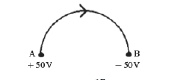
How much work must we do on an electron to move it from point A, which is at a potential of +50V, to point B, which is at a potential of -50 V, along the semicircular path shown in the figure? Assume the system is isolated from outside forces. (e = 1.60 × 10⁻¹⁹ C)
a)
1.60 × 10⁻¹⁷ J
b)
-1.6 J
c)
1.6 J
d)
-1.60 × 10⁻¹⁷ J
9.
A proton that is initially at rest is accelerated through an electric potential difference of magnitude 500 V. What speed does the proton gain? (e = 1.60 × 10⁻¹⁹ C , mproton = 1.67 × 10⁻²⁷ kg)
a)
1.1 × 10⁵ m/s
b)
2.2 × 10⁵ m/s
c)
9.6 × 10⁵ m/s
d)
3.1 × 10⁵ m/s
10.
A 4.0-g bead carries a charge of 20 μC. The bead is accelerated from rest through a potential difference V, and afterward the bead is moving at 2.0 m/s. What is the magnitude of the potential difference V?
a)
400 V
b)
200 V
c)
400 kV
d)
800 kV
11.
A sphere with radius 2.0 mm carries a charge. What is the potential difference, between point B, which is from the center of the sphere, and point A, which is from the center of the sphere? (k = 1/4πε0 = 9.0 × 10⁹ N ∙ m2/C2)
a)
1500 V
b)
-0.63 V
c)
-1500 V
d)
170 V
12.
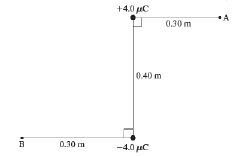
A +4.0-μC and a -4.0-μC point charge are placed as shown in the figure. What is the potential difference between points A and B? (k = 1/4πε0 = 9.0 × 10⁹ N ∙ m2/C2)
a)
0 V
b)
48 kV
c)
96 kV
d)
48 V
13.
An electron is released from rest at a distance of 9.00 cm from a fixed proton. How fast will the electron be moving when it is 3.00 cm from the proton? (k = 1/4πε0 = 8.99 × 10⁹ N ∙ m2/C2, e = 1.60 × 10⁻¹⁹ C, melectron = 9.11 × 10⁻³¹ kg, mproton = 1.67 × 10⁻²⁷ kg)
a)
130 m/s
b)
4.64 × 10⁵ m/s
c)
1.06 × 10³ m/s
d)
106 m/s
14.
In a region where the electric field is uniform and points in the +x direction, the electric potential is -2000 V at x = 8 m and is +400 V at x = 2 m. What is the magnitude of the electric field?
a)
500 V/m
b)
600 V/m
c)
200 V/m
d)
400 V/m
15.
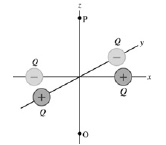
Four charged particles (two having a charge +Q and two having a charge -Q) are arranged in the xy-plane, as shown in the figure. These particles are all equidistant from the origin. The electric potential (relative to infinity) at point P on the z-axis due to these particles, is
a)
Positive
b)
Negative
c)
zero
d)
impossible to determine based on the information
100 %

