wayground logo

Free Printable Worksheets

Font size

S
M
L
XL
Worksheets

Plate Tectonics plus Earthquakes

Total questions: 47

Worksheet time: 2hrs 14mins

Name
Class
Date
1.
What is this a picture of?
a)
plate tectonics
b)
continental drift
c)
pangea
d)
glacier scaring
2.
The Theory of Continental Drift states that Pangaea broke apart and the continents "drifted" away from each other
a)
True
b)
False
3.
What does the theory of continental drift state?
a)
The continents were once joined in a super-continent and have moved over time
b)
Continents are stationary and do not move
c)
The Earth is broken into lithospheric plates that move due to convection currents
d)
none of the above
4.
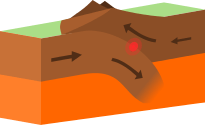
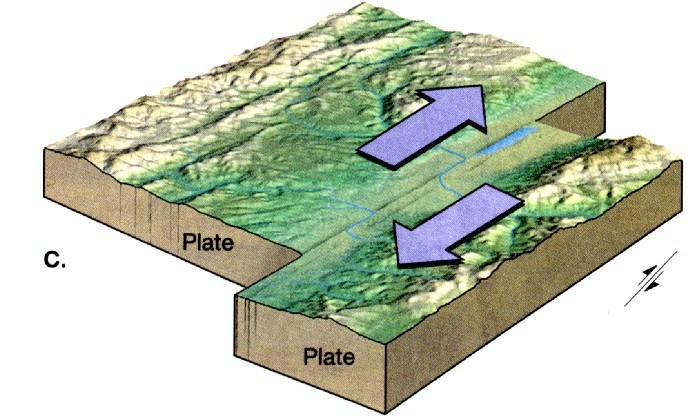
Name the boundary
a)
convergent boundary
b)
divergent boundary
c)
transform boundary
d)
sergent boundary
5.
Name the boundary
a)
convergent boundary
b)
divergent boundary
c)
transform boundary
d)
sergent boundary
6.
A collision between two pieces of continental crust at a converging boundary produces a
a)
mid ocean ridge
b)
deep ocean trench
c)
rift valley
d)
mountain range
7.

An underwater mountain chain caused by a divergent boundary, where new ocean floor is formed.

a)

mid ocean ridge

b)

volcano

c)

rift valley

d)

trench

8.
A collision between a continental crust and an oceanic crust at a converging boundary produces a
a)
mid ocean ridge
b)
deep ocean trench
c)
rift valley
d)
mountain range
9.
What are the two types of crust
a)
continental and oceanic
b)
ocean and upper
c)
lower and upper
d)
pizza and subway
10.
Which layer has convection currents?
a)
Inner Core
b)
Outer Core
c)
Mantle
d)
Crust
11.

Subduction zones in the ocean can create which features?

a)

islands

b)

volcanoes

c)

earthquakes

d)

all of the above

12.
Earthquakes and volcanoes are most likely found in which locations?
a)
At plate boundaries
b)
in oceans
c)
in the middle of continents
d)
in the middle of plates
13.
Which of the following is NOT a tectonic boundary?
a)
Convergent
b)
Divergent
c)
Sedergent
d)
Transform
14.
The area where two tectonic plates meet.
a)
mantle
b)
focus
c)
plate boundary
d)
convection
15.
Scientists think that convection currents that move the plates flow in Earth's
a)
Continental crust
b)
Oceanic crust
c)
Asthenosphere
d)
Lithosphere
16.

What is a Subduction zone?

a)

When an oceanic plate moves under a continental plate

b)

When two plates slide by each other

c)

When two plates move away from each other.

d)

When a continental plate moves under an oceanic plate.
17.
New crust forms at
a)
divergent plate boundaries
b)
convergent plate boundaries
c)
transform fault boundaries
d)
all of the above
18.
What is the process that is thought to move the tectonic plates?
a)
Earth's rotation
b)
tidal forces from the Sun and Moon
c)
convection currents
d)
magnetic anomalies
19.
What type of plate boundary is this?
a)
Transform
b)
Convergent
c)
Divergent
d)
Plate
20.
What type of plate boundary is this?
a)
Plate
b)
Divergent
c)
Convergent
d)
Transform
21.

What two words are BEST used to describe how the seafloor spreads?

a)

Magma and convection

b)

Earthquakes and convection

c)

Volcanoes and convention

d)

Volcanoes and earthquakes

22.
The mantle convection pictured here happens at a ______________ plate boundary. 
a)
Transform
b)
Divergent
c)
Convergent 
23.

Lithosphere

a)

Layer where oceanic and continental crusts are found

b)

Layer where magma is found

c)

Layer where very hot rock rises and falls

24.

Wegener used the following evidence to prove his theory of continental drift?

a)

The shape of the continents

b)

Similar fossils found on separate continents

c)

Rocks found on separate continents

d)

All of the above

25.

Oceanic crust subducts under continental crusts because

a)

Oceanic crust is less dense

b)

Oceanic crust is more dense

c)

Continental crust is more dense

d)

Oceanic crust and continental crust is the same

26.

The mantle convection pictured here happens at a ______________ plate boundary.

a)

Convergent

b)

Divergent

c)

Transform

27.
When looking at mid ocean ridges the oldest rocks are 
a)
In the middle
b)
Found close to the rift zone
c)
Found far from the mid ocean ridges
28.
Process by which new ocean lithosphere forms.
a)
Seafloor spreading
b)
Continental drift
c)
Mid-ocean ridge
d)
Rift
29.

The YOUNGEST seafloor is located?

a)

Closest to the mid-ocean ridge

b)

Farthest from the mid-ocean ridge

30.
True or False : Sea-floor Spreading adds new material to the ocean floor?
a)
True
b)
False
31.
What is the shaking of the Earth’s crust caused by a release of energy?
a)
Earthquake
b)
Epicenter
c)
Fault
d)
Plate
32.
Which of the following is NOT a cause of an earthquake?
a)
Collapse of Cavern
b)
Eruption of Volcano
c)
Lightning Strikes
d)
Moving Tectonic Plates
33.
Which type of wave is the first to arrive after an earthquake occurs?
a)
P Wave
b)
Rayleigh Wave
c)
S Wave
d)
Shear Wave
34.

Which type of wave is the second to arrive after an earthquake occurs?

a)

P Wave

b)

Rayleigh Wave

c)

S Wave

d)

Shear Wave

35.
P Waves can move through which of the following?
a)
Gas
b)
Liquid
c)
Solid
d)
All of these
36.

S Waves can only move through which of the following?

a)

Gas

b)

Liquid

c)

Solid

d)

All of these

37.

The seismic wave that allowed scientists to discover the liquid part of the core are the

a)

S-waves

b)

P-waves

c)

Love waves

d)

Rayleigh waves

38.

What is point X called?

a)

Epicenter

b)

Fault

c)

Hypocenter

d)

Focus

39.

The location underground where an earthquake begins is called the

a)

Epicenter

b)

Focus

c)

Fault

d)

Plate

40.

The location on the Earth's surface directly above the spot where the Earthquake actually occurs?

a)

Epicenter

b)

Focus

c)

Fault

d)

Triangulation

41.

What is point Y called?

a)

Epicenter

b)

Fault

c)

Hypocenter

d)

Focus

42.
What is the name of the waves given off by an earthquake? 
a)
Seismic waves
b)
Radiation waves
c)
Sound waves
d)
Compaction waves
43.
An instrument that detects and measures earthquakes is a 
a)
seismogram
b)
focus seismic map
c)
focus
d)
seismograph 
44.

If seismograph station B is 4000 km from where an earthquake occurs, at what time would P waves be felt?

a)

6 minutes

b)

5 minutes

c)

10 minutes

d)

15 minutes

45.
What is another term for P Wave?
a)
Compression Wave
b)
Principal Wave
c)
Shear Wave
d)
Secondary Wave
46.

What did one earthquake say to the other earthquake?

a)

"Sup Bro"

b)

Nothing earthquakes don't talk

c)

"Hello"

d)

"It's all your fault!"

47.

What is another term for S Wave?

a)

Compression Wave

b)

Principal Wave

c)

Shear Wave

d)

Primary Wave