
 Worksheets
Unit 6: Force and Motion
Total questions: 72
Worksheet time: 1hrs 26mins
Name
Class
Date
1.
Energy due to motion is ____________ energy.
a)
Potential
b)
Energy
c)
Kinetic
d)
Friction
2.
The faster an object moves, the ________ kinetic energy it has.
a)
more
b)
less
c)
none of the above
d)
all of the above
3.
__________ energy is stored energy.
a)
Potential
b)
Kinetic
c)
None of the above
d)
All of the above
4.
Gravitational potential energy depends on the ________ and ________ of the object.
a)
Height and mass
b)
Friction and movement
c)
Mass and Movement
d)
Height and Friction
5.
When you stretch a rubber band, you are storing __________ energy.
a)
kinetic
b)
potential
c)
none of the above
d)
all of the above
6.

Which point in the path of this rolling ball has the most potential energy?
a)
G
b)
F
c)
B
d)
A
7.

Which 2 letters have the most kinetic energy?
a)
W & Y
b)
X & Z
c)
W & X
d)
Z & W
8.

At which point is potential energy greatest?
a)
W
b)
X
c)
Y
d)
Z
9.

As a pendulum swings from its highest to lowest position, what happens to its kinetic and potential energy?
a)
Both the potential energy and kinetic energy decrease
b)
The potential energy decreases while the kinetic energy increases
c)
The kinetic energy decreases while the potential energy increases
d)
Bothe the potential energy and kinetic energy increase
10.
Which would have the greatest gravitational potential energy?
a)
A 4lb rat on a school desk
b)
A 45lb dog in an oak tree
c)
A 14 pound platypus on a swing
d)
A 45lb child on a bike
11.

Where would a person have to be located to have the maximum gravitational potential energy?
a)
up on the roof
b)
down in the basement
c)
in the middle
d)
outside
12.
The kinetic energy of a moving object depends on its mass and its ___________.
a)
height
b)
weight
c)
speed
13.
What is an example of kinetic energy at work?
a)
A Frisbee flying through the air
b)
A car in a garage
c)
A Frisbee lodged into a tree
14.

What is happening between 9am and 11am?
a)
The cyclist is traveling up a hill
b)
The cyclists is speeding up
c)
The cyclists is traveling at a constant speed
d)
The cyclist is slowing down
15.

What do you think the cyclist is doing between 11am and 1pm?
a)
The cyclist has stopped for lunch
b)
The cyclists is riding at a constant speed on flat ground
c)
The cyclist is practicing sprints
d)
The cyclist is riding up a hill
16.

What was the average speed of the cyclist between 9am and 11am? *Remember to divide distance by time
a)
10 mph
b)
30 mph
c)
3 mph
d)
3.3 mph
17.

What is the average speed from 11am to 4pm?
a)
12 mph
b)
6 mph
c)
15 mph
d)
10 mph
18.
Can speed ever be a negative number?
a)
yes
b)
no
19.

What is the speed of the object at point A? *Distance/Time
a)
3 m/s
b)
12 m/s
c)
4 m/s
d)
6 m/s
20.

How fast is the object traveling at point D? *Distance/ Time
a)
1 m/s
b)
2 m/s
c)
1/2 m/s
d)
4 m/s
21.

What is speed?
a)
how far you go
b)
how much distance is covered over a period of time
c)
how fast you accelerate
d)
the change in the location of a object
22.

What is the formula to calculate speed?
a)
S = t/d
b)
S = d/t
c)
S = d x t
d)
S = t x d
23.

What is velocity?
a)
the quickness of an object
b)
the location of an object
c)
acceleration
d)
speed in a specific direction
24.

A runner races in the 100 meter dash. It takes her 10 seconds to finish. What is her average speed?
a)
10 m/s
b)
1000 m/s
c)
100 seconds
d)
10 seconds
25.

Total distance divided by total time is
a)
average speed
b)
constant speed
c)
instantaneous speed
d)
acceleration
26.

Alan travels 100 km in 5hrs. Find his average speed in km/h
a)
5km/hr
b)
10km/hr
c)
50km/hr
d)
20km/hr
27.

What does this graph represent?
a)
Constant Speed
b)
Acceleration
c)
Not moving
28.
This is speed in a specific direction.
a)
Velocity
b)
Motion
c)
Position
29.

What is happening at D?
a)
Stationary
b)
Accelerating
c)
Fast steady speed; moving away from the starting position
d)
Slower steady speed; moving away from the starting position
30.

What is happening at E?
a)
Stationary
b)
Accelerating
c)
Fast steady speed; moving away from the starting position
d)
Steady speed; returning to start position
31.

What is happening at A?
a)
Stationary
b)
Accelerating
c)
Slower steady speed; moving away from the starting position
d)
Steady speed; returning to start position
32.
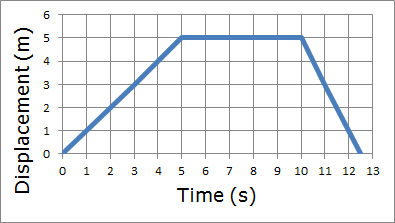
According to the graph how far does the person travel in the first 5 seconds?
a)
2 m
b)
10 m
c)
0 m
d)
5 m
33.
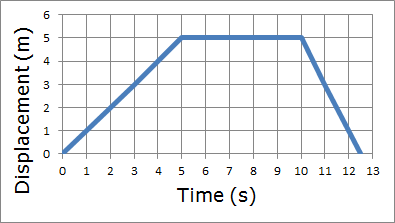
What is the person doing from 5 seconds to 10 seconds?
a)
Walking
b)
Running
c)
Standing Still
d)
Walking Fast
34.

How far is the person from the starting point after 3 seconds?
a)
0 m
b)
2 m
c)
3 m
d)
6 m
35.

What is the average speed of the person during the first 5 seconds?
a)
0 m/s
b)
1 m/s
c)
3 m/s
d)
6 m/s
36.

At which point in time, does this person turn around?
a)
3 seconds
b)
5 seconds
c)
10 seconds
d)
25 seconds
37.

Describe the motion the graph shows
a)
Constant Speed
b)
Speeding up
c)
Slowing Down
d)
all the answer choices
38.

Which graph shows the object standing still?
a)
A
b)
B
c)
C
d)
D
39.
How can we tell that an object is accelerating?
a)
The line gets steeper.
b)
The line is flatter.
c)
The line gets longer
d)
The line gets shorter
40.
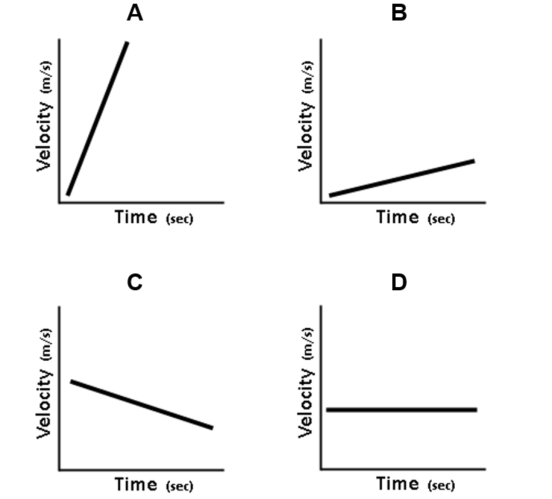
Which graph represents the greatest acceleration?
a)
A
b)
B
c)
C
d)
D
41.
What is the speed of an object that travels 60 meters in 4 seconds?
a)
240 m/s
b)
15 m/s
c)
0.067 m/s
d)
15 mph
42.

Flagpole
a)
wedge
b)
pulley
c)
incline plane
d)
wheel and axle
43.

Lightbulb
a)
wedge
b)
pulley
c)
incline plane
d)
screw
44.

Stairs
a)
wedge
b)
pulley
c)
inclined plane
d)
wheel and axle
45.
A sloping force, like a ramp, that reduces the mount of force required to lift an object.
a)
screw
b)
wheel and axle
c)
inclined plane
46.
How can an incline plane reduce the amount of force required to lift an object?
a)
increase the length of the ramp
b)
increase the height of the ramp
c)
decrease the length of the ramp
47.

This device
a)
wedge
b)
lever
c)
incline plane
d)
wheel and axle
48.

This device
a)
wedge
b)
lever
c)
incline plane
d)
wheel and axle
49.

What type of simple machine is this?
a)
wheel and axle
b)
gear
c)
lever
d)
inclined plane
50.
A _____ is a fixed bar that us free to move around a fixed point known as a fulcrum.
a)
pulley
b)
inclined plane
c)
lever
51.
A ______ is a grooved wheel with a rope running along the groove.
a)
lever
b)
pulley
c)
screw
52.
Consists of two circular objects; a central shaft (axle) and a wheel.
a)
wheel and axle
b)
screw
c)
pulley
53.
A simple machine that can split things apart or hold a door open.
a)
wedge
b)
screw
c)
lever
54.
A simple machine that is made up of an incline plane wrapped around a cylinder. It is often used to hold things together.
a)
lever
b)
screw
c)
wedge
55.
Mr. Taylor rode his bike at a speed of 5 miles per hour.
a)
Speed
b)
Velocity
56.
An airplane flew toward Dallas at a speed of 300 miles per hour.
a)
Speed
b)
Velocity
57.
Mr. Taylor rode his bike west at a speed of 5 miles per hour.
a)
Speed
b)
Velocity
58.
Ms. Rose was jogging south down Main Street at a speed of 5 kilometers per hour.
a)
Speed
b)
Velocity
59.
Ms. Rose was jogging 5 kilometers per hour.
a)
Speed
b)
Velocity
60.
An airplane flew at a speed of 300 miles per hour.
a)
Speed
b)
Velocity
61.
Mr. Williamson races in the 100 meter dash. It takes him 10 seconds to finish. What is his speed?
a)
10 m/s
b)
1000 m/s
c)
100 seconds
d)
10 seconds
62.
What is velocity?
a)
the quickness of an object
b)
the location of an object
c)
acceleration
d)
speed in a given direction
63.
What is speed?
a)
how far you go
b)
how much distance is covered over a period of time
c)
how fast you accelerate
d)
the change in the location of a object
64.
What is the formula to calculate speed?
a)
S = t / d
b)
S = d / t
c)
S = d x t
d)
S = t x d
65.
What two measurements are necessary for calculating speed?
a)
mass and time
b)
temperature and mass
c)
mass and distance
d)
distance and time
66.
Changes in speed, direction or both are called _________.
a)
gravity
b)
changes
c)
acceleration
d)
deceleration
67.
Acceleration is defined as a change in _________.
a)
time of motion to another place.
b)
velocity
c)
distance
d)
speed
68.
When are you experiencing acceleration in a car?
a)
speeding up
b)
slowing down
c)
making turns
d)
All of the above
69.
Acceleration only takes place when things speed up.
a)
True
b)
False
70.

What is this graph showing?
a)
Constant Speed
b)
Acceleration (speeding up)
c)
Deceleration (slowing down)
d)
No motion
71.

What does this graph represent?
a)
Constant speed
b)
Acceleration
c)
Not moving
d)
Velocity
72.

How many times does this object STOP moving?
a)
None
b)
One time
c)
Two times
d)
Three times
100 %

