
 Worksheets
Structure and Functions of Plants and Animals
Total questions: 69
Worksheet time: 52mins
Name
Class
Date
1.
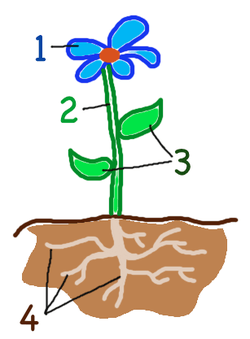
What part of the plant is #1?
a)
flower
b)
stem
c)
root
d)
leaf
2.
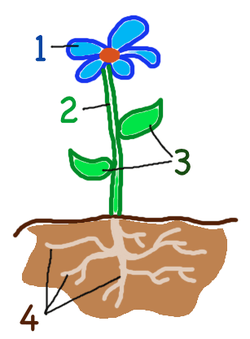
What part of the plant is #2?
a)
leaf
b)
flower
c)
stem
d)
root
3.
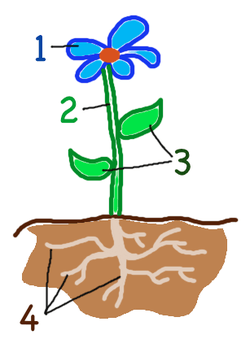
What part of the plant is #3?
a)
leaf
b)
root
c)
flower
d)
stem
4.
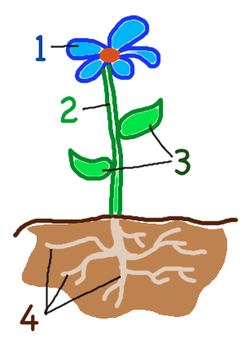
What part of the plant is #4?
a)
leaf
b)
flower
c)
stem
d)
root
5.
The part of the plant that holds the plant in place and absorbs water and minerals from the soil.
a)
stem
b)
roots
c)
leaves
6.
This part of the plant acts like an "elevator" carrying nutrients to the plant.
a)
roots
b)
stem
c)
leaves
d)
flower
7.
who uses photosynthesis
a)
us
b)
no body
c)
i dont know
d)
plants
8.
The roots absorb what for the plant?
a)
Water and Nutrients
b)
Soil and Sun
c)
Warmth and Water
d)
Sun and Photosynthesis
9.
Which part of the plant makes the food?
a)
roots
b)
stem
c)
leaf
d)
flower
10.
What process do plants use to make their own food?
a)
Hunting
b)
Scavenging
c)
Cooking in the kitchen
d)
Photosynthesis
11.
What is the part of the flower that is brightly colored to attract pollinators?
a)
Petals
b)
Stamen
c)
Pistil
d)
Sepals
12.
After taking a walk through a field, Jan picked burs off her socks and dropped them. What did she do by dropping the burs?
a)
She pollinated a plant
b)
she did nothing important
c)
she left food for animals that live in the field
d)
she helped to scatter a plant's seeds
13.
Why do trees grow so tall?
a)
They are naturally big plants.
b)
They are competing for sunlight.
c)
Their roots can soak up lots of water to make them grow tall.
14.
What is the protective covering of a tree?
a)
leaves
b)
bark
c)
roots
d)
seeds
15.
What does it mean when a plant adapts?
a)
It grows on the rain forest floor or underwater.
b)
It changes itself to fit in better with its environment.
c)
It grows giant leaves and has very bright flowers.
d)
It converts its surroundings into a kinder climate.
16.
Plants are considered producers because
a)
they produce carbon dioxide
b)
they produce their own water
c)
they produce sunlight
d)
they produce their own food
17.
What do plants release during photosynthesis that is essential for life?
a)
sugar
b)
carbon dioxide
c)
oxygen
d)
water
18.

Which of an eagle's structures helps it fly and survive in its environment?
a)
legs
b)
head
c)
wings
19.

The desert is a hot, harsh environment. Which adaptation helps a cactus protect itself from animals trying to consume it?
a)
Needle-like leaves
b)
Bad odor
c)
Poisonous venom
20.

A cactus can live in the desert because of this adaptation.
a)
has wide flat leaves to catch water
b)
has shallow roots
c)
thick, waxy leaves help it store water
21.
What does it mean to survive?
a)
to grow
b)
to have energy
c)
to be born
d)
to stay alive
22.

A nice smell is an adaptation that__________.
a)
helps the plant keep water inside the leaves
b)
pokes animals that try to eat the plant
c)
attracts pollinators to the plant.
23.

Which feature of a rose helps it grow without being eaten by large animals?
a)
flowers with bright colors
b)
sharp thorns
c)
small seeds
d)
deep roots
24.

Which foot is best suited for a wet environment?
a)
Clawed foot with talon
b)
Human-like foot
c)
Webbed foot
d)
Small clawed foot without a talon
25.

The colors & patterns on a turtles shell help it blend in with the forest floor. This is:
a)
hibernation.
b)
behavior.
c)
migration.
d)
camouflage.
26.
Adaptations for defense against a predator would include ____________.
a)
feathers
b)
paw pads
c)
claws
d)
big ears
27.
How do adaptations help animals?
a)
To hide from predators
b)
to hunt for food
c)
to survive in their habitats
d)
All of these are correct
28.

The American Beaver has ______ to help it survive in its environment.
a)
webbed feet
b)
waterproof feathers
c)
talons
d)
a foot to help it stay under water
29.

A Wood Duck has ________ to help it survive in its environment.
a)
feathers covered with oil
b)
talons
c)
sharp beak
d)
paddle tail
30.

The Bald Eagle has __________.
a)
keen eyesight
b)
sharp talons
c)
sharp beak
d)
all of the above
31.
An alligator
a)
uses sharp teeth to catch prey
b)
uses webbed feet to swim
c)
has dark skin to blend into its surroundings
d)
all of the above
32.

The bald cypress tree has
a)
knees that help is stand in water
b)
spiny leaves that protect it from animals
c)
leaves shaped to prevent water loss
d)
poisons to protect it from animals
33.
Deserts are hot and dry so an example of a plant adaptation here is...
a)
long and deep root systems to absorb ground water
b)
plants grow on each other to reach sunlight
c)
dark in color to absorb sunlight
d)
grow on each other to protect from wind
34.
Animals _________ plant pollination and seed dispersal.
a)
hurt
b)
make no difference to
c)
destroy
d)
help
35.
I am a flower that produces nectar. What is the function of the nectar?
a)
To provide food for the flower
b)
To attract pollinators
c)
To attract animals to disperse the fruits
d)
To produce perfumes for Man
36.
I am an animal that lives in the arctic. I have adaptations that allow me to survive in my environment. Which of the following is an adaptation that will allow me to survive the arctic?
a)
thick white fur
b)
speed
c)
digging in the ground
d)
short, fluffy tail
37.
Gills are to fish, like ______ are to humans
a)
heart
b)
kidneys
c)
lungs
d)
feet
38.
Which type of body would a fish need to swim quickly?
a)
Round and puffy
b)
Long and slender
c)
Medium and spiky
39.
The gas that plants take in from the air is
a)
carbon monoxide
b)
oxygen
c)
carbon dioxide
40.
Camels have long eyelashes
a)
Camels have long eyelashes to prevent the entry of sand dust and particles
b)
To lose tears
c)
To keep body temperature constant
d)
To lose excess heat
41.

When plants _____they produce new living things.
a)
reporoduce
b)
trait
c)
survive
d)
adaptation
42.

Which one is an adaptation to live in a cold place?
a)
wings or feathers
b)
a layer of fat under the skin
c)
a long neck
d)
spotted fur
43.

What adaptation does this squirrel have that allows it to glide through the air?
a)
Extra skin under the arms and legs to capture air as it falls.
b)
Big ears to capture are as it falls
c)
Small eyes to see where it will land
d)
A short thin tail
44.

What is the function (job) of fish gills?
a)
To absorb water from the water
b)
To make the fish faster
c)
To make the fish lighter
d)
To absorb oxygen from the water
45.
Why do hollow bones help birds during flight?
a)
Hollow bones make the birds weigh less
b)
Hollow bones are full of heavy blood
c)
Hollow bones store water
d)
Hollow bones are made of feathers
46.

Anteaters have a long thin snout and even longer tongue. What is this adaptation most likely for?
a)
To reach through small tunnels in the ground where it can find insects.
b)
To reach for fruits in trees
c)
To fight off predators
d)
'to lick himself after eating
47.
Which of these BEST describes how some birds survive when the weather gets cold?
a)
They store twigs and sticks in their nest
b)
They grow more feathers to stay warm in the winter
c)
They hide in bushes and wait for warm weather
d)
They migrate to a warmer climate
48.

What helps a giraffe find food?
a)
long neck
b)
talons
c)
sharp teeth
d)
claws
49.

Why might some plants that grow on the shady rain forest floor have large leaves?
a)
to stay safe from predators
b)
to attract different animals
c)
to survive harsh winters with heavy snowfall
d)
to take in as much sunlight as possible
50.

What plant adaptation is displayed in the picture?
a)
seed dispersal
b)
bulb formation
c)
geotropism
d)
none of the above
51.

What is the basic function of your brain?
a)
pumps blood and oxygen throughout your body
b)
take in oxygen
c)
gets information from your senses; control center of your body
d)
make your body move
52.

What is the basic function of your lungs?
a)
supports your body
b)
pumps blood and oxygen throughout your body
c)
breaks down food
d)
take in oxygen
53.

What is the basic function of your heart?
a)
pumps blood and oxygen throughout your body
b)
supports your body
c)
breaks down food
d)
control center of your body
54.

What is the basic function of your muscles?
a)
make your body move
b)
supports your body
c)
control center of your body
d)
pumps blood and oxygen throughout your body
55.

What is the basic function of your stomach?
a)
control center of your body
b)
take in oxygen
c)
make your body move
d)
breaks down food
56.
Which body parts hold you up and help you move?
a)
the heart and lungs
b)
the muscles and bones
c)
the stomach and brain
d)
the brain and lungs
57.
Which system are the lungs in?
a)
respiratory
b)
digestive
c)
excretory
58.
Which system is the stomach in?
a)
respiratory
b)
digestive
c)
nervous
59.

Which best describes how a porcupine defends itself from predators?
a)
it changes color
b)
it has sharp quills
c)
it moves very rapidly
d)
it makes a loud noise
60.
An organism that eats only plants is called a(n) _______.
a)
consumer
b)
carnivore
c)
herbivore
d)
omnivore
61.
Animals get the energy they need for growth and repair from __
a)
avoiding predators
b)
the action of muscles
c)
protective coloration
d)
the food they eat
62.

What is the source of energy for photosynthesis?
a)
carbohydrates-chemical
b)
sunlight-radiant
c)
heat-thermal
d)
television-electrical
63.

What is a carnivore?
a)
an animal that gets energy by eating other animals
b)
An animal that gets energy by eating only plants
c)
an animal that gets energy by eating both plants and animals
d)
an animal that makes its own energy through photosynthesis
64.

Which description fits a mammal?
a)
Has rough, dry skin and scales
b)
Has six legs
c)
Feeds milk to its young
d)
Lives on land and water
65.

Which description fits an amphibian?
a)
Has rough, dry skin and scales
b)
Many have wings
c)
Feeds milk to its young
d)
The body helps it live on land and water
66.

Which description fits a reptile?
a)
Has rough, dry skin and scales
b)
Many have wings
c)
Feeds milk to its young
d)
The body helps it live on land and water
67.
A frog is a(n)....
a)
insect
b)
mammal
c)
bird
d)
amphibian
68.
A snake is a(n)....
a)
reptile
b)
mammal
c)
bird
d)
fish
69.
A rabbit is a(n)....
a)
insect
b)
mammal
c)
bird
d)
fish
100 %

