
 Worksheets
Optics Review
Total questions: 19
Worksheet time: 2hrs 34mins
The production of light energy when an object is heated describes which source of light?
Fluorescence
Incandescence
Chemiluminescence
Triboluminescence

What source of light is shown in the image above?
Incadescence
Fluorescence
Bioluminescence
Triboluminescence
Which of the following statements is false?
Opaque objects only absorb light.
Translucent materials only transmit some light.
Transparent materials allow light to pass through freely.
According to the ray model of light, light travels in a straight line.
The angle of reflection is always equal to the angle of incidence.
True
False

What type of reflection is shown in the image?
Regular reflection
Diffuse reflection
Total internal reflection
SALT is an acronym used to describe characteristics of an image. What does SALT stand for?
Size, Altitude, Location, Time
Size, Attitude, Location, Type
Size, Amplitude, Location, Type
Smell, Attitude, Location, Type
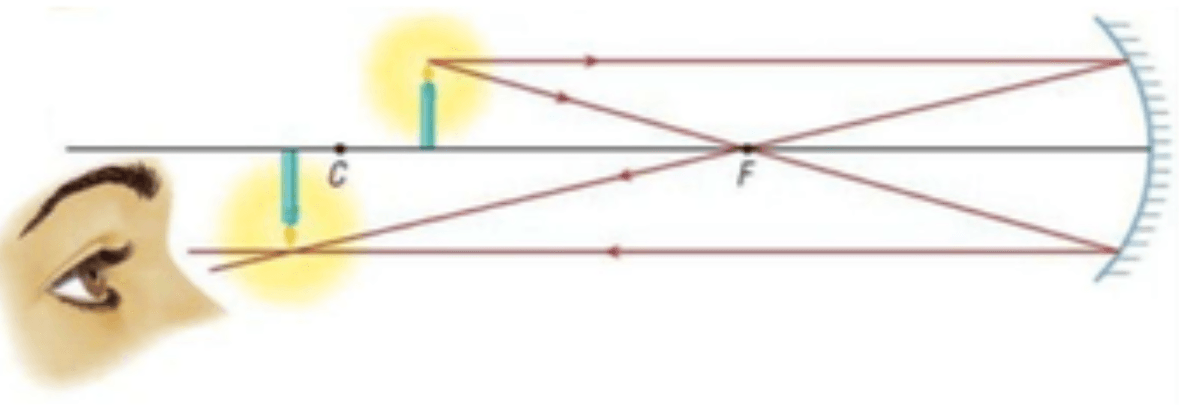
Using S.A.L.T, describe the image of the object.
Smaller, Inverted, Between one and two focal lengths infront of the mirror, Real
Larger, Upright, More than two focal lengths infront of the mirror, Real
Smaller, Inverted, More than two focal lengths infront of the mirror, Virtual
Larger, Inverted, More than two focal lengths infront of the mirror, Real
Which of the following statements about convex mirrors are false?
Convex mirrors spread out light rays.
Convex mirrors produce images that are smaller, upright, behind the mirror, real
Often used as store security mirrors
Which of the following statements is true about refraction?
Light does not bend as it passes from one medium to another.
Refraction is due to changes in temperature.
Light travels faster in glass than air.
Refraction is due to changes in the speed of light.
Which statement does not properly compare the refractive index of water and air?
Light moves slower in water than air.
Water is more dense than air.
Air has a higher refractive index than water.
Light moves fastest in air.
The speed of light in leaded glass is 1.72 X10⁸ m/s. What is the index of refraction of this type of glass?
1.47
1.53
1.67
1.74
What is the speed of light in gallium phosphide given that gallium phosphide has a refractive index of 3.50?
8.75 X10⁸ m/s
8.75 X 10⁷ m/s
8.57 X 10⁷ m/s
8.75 X 10⁸ m/s
Which of the following statements about total internal reflection is true?
Total internal reflection can occur when light moves from a less dense medium to a more dense medium.
Total internal reflection occurs when the angle of incidence is the same as the critical angle.
When the angle of incidence is greater than the critical angle, total internal reflection occurs.
Total internal reflection can occur when light moves from a more dense medium to a less dense medium.

Which statement does not describe this image?
Light is refracted twice.
Light is slowing down in the first refraction.
Light is slowing down in the second refraction.
The rectangle medium is more dense than the surrounding medium.

Which statement does not describe the image above?
The image shows a convex lens.
The image shows a converging lens.
The image shows a concave lens.

Using S.A.L.T, describe the image of the object.
Smaller, Upright, Between one and two focal lengths away, Real
Smaller, Inverted, Less than one focal length away, Virtual
Smaller, Upright, Less than one focal length away, Virtual
Smaller, Upright, More than two focal lengths away, Real
A convex lens of a magnifying glass is held 3.00 cm above a page to magnify the print. If the image produced by the lens is 4.20 cm away and virtual, what is the focal length of the magnifying glass?
9.5 cm
10 cm
10.5 cm
11 cm
A convex lens focusses the light from a bacterium that is 0.030 cm from the lens. If the focal length of the lens is 0.040 cm, how far from the lens is the image?
0.21 cm
0.12 cm
-0.21 cm
-0.12 cm
A converging (concave) mirror with a focal length of 27 cm is held 14 cm from your face. Determine the location and magnification of the image.
29.07 cm behind the mirror, magnification of 2.08
29.07 cm in front of the mirror, magnification of -2.08
19.7 cm behind the mirror, magnification of 3.08
19.7 cm in front of the mirror, magnification of -3.08

