
 Worksheets
Weather, water cycle and Earth's Patterns
Total questions: 47
Worksheet time: 44mins

What is the water cycle?
the 3 forms of water
the movement of water on, above, or below the surface of the Earth
when water melts
when clouds form

What part of the water cycle does this picture show?
condensation
precipitation
evaporation

Snow, sleet, hail, and rain are all examples of ________________.
evaporation
condensation
accumulation
precipitation

Which stages does liquid water from the ocean turn into water vapor?
condesantion
evaporation
precipitation
run off

Which stage does the #2 show in the diagram?
condensation
evaporation
precipitation
run off

Which stage does the #3 show in the diagram?
condensation
evaporation
precipitation
run off

what does the #4 show in the diagram?
condensation
evaporation
precipitation
run off

A cold front is approaching Minneapolis. What will happen to the air temperature?
stay the same
increase
decrease
The amount of precipitation in an area is measured and collected by which weather tool?
Anemometer
Rain Gauge
Wind Vane
Barometer

This Symbol is associated with a _____________________Front.
Warm
Cold

This picture represents the symbol for a __________________________Front.
Warm
Cold

What front is moving through the NW part of the US?
Cold
Warm

What direction is the cold front moving?
Northwest
Southeast
Northeast
Southwest

Which city can expect to see an increase in temperatures over the next 24 hours?
Billings, Montana
Atlanta, Georgia
Minneapolis, Minnesota
Miami, Florida

After a cold front passes through, what type of weather will there be?
Rainy or stormy, and cloudy
Clear, dry, and sunny

Which weather front are severe storms most likely to develop?
warm front
cold front
About how many days does it take the moon to go through a complete cycle?
7 days
365 days
29 days
20 days

When the visible (lit) portion of the moon is increasing, the moon is:
waning
full
waxing
new
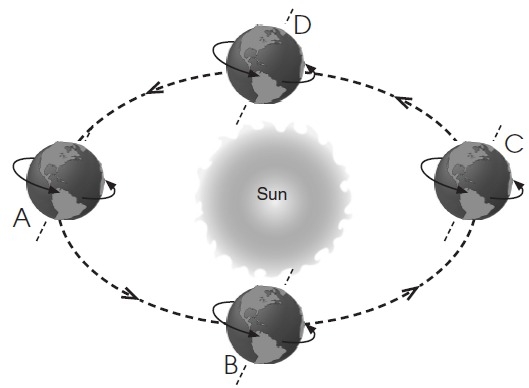
What season is the Northern Hemisphere having at position A?
Winter
Summer
Spring
Fall
When the Northern Hemisphere is pointing towards the sun, what season is the Southern Hemisphere?
Winter
Spring
Fall
Summer
What are the reasons for the seasons?
Earth's tilt and rotation.
Earth's rotation and revolution.
Earth's tilt and revolution.
Tides are caused by ___________
wind
gravitational pull of moon
waves gravitation toward land
rain

How many low tides and high tides happen in a day?
1 low tide, 1 high tide
4 low tides, 4 high tides
3 low tides, 3 high tides
2 low tides, 2 high tides
What causes a shadow to change during the day?
The sun's position in the sky
Where the moon is located during the day
When the sun sets
The higher the sun is in the sky, the ________ the shadows are
tall
shorter
darker
What causes shadows?
An object blocking the light source
The water cycle
An object letting the light source through
The moon
What time of day are shadows the shortest?
Early morning
Late Morning
Noon
Sunset
It is the imaginary line around which Earth rotates. Earth has a tilt of 23.45 degrees which helps to create seasonal weather and climate
axis
revolution
shadow
sun
Refers to the spinning of our planet on its axis. This takes 24 hours and is responsible for day and night.
Rotation
Revolution
Shadow
Axis
The orbit of the Earth around the sun. It takes about 365 days to complete one orbit.
Revolution
Rotation
Shadow
Axis

What happens when the area in which you live tilts away from the sun?
It is summer.
It is spring.
It is winter.
It is fall.

What causes the seasons to change?
The warming and cooling of Earth's core.
The distance from the sun.
Earth's tilt in relation to the sun.
Earth's rotation on its axis.

Ellen grabs a soil sample in her hand. She rubs it between her fingers. The soil feels gritty. What type of soil is it?
clay
sand
silt
humus
When plants, animals, and other organisms die, they break down and become part of the soil. What is this part of the soil called?
sand
silt
clay
humus
You dig a small hole in the soil and the next day it rains. The hole fills with water, but does not empty even after several days of dry weather. What is the soil mostly made of?
clay
sand
humus
silt
This type of soil is sticky when wet and hard when dry. It is often orange in color
clay
silt
sand
gravel
This type of soil is best for plant growth.
rock
sand
loam
clay
What physical property of soil determines if it retains water?
color
particle size
texture
weight
This is gray with large particles and doesn't retain water
loam
clay
gravel
topsoil

