Wayground logo

Free Printable Worksheets

Font size

S
M
L
XL
Worksheets

The 20's and 30's

Total questions: 213

Worksheet time: 3hrs 16mins

Name
Class
Date
1.
 What were the most popular types of music in the 1920’s.
a)
Rap
b)
Classical
c)
Jazz and Blues
d)
Country
2.
The most direct result of the 18th Amendment(Prohibition) was that ________
a)
people were mostly in support of the amendment.
b)
organized crime in America increased
c)
organized crime in America decreased
d)
people stopped drinking alchohol
3.
During the 1920s people lives changed because they began listening to the what? 
a)
mass media 
b)
movies 
c)
radio 
d)
music 
4.
These two Italian immigrants were wrongly convicted of murdering a man in the 1920’s. The evidence that had been collected by police did not support convicting these two men, and the evidence actually pointed away from the two. What were the names of these two men that were wrongly convicted of murder?
a)
Sacco and Vanzetti
b)
Mario and Luigi
c)
O'Reilly and Sansom
d)
Lenin and De Gaulle
5.
These hate group gained traction in the 1920’s, even though they had been around since right after the Civil War. They are notorious for hating people who are of different races, or from different countries. What is the name of this hate group?
a)
NAACP
b)
War Hawks
c)
Klu Klux Klan
d)
Nazis
6.
What was the name given to secret bars where people acquired alcohol illegally?
a)
Speakeasies
b)
Top Secret Bars
c)
Secret Saloons
d)
Quiet Places
7.
What was the name given to people who illegally transported and sold alcohol during Prohibition?
a)
Diabolical Drivers
b)
Bootleggers
c)
Rule Breakers
d)
Tricksters
8.
This man is one of the most famous criminals in U.S. History. He was rumored to have made $60 million a year during Prohibition. What was the name of the most famous bootlegger during Prohibition?
a)
Baby Face Nelson
b)
Al Capone
c)
George Harris
d)
James Jones
9.
_______________ were young women who rebelled against traditional ways of thinking and acting.
a)
Expatriates
b)
Jazzers
c)
Flappers
d)
Scats
10.
Both Warren Harding and Calvin Coolidge 
a)
believed in a laissez faire approach to the economy and government 
b)
believed government intervention was important to a successful economy.
c)
were anarchists 
d)
had administrations riddled with scandal. 
11.
The Harlem Renaissance was focused on the writing and music related to
a)
African Americans
b)
Communists
c)
Anarchists
d)
Immigrants
12.
What was Prohibition?
a)
A complete ban on the sale of food
b)
A complete ban on the sale of clothes
c)
A complete ban on the sale of alcohol
d)
A complete ban on the sale of cars
13.
Millions of Black Americans migrated North during the early 1900s and into the 1920s. This is known as: 
a)
The Big Move
b)
The Great Migration 
c)
The Great Agitation 
d)
The Great Separation 
14.
Scandals like the ________ Scandal led Americans to have distrust in the elected officials of our country.
a)
Oriental Express
b)
Harlem Renaissance
c)
Alaska Pipeline
d)
Teapot Dome
15.
The availability of electricity in the US led to the manufacture and sale of many _____ that could perform many different jobs in the house.
a)
appliances
b)
wire rolls
c)
robots
d)
computers
16.
The Red Scare in America was a result of the spread of _______ overseas.
a)
disease
b)
Democracy
c)
Communism
d)
immigrants
17.
 What coincided with the Great Migration to the north from the South by African Americans, as well as an increase in education by these same people.
a)
Socialism
b)
Evolution
c)
Native Americans
d)
 Harlem Renaissance
18.
Who was the first pilot to fly a trans atlantic flight?
a)
Marcus Garvey
b)
Henry Ford
c)
Charles Lindeburgh
d)
Herbert Hoover
19.
The 19th amendment is very important in history be cause it____________
a)
prohibited alchohol
b)
gave us freedom
c)
guaranteed women the right to vote
d)
abolished slavery
20.
What year did the stock market crash?
a)
1950
b)
1935
c)
1929
d)
1925
21.
This Jazz musician would become the most popular jazz musician of his time.
a)
Paul Lawrence Dunbar
b)
Eugene O'Neill
c)
Louis Armstrong
d)
Ernest Hemingway
22.
An explosion in the popularity of jazz music gave the decade the nickname of ______________________.
a)
Rock and Roll.
b)
The Jazz Age.
c)
The Bop era.
d)
The Swing Era.
23.
______________________________ was a famous writer who produced poems, plays, and novels about African American life.
a)
Ernest Hemingway
b)
Langston Hughes
c)
F. Scott Fitzgerald
d)
Zora Neale Hurston
24.
Who was the baseball player whose record of 60 home runs in 1927 would stand for 34 years?
a)
Gertrude Ederle
b)
Jack Dempsey
c)
Babe Ruth
d)
Bobby Jones
25.
The 1920s were referred to the the Roaring 20s because
a)
of a booming economy and exciting forms of entertainment
b)
explosion in the popularity of the jazz music
c)
Southern influence
d)
reference to the Great Gatsby
26.
The United States elected three new presidents during the 1920's. Calvin Coolidge, Herbert Hoover, and ___________
a)
Warren Harding
b)
Abraham Lincoln
c)
Franklin Roosevelt
d)
Richard Nixon
27.
A major reason for the emergence of the "consumer culture" of the 1920s was:
a)
the federal government encouraged labor to organize.
b)
minimum wage laws expanded buying power.
c)
installment payments encouraged buying.
28.
Which of the following describes when companies make too many durable goods?
a)
Over-Consumption
b)
Under-Production
c)
Under-Consumption
d)
Over-Production
29.
This is the phrase for buying stocks using borrowed money
a)
Buying on Margin
b)
Buying on Stock
c)
Buying on Margarine
d)
Buying on Butter
30.
True or False:  The Great Depression happened all over the world--not just in the US
a)
True
b)
False
c)
Nah fam it was just here
d)
Wait does Canada count as part of the US?
31.
Black Tuesday: October 29, 1929
a)
Banks Failed
b)
Car Industry shut down
c)
Banks Runs begin
d)
Stock Market Crash
32.
One of the causes of the Great Depression occurred when people would purchase products and stocks on an installment plan, but what caused this installment (payment) method to fail?
a)
People would buy less than they could afford
b)
People could not afford the monthly payments, so they would not be able to pay back their loans
c)
People paid too much up front for their products
d)
Demand for consumer goods was low, so people would not even want to buy these luxury goods
33.
After the Stock Market Crash, many people lost their life savings because ___________.
a)
banks closed for business
b)
banks gave away their money
c)
they couldn't remember where they put their money
d)
someone stole their money from the banks
34.
In the 1920s, the belief in a never-ending prosperity helped to promote:
a)
strict enforcement of governmental regulations.
b)
government efforts to increase the income of farmers.
c)
heavy increases in stock speculation.
35.
On October 29, 1929 share prices on the New York Stock Exchange completely collapsed and partially caused the Great Depression.
a)
Black Thursday
b)
Black Tuesday
c)
Black Friday
d)
Black Sunday
36.
Why did people invest in the stock market in the early 1900s?
a)
To get rich
b)
To own a buisness
c)
to buy and sell stock
d)
To get shares of a business
37.
Why would a company need to issue stock?  
a)
To increase its' customer base.
b)
To raise money.
c)
To stop the government from regulating it.
d)
To show customers that it's successful.
38.
Which of the following BEST describes the Great Depression?
a)
The depression was severe, but only in the United States. 
b)
Governments acted quickly and the depression only lasted two years
c)
The depression caused revolutions all across the world. 
d)
Many countries around the world experienced the economic depression
39.
Which of the following factors was most significant in contributing to the onset of Great Depression in US?
a)
Declining agricultural prosperity
b)
Increasing reliance on foreign imports
c)
Inadequately skilled workforce
d)
Vast military expenditure during WWI
40.
Which one of these was NOT a cause of the Great Depression?
a)
Consumer Debt
b)
Severe destruction of infrastructure during WWI
c)
Uneven Distribution of wealth
d)
Stock Market Crash
41.
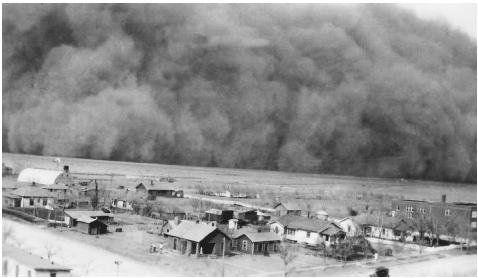
During the 1930s, the conditions shown in this photograph occurred mainly
a)
on the Atlantic Coast
b)
 on the Great Plains
c)
in the Rocky Mountains
d)
in the Pacific Northwest
42.
What was one major result of the Dust Bowl?
a)
increased nativist sentiment in the Midwest
b)
creation of the Environmental Protection Agency
c)
demands made by the Populist Movement
d)
migration of agricultural laborers to California
43.
Why did so many banks fail during the early years of the Great Depression?
a)
People panicked and went on bank runs, depleting deposits
b)
The banks lost their investments in the stock market
c)
The federal government did not insure deposits
d)
All choices are correct
44.
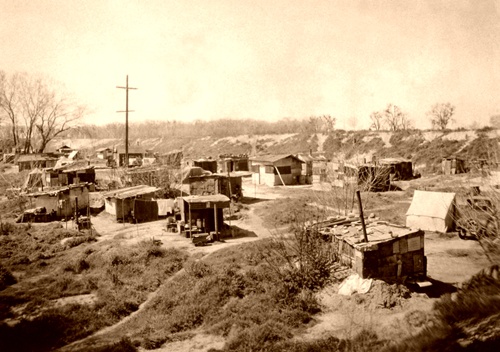
The depression left millions unemployed, many of whom lived in "Hoovervilles."  Why did Americans blame Hoover?
a)
Hoover's positive statements seemed out of touch.
b)
His philosophies made many think he did not care.
c)
His federal efforts were too little and too late.
d)
All answer choices are correct.
45.
The president who followed President Hoover began the New Deal, a program to help people during the Great Depression. This president was
a)
Warren Harding
b)
Calvin Coolidge
c)
Franklin Roosevelt
d)
Woodrow Wilson
46.
When was the Great Depression?
a)
1919-1929
b)
1929-1939
c)
1939-1949
d)
1999-2009
47.
What was the unemployment rate during the Great Depression?
a)
8.0%
b)
15.6%
c)
54.0%
d)
24.9%
48.
_____________ were people, mostly young men that left their towns in search of work in other towns, sometimes hitching rides on trains.  They also had their own code when entering a town to help them know what to expect.
a)
Immigrants
b)
Hoboes
c)
Okies
d)
Repatriots
49.
Which of the following compounded the devastation caused by the Great Depression?
a)
the beginning of WWII
b)
the Red Scare and infiltration of communistic ideas
c)
influenza epidemic and poor healthcare
d)
Midwestern drought and Dust Bowl
50.
What were the villages full of shacks located in cities filled with unemployed Americans called?
a)
Hoovervilles
b)
Okies
c)
Bonus Army Bases
d)
Rooseveltowns
51.
Passage of the Social Security Act (1935) helped American workers by
a)
creating jobs for the unemployed
b)
providing financial assistance after retirement
c)
guaranteeing a minimum wage
d)
legalizing the right to join labor unions
52.
Opponents of the New Deal criticized President Franklin D. Roosevelt for
a)
expanding the role and size of the federal government
b)
permitting banks to operate without government regulation
c)
weakening the executive branch
d)
reducing spending to balance the budget
53.
What protects one's money in the bank?
a)
CCC
b)
NRA
c)
FDIC
d)
FBLA
54.
Which New Deal agency was responsible for building forest trails and roads, planting trees, and improving national parks?
a)
AAA
b)
CCC
c)
FERA
d)
WPA
55.
Agency that protected the price of crops. 
a)
AAA
b)
CCC
c)
CWA
d)
FDIC
56.
Largest agency that employed over 9 million workers in construction and even performing arts. 
a)
CCC
b)
WPA
c)
TVA
d)
NRA
57.
The New Deal program which primarily employed single, young men and worked to preserve parks and forests
a)
Works Progress Administration
b)
Tennessee Valley Authority
c)
Civilian Conservation Corps
d)
Bureau of Land Management
58.
Which New Deal law restricted crop production to reduce crop surplus and was ruled unconstitutional by the Supreme Court?
a)
The Agricultural Adjustment Act
b)
The Glass-Steagall Act
c)
The Pure Food and Drug Act
d)
The Truth-in-Labelling Act
59.
The New Deal pulled America out of its economic mess!  Several New Deal agencies, such as the CCC, WPA, and the TVA, were important because ____________________.
a)
they built bridges, dams, and other useful projects
b)
they helped create jobs and put Americans back to work
c)
they offered assistance to farmers
d)
they provided electricity to a poor region
60.
A series of radio broadcasts
a)
Fireside Chats
b)
Radio Chats
c)
Broadcast Chats
61.
 What were the most popular types of music in the 1920’s.
a)
Rap
b)
Classical
c)
Jazz and Blues
d)
Country
62.
The most direct result of the 18th Amendment(Prohibition) was that ________
a)
people were mostly in support of the amendment.
b)
organized crime in America increased
c)
organized crime in America decreased
d)
people stopped drinking alchohol
63.
The Scopes Monkey Trial of 1925 had to do with teaching of Fundamentalism and ______.
a)
school
b)
evolution
c)
abstinence
d)
religion
64.
During the 1920s people lives changed because they began listening to the what? 
a)
mass media 
b)
movies 
c)
radio 
d)
music 
65.
These two Italian immigrants were wrongly convicted of murdering a man in the 1920’s. The evidence that had been collected by police did not support convicting these two men, and the evidence actually pointed away from the two. What were the names of these two men that were wrongly convicted of murder?
a)
Sacco and Vanzetti
b)
Mario and Luigi
c)
O'Reilly and Sansom
d)
Lenin and De Gaulle
66.
These hate group gained traction in the 1920’s, even though they had been around since right after the Civil War. They are notorious for hating people who are of different races, or from different countries. What is the name of this hate group?
a)
NAACP
b)
War Hawks
c)
Klu Klux Klan
d)
Nazis
67.
What was the name given to secret bars where people acquired alcohol illegally?
a)
Speakeasies
b)
Top Secret Bars
c)
Secret Saloons
d)
Quiet Places
68.
What was the name given to people who illegally transported and sold alcohol during Prohibition?
a)
Diabolical Drivers
b)
Bootleggers
c)
Rule Breakers
d)
Tricksters
69.
This man is one of the most famous criminals in U.S. History. He was rumored to have made $60 million a year during Prohibition. What was the name of the most famous bootlegger during Prohibition?
a)
Baby Face Nelson
b)
Al Capone
c)
George Harris
d)
James Jones
70.
Many believe this author captured the spirit of the "Roaring Twenties" with his novel Titled The Great Gatsby.
a)
Paul Lawrence Dunbar
b)
F. Scott Fitzgerald
c)
Ernest Hemingway
d)
Louis Armstrong
71.
_______________ were young women who rebelled against traditional ways of thinking and acting.
a)
Expatriates
b)
Jazzers
c)
Flappers
d)
Scats
72.
The cartoon shows a growing reluctance towards _________________in the 1920s 
a)
education
b)
immigration 
c)
buying on credit 
d)
eating stew 
73.
This man was a political leader in the Black community during the Harlem Renaissance who wanted Black Americans to be proud of themselves, see the beauty of themselves, and stay separate from White people. 
a)
Marcus Garvey 
b)
Calvin Coolidge  
c)
Duke Ellington
d)
Langston Hughes 
74.
Both Warren Harding and Calvin Coolidge 
a)
believed in a laissez faire approach to the economy and government 
b)
believed government intervention was important to a successful economy.
c)
were anarchists 
d)
had administrations riddled with scandal. 
75.
The Harlem Renaissance was focused on the writing and music related to
a)
African Americans
b)
Communists
c)
Anarchists
d)
Immigrants
76.

Which pull factor contributed to the Great Migration?

a)

The availability of land grants for homesteaders

b)

Economic opportunities in industrialized cities

c)

Better soil conditions in previously uncultivated areas

d)

The lower cost of living in urban areas

77.

During the 1920's, what was one result of innovations in U.S. transportation technology?

a)

Commercial airplanes replaced ocean liners as the primary means of travel to Europe.

b)

Mass-produced automobiles made travel more affordable for many people.

c)

Cable cars provided a comfortable means of quick travel to any city within a state.

d)

Container ships delivered agricultural goods to ports along the Pacific coast.

78.

The establishment of speakeasies in the 1920's was an unintended consequence of which federal government action?

a)

The taxation of imported luxury goods

b)

The deportation of suspected communist sympathizers

c)

The prohibition of the sale of alcoholic beverages

d)

The implementation of immigration restrictions

79.

Many progressives opposed Social Darwinism because it promoted the idea that --

a)

people in lower classes were not capable of economic success

b)

immigration weakened national unity

c)

the government should take responsibility for the well being of people

d)

poverty could be eradicated through increased economic regulation

80.

During the 1920's, Clarence Darrow and William Jennings Bryan were most closely identified with the --

a)

increased use of credit by U.S. consumers

b)

development of new forms of popular entertainment

c)

decline of public support for Progressive reforms

d)

conflict between modernism and traditionalism

81.

Why did the "Return to Normalcy" agenda of the U.S. presidential candidate Warren G Harding appeal to many voters in the 1920 election?

a)

The public wanted to help rebuild war-torn countries

b)

There were significant shortages of military supplies

c)

There was a decrease in demand for consumer goods

d)

The public wanted to concentrate on domestic economic issues.

82.

Which of the following identifies two effects of the Harlem Renaissance?

a)

Increased geographic concentration of African American

Increased popularity of venues featuring African American Artists

b)

Founding of colleges for African Americans

Founding of the Socialist Party

c)

Founding of Tuskegee University

Migration of African Americans to western states

d)

Ratification of Constitutional amendments ensuring rights for African Americans

Increased support for prohibition of alcoholic bevegrages

83.

The Roaring Twenties were characterized by --

a)

internment camps, the rationing of goods, and the first use of the atomic bomb

b)

bank failures, the New Deal and bread lines

c)

installment plans, Prohibition, and flappers

d)

brinkmanship, McCarthyism, and a policy of containment

84.

Which pull factor contributed to the Great Migration?

a)

The availability of land grants for homesteaders

b)

Economic opportunities in industrialized cities

c)

Better soil conditions in previously uncultivated areas

d)

The lower cost of living in urban areas

85.

During the 1920's, what was one result of innovations in U.S. transportation technology?

a)

Commercial airplanes replaced ocean liners as the primary means of travel to Europe.

b)

Mass-produced automobiles made travel more affordable for many people.

c)

Cable cars provided a comfortable means of quick travel to any city within a state.

d)

Container ships delivered agricultural goods to ports along the Pacific coast.

86.

The establishment of speakeasies in the 1920's was an unintended consequence of which federal government action?

a)

The taxation of imported luxury goods

b)

The deportation of suspected communist sympathizers

c)

The prohibition of the sale of alcoholic beverages

d)

The implementation of immigration restrictions

87.

Many progressives opposed Social Darwinism because it promoted the idea that --

a)

people in lower classes were not capable of economic success

b)

immigration weakened national unity

c)

the government should take responsibility for the well being of people

d)

poverty could be eradicated through increased economic regulation

88.

Which of these resulted from prohibition of alcohol during the 1920s?

a)

A decline in immigration rates

b)

A growing fear of communism

c)

The expansion of consumer economy

d)

The rise of organized crime

89.

During the 1920's, Clarence Darrow and William Jennings Bryan were most closely identified with the --

a)

increased use of credit by U.S. consumers

b)

development of new forms of popular entertainment

c)

decline of public support for Progressive reforms

d)

conflict between modernism and traditionalism

90.

Why did the "Return to Normalcy" agenda of the U.S. presidential candidate Warren G Harding appeal to many voters in the 1920 election?

a)

The public wanted to help rebuild war-torn countries

b)

There were significant shortages of military supplies

c)

There was a decrease in demand for consumer goods

d)

The public wanted to concentrate on domestic economic issues.

91.

Which of the following identifies two effects of the Harlem Renaissance?

a)

Increased geographic concentration of African American

Increased popularity of venues featuring African American Artists

b)

Founding of colleges for African Americans

Founding of the Socialist Party

c)

Founding of Tuskegee University

Migration of African Americans to western states

d)

Ratification of Constitutional amendments ensuring rights for African Americans

Increased support for prohibition of alcoholic bevegrages

92.

Which of these cause- and- effect relationships is accurate?

a)

The ideas of social Darwinism led to the passage of Prohibition laws

b)

The signing of the Treaty of Versailles contributed to the implementation of the New Deal

c)

The ideas of the Harlem Renaissance influenced the growth of the Civil Rights movement

d)

The rise of fascism in Italy influenced the onset of the Red Scare.

93.

Which of the following was a major contribution of the Harlem Renaissance to U.S. culture?

a)

It led to the increased popularity of Vaudeville stage performers.

b)

It brought the most significant beat poets together.

c)

It established jazz as a prominent musical form.

d)

It focused attention on the antiwar literary genre

94.

Which of these is an example of a successful innovation of the assembly- line production model?

a)

a social media company initiates a new privacy policy for its subscribers

b)

a financial adviser redistributes money throughout a customers portfolio

c)

a computer is built to a purchaser's specification using the availability of supplies

d)

a cable-television company updates its system to include more chanels

95.

How did these developments in transportation most affect the standard of living in the U.S. cities?

a)

By increasing the expenses associated with relocation

b)

By giving residents more flexibility in employment

c)

By expanding the options for personal education

d)

By increasing traffic congestion on city streets

96.

Which inference about the 1920's is supported by this illustration?

a)

Women confronted discrimination in employment and education

b)

Women challenged traditional attitudes and social norms

c)

Reform organizations targeted women's issues

d)

Mass media reflected trends popular in rural communities

97.

What was the primary reason for the raids described in this excerpt?

a)

To prevent workers from joining labor organizations

b)

To block civil rights advocates from staging public protests

c)

To suppress the teaching of evolution in colleges

d)

To halt the spread of communist ideas by radicals

98.

Cartoons such as this one took the position that deportation was necessary because --

a)

assimilation programs in the United States had been unsuccessful

b)

economic decline had increased the competition for jobs

c)

communist were infiltrating the US

d)

political machines had too much power in urban areas

99.

This excerpt illustrates Harding's campaign promise to be a president who could --

a)

help the country recover from the turmoil of the previous decade

b)

refuse to allow the continuation of laissez faire economic policies

c)

use diplomacy to establish alliances with other countries

d)

improve economic growth by promoting unrestricted immigration

100.

How did the introduction of these new practices most benefit U.S. businesses?

a)

By increasing production efficiency

b)

By preventing shortages of goods

c)

By increasing protective tariffis

d)

By decreasing exports

101.

This 1924 cartoon satirizes a scandal that led to

a)

public disappointment over revelations of government corruption

b)

widespread dissatisfaction with a lack of economic development

c)

public frustration with government neglect of the working class

d)

widespread anger over excessive partisan politics

102.

Which headline describes a consequence of the Teapot Dome scandal?

a)

A

b)

B

c)

C

d)

D

103.

How did the events on this time line affect U.S. businesses?

a)

Profit sharing became a standard practice for industrial corporations

b)

Monopolistic practices were abolished by federal legislation

c)

Mass-manufacturing techniques were adopted to maximize production

d)

Retirement plans were guaranteed to factory workers.

104.

What was a major influence on the popularity of the flapper during the 1920's?

a)

A decline in the number of women working in urban factories

b)

A shift away from the traditional roles of women

c)

An increase in the use of credit and installment plans

d)

A decrease in crime associated with prohibition

105.

Which pull factor contributed to the Great Migration?

a)

The availability of land grants for homesteaders

b)

Economic opportunities in industrialized cities

c)

Better soil conditions in previously uncultivated areas

d)

The lower cost of living in urban areas

106.

What was a result of the social problems presented in this 1917 political cartoon?

a)

Government leaders introduced health- care reform laws.

b)

Lobbyists focused attention of the power of corporate monopolies.

c)

Women worked to improve conditions in tenement houses.

d)

Progressives worked to ratify a prohibition amendment.

107.
October 29th, 1929
a)
Black Monday
b)
Black Tuesday
c)
Black Wednesday
d)
Black Friday
108.
President Hoover's philosophy that Americans must work harder to dig out of the depression.
a)
chicken in every pot
b)
rugged individualism
c)
Square Deal
d)
New Deal
109.
The Dust Bowl devastated what part of the U.S. during the Great Depression?
a)
West Coast
b)
New England
c)
Deep South
d)
Great Plains
110.
Which of the following DID NOT cause the Dust Bowl?
a)
overproduction
b)
windstorms
c)
drought
d)
tornadoes
111.
Which of the following was NOT a cause of the Great Depression?
a)
Hawley-Smoot Tariff
b)
Easy Credit
c)
Mistakes of the Federal Reserve
d)
high farm prices
112.
Paying a small % of a stock's price & borrowing the rest is known as what?
a)
buying on margin
b)
speculation
c)
fiat money
d)
price supports
113.
Buying stock without knowing the risks, assuming it will just go up is known as ________.
a)
speculation
b)
buying on margin
c)
market capitalization
d)
hammering the market
114.
Who are these people?
a)
hoboes
b)
immigrants
c)
tourists
d)
carpet baggers
115.
This natural disaster served to worsen the effects of the Great Depression on Farmers in the Midwest 
a)
Tornados
b)
Dust Bowl
c)
Black Tuesday 
d)
Hurricanes
116.
When people went to the bank to withdraw their money and the banks had no money was known as the 
a)
Bank Crisis 
b)
Black Tuesday
c)
Stock Market Crash
d)
New Deal 
117.
The collection of markets and exchange where the issuing and trading of equities, bonds and other sorts of securities takes place.
a)
Margin
b)
New Deal
c)
Deficit Spending 
d)
Stock Market 
118.
On October 29, 1929 share prices on the New York Stock Exchange completely collapsed and partially caused the Great Depression.
a)
Black Thursday
b)
Black Tuesday 
c)
Black Friday
d)
Black Sunday 
119.
A time in America following the roaring 20's where America experience rising unemployment that did not end until the onset of World War II. 
a)
New Deal
b)
Roaring 20's
c)
Great Depression
d)
Cold War 
120.
What percentage of Americans were unemployed in 1933?
a)
25%
b)
35%
c)
50%
d)
2%
121.
What effect did the Dust Bowl storms have on the Great Depression?
a)
Many farmers were forced to leave the Great Plains.
b)
Unemployment decreased gradually.
c)
Many homes long the Mississippi River were flooded.
d)
Hoover was re-elected as president.
122.
The Bonus Army incident in 1932 best illustrates the idea that
a)
F.D.R.'
s relief programs were unsuccessful.
b)
many felt that Herbert Hoover was not handling the Depression well.
c)
protests by veterans during the Depression were effective.
d)
the U.S. Army had increased in size and power during the Depression.
123.
Month and Day that Stock Market Crashed
a)
October 28, 1929
b)
October 29, 1928
c)
October 29, 1929
d)
October 29, 1939
124.
Which was NOT a LONG-TERM cause of the Great Depression?
a)
Buying stock on margin
b)
Stock market crash (Black Tuesday)
c)
too much production and consumer spending
d)
Laisezz-faire economic policies
125.
What were the villages full of shacks located in cities filled with unemployed Americans called?
a)
Hoovervilles
b)
Okies
c)
Bonus Army Bases
d)
Rooseveltowns
126.
Which economic factor contributed most directly to the start of the Great Depression?
a)
low worker productivity
b)
high income taxes
c)
decreasing tariff rates
d)
buying stocks on margin
127.
Which of the following was NOT an effect of the Great Depression?
a)
homelessness
b)
bank failures
c)
high tariffs
d)
struggling farmers
128.
Pick the best answer.  Over-production of what led to the Great Depression?
a)
farm goods
b)
consumer goods
c)
farm and consumer goods
d)
iPhones
129.
What is a good title for this list?
a)
Culture of the 1920s
b)
The Great Migration
c)
Impact of the Great Depression
d)
Features of the New Deal
130.
Which cause of the Great Depression led to the decrease in the prices of goods and food?
a)
Stock Market Crash
b)
Overproduction
c)
Federal Reserve did not help failing banks
d)
High Tariffs 
131.
All of the following were causes of the Great Depression except - 
a)
Prohibition
b)
Overspeculation on stocks
c)
failing banks
d)
high tariffs
132.

By 1920s, majority of US population live in urban center.

a)

True

b)

False

133.

Purchasing method introduced in the 1920s where people could buy things without having all of the money for it (basically credit, where they would pay back the price of the good with some interest each month)

a)

Credit Cards

b)

Debit Cards

c)

Installment Plans

d)

Debit Plans

134.

Which statement is NOT true regarding the "Harlem Renaissance?"

a)

It was a celebration of African heritage and self-expression

b)

It included diverse forms of art: poetry, prose, music (jazz), painting, sculpture, dance, opera, etc.

c)

most, if not all, representation of African Americans in popular culture during the Harlem Renaissance was written by and done by white people.

d)

African Americans gained more control over their own cultural representation

135.

1920s women who were known for their energetic freedom, both in fashion and mannerisms. Some had short “bob” haircuts and some experimented with cigarettes and alcohol. These were women learning to value their individuality and independence.

a)

Flappers

b)

Traditionalists

c)

Hipsters

d)

Bobbers

136.

EVERYONE began believing in the theory of evolution with no problems in the 1920s

a)

True

b)

So false

137.

During the 1920s, there was a resurgence of the racism & nativism

a)

True

b)

False

138.

Speakeasies, gangs, and mobsters formed over the illegal sale and distribution of ___________, leading to violence, including homicide and burglary.

a)

Vehicles

b)

Washing machines

c)

Model-Ts

d)

Alcohol

139.

Who was president when the stock market crashed?

a)

Theodore Roosevelt

b)

Woodrow Wilson

c)

Herbert Hoover

d)

Franklin Delano Roosevelt

140.

What did it mean if you were a "speculator" during the 1920s? You . . .

a)

majorly questioned actions of the government

b)

bought stocks at great risk with the anticipation that prices will rise

c)

watched America's greatest past time of baseball

d)

majorly questioned actions of the banks

141.

People could buy stocks with loans ($ they did not technically have)

a)

True

b)

False

142.

When the stock market "peaked," people frantically _______ their stocks.

a)

Hid

b)

Bought

c)

Paid off

d)

Sold

143.

Who would lose money/their savings if the banks failed in the 1920s/30s?

a)

Speculators

b)

Big Business

c)

Everyone

d)

The working class

144.

Banks had invested/risked depositors' money in the stock market as well.

a)

True

b)

False

145.

Which of the following is NOT one of the "Root Causes" of the Great Depression?

a)

Uneven distribution of income

b)

Loss of export sales

c)

Mistakes by the Federal Reserves (National Banks)

d)

WWI

146.

Which president believed that federal government should NOT interfere in "free enterprise" (business).

a)

Hoover

b)

FDR

147.

Which of the following was NOT one of the 3 "R's" of FDR's New Deal?

a)

Relief

b)

Recovery

c)

Reform

d)

Republican

148.

FDR's administration introduced to the country Social Security.

a)

True

b)

False

149.

Resulted from a combination of overproduction of wheat by farmers trying to make up for losses when crop prices dropped & terrible Great Plains drought of 1930s.

a)

Superbowl

b)

Dust Bowl

c)

Drought Bowl

d)

Dust Plate

150.

Gathering of 10,000-25,000 WWI veterans who demanded immediate (approved) bonus payment for their wartime services to help economic hardships of the Great Depression.

a)

Blue Army

b)

Red Army

c)

Great Depression Corp

d)

Bonus Army

151.

Which amendment is the only amendment to overturn another amendment (prohibition of alcohol)?

a)

13

b)

18

c)

19

d)

21

152.

How did FDR plan to change the role of the federal government?

a)

He wanted to increase the role of the executive branch and its power over Congress and the Supreme Court

b)

He wanted to put Congress in charge of the Supreme Court

c)

He wanted to follow the direction of Congress to solve the Great Depression

d)

He wanted to reduce the overall power of the federal government over the states

153.
FDR addressed the American public in weekly broadcasts known as:
a)
FDR Hour
b)
Hangin' With Franklin
c)
Fireside Chats
d)
Around the Fire
154.

What event brought the country out of the Great Depression?

a)

the Bonus Army

b)

the building of the Hoover Dam

c)

going off of the gold standard

d)

World War II

155.
What was the name of FDR's plans and programs designed to meet the needs and problems of the Great Depression?
a)
New Deal
b)
Great Deal
c)
Social Security
d)
the New Liberalism
156.
What were the major goals of the New Deal?
a)
no gold standard and free coinage of silver
b)
abolition and suffrage
c)
relief, recovery, and reform
d)
expanding the size and economic influence of the United States
157.

What New Deal program was an answer to demands for retirement?

a)

National Labor Relations

b)

Tennessee Valley Authority

c)

Works {rogress Administration

d)

Social Security

158.
What protects one's money in the bank?
a)
CCC
b)
NRA
c)
FDIC
d)
FBLA
159.
–regulate the stock market & prevent another stock market crash 
a)
ACC
b)
SEC
c)
TVA
d)
CCC
160.
What was the nickname given to the government agencies under the New Deal?
a)
Alphabet Letters
b)
Alphabets and Numbers
c)
Alphabet Soup
161.
Who did the AAA or Agricultural Adjustment Administration help?
a)
Farmers
b)
Young Men
c)
Skilled Craftmen
162.
What did young men  employed by the CCC or Civil Conservation Corps do?
a)
Planted crops on farms
b)
Cleaned the nations rivers and waterways
c)
Planted trees on public lands
163.
What did men employed by the WPA or Works Progress Administration do?
a)
Plant trees on public land
b)
Build roads, schools, and parks
c)
Farmers decrease production of crops
164.
What did the TVA or Tennessee Valley Authority accomplish?
a)
It built roads and schools across the South
b)
It built stores and parks in the South
c)
It built dams along rivers  and power plants in the South
165.
Who was Franklin D. Roosevelt's wife?
a)
Mary Roosevelt
b)
Jennifer Roosevelt
c)
Samantha Roosevelt
d)
Eleanor Roosevelt 
166.
When FDR closed all banks this became known as the "______________Holiday."
a)
Federal
b)
Winter
c)
Banking
d)
Money
167.
A surplus occurs when farmers produce __________than they can sell.
a)
less
b)
more
168.

Why were "bank holidays" declared during the depression?

a)

Employees needed a break

b)

To prevent bank runs

c)

To cause the dollar to lose value

d)

Help out the Federal Reserve

169.

FDR's advisers that supported "New Nationalism" suggested

a)

Working with businesses

b)

Running key parts of the economy

c)

Breaking up large companies

d)

Setting up welfare programs

170.

What was the first thing FDR did to fight the depression

a)

Provide direct relief to people

b)

Set up public works programs

c)

Restore confidence in the banks

d)

Provide relief for farmers

171.

Congress created what to regulate the stock market

a)

Federal Trade Commission

b)

Securities and Exchange Commission

c)

National Recovery Administration

d)

Social Security Administration

172.

What did the Townsend plan suggest?

a)

Free up jobs for the unemployed

b)

Redistribute the wealth

c)

Nationalize the banking systems

d)

End the public works program

173.

The Social Security Act was meant to be

a)

An insurance measure

b)

A welfare measure

c)

A retirement pension measure

d)

A relief measure

174.

The "Court packing plan backfired on FDR because

a)

Many Americans opposed the idea of forced retirement

b)

The angry judges reacted by striking down much of the New Deal laws

c)

It appeared to interfere with the Constitution’s separation of powers

d)

The angry judges struck down the plan as unconstitutional

175.

FDR's advisers disagreed on a lot of things but most favored

a)

Promotion of competition

b)

Assistance to small business

c)

Involvement in health care

d)

Intervention in the economy

176.

How did the Emergency Banking Relief Act help solve the banking crisis

a)

Putting all banks under government operation

b)

Declaring that the gold standard would not be given up

c)

Issuing licenses to banks that the federal examiners found to be financially sound

d)

Closing the banks long enough for the Federal Reserve to replenish their gold reserves

177.

The AAA tried to help farmers by?

a)

Helping small farmers become more efficient

b)

Paying them not to grow crops

c)

Buying farm supplies

d)

Making land available for farming

178.

The Home Owners’ Loan Corporation

a)

Provided money to help the unemployed pay their mortgages

b)

Lowered mortgages rates when people lost their jobs

c)

Lengthened the mortgage repayment term and lowered rates for the employed

d)

Provided low cost loans to help people buy a home

179.

Who did the Federal Number One program employ?

a)

Young men ages 18-25

b)

Workers in the construction industry

c)

Displaced tenant farmers

d)

People in the arts

180.

The Farm Credit Administration helped farmers by

a)

Refinance their mortgages

b)

Purchase new farm equipment

c)

Sell land at a fair price

d)

Use new methods to increase production

181.

What did the committee for Industrial Organization want to organize?

a)

White collar workers in Michigan

b)

Office workers in Michigan

c)

All unskilled workers in the steel industry

d)

All skilled and unskilled workers in the car industry

182.

How did FDR trigger another recession in the late 30's

a)

Launching new programs

b)

Decreased government spending

c)

Breaking up trusts

d)

Decreasing taxes

183.

Proposed a government pension for those over 60 to be completely spent each month

a)

Francis Townsend

b)

Public Works Administration (PWA)

c)

Agricultural Adjustment Act (AAA)

d)

Federal Deposit Insurance Corporation (FDIC)

184.

Hired workers directly, including thousands of women, to build or improve airports, roads, etc.

a)

Civil Works Administration (CWA)

b)

National Industrial Recovery Act (NIRA)

c)

Civilian Conservation Corp (CCC)

d)

Agricultural Adjustment Act (AAA)

185.

Formed to oppose the New Deal

a)

American Liberty League

b)

Federal Deposit Insurance Corporation (FDIC)

c)

National Industrial Recovery Act (NIRA)

d)

Francis Townsend

186.

Gave farmers money for not planting crops in their fields to raise crop prices

a)

Agricultural Adjustment Act (AAA)

b)

Social Security Act

c)

Wagner Act

d)

Civilian Conservation Corp (CCC)

187.

Offered unemployed young men work planting trees, fighting forest fires, etc.

a)

Civilian Conservation Corp (CCC)

b)

National Industrial Recovery Act (NIRA)

c)

Public Works Administration (PWA)

d)

Civil Works Administration (CWA)

188.

Promoted codes of fair competition

a)

National Industrial Recovery Act (NIRA)

b)

Civilian Conservation Corp (CCC)

c)

Agricultural Adjustment Act (AAA)

d)

Civil Works Administration (CWA)

189.

Set up a process where unhappy union members could make their complaints heard

a)

Wagner Act

b)

American Liberty League

c)

Social Security Act

d)

Francis Townsend

190.

Gave contracts to companies to build highways, dams, schools, and other facilities

a)

Public Works Administration (PWA)

b)

National Industrial Recovery Act (NIRA)

c)

Agricultural Adjustment Act (AAA)

d)

Civil Works Administration (CWA)

191.

Established for the elderly and the unemployed

a)

Wagner Act

b)

American Liberty League

c)

Social Security Act

d)

Francis Townsend

192.

Covered peoples Savings in banks against loss

a)

American Liberty League

b)

Federal Deposit Insurance Corporation (FDIC)

c)

National Industrial Recovery Act (NIRA)

d)

Francis Townsend

193.

Some would argue that this cartoon proves that who(m) seemed to have much of the control of the New Deal

a)

Executive Branch

b)

Judicial Branch

c)

Legislative Branch

d)

All of the above

194.

Which two sections of the New Deal below served as safeguards for wealth & investments? ($$$)

a)

AAA & TVA

b)

CCC & FDIC

c)

NAACP & WPA

d)

SEC & FDIC

195.

Which choice(s) below were accomplished as a result of what you see in this image? (Hint- Think about the name of the act!!!)

a)

a "living"/minimum wage

b)

overtime pay

c)

child labor prohibition

d)

a forty hour work week

196.

Although it never came to fruition, some say the image above may have actually inspired which of the following? (Hint - Read the badge!)

a)

Medicaid

b)

Medicare

c)

Social Security

d)

FDIC

197.

The United Auto Workers used a sit down strike in 1936 & eventually were given better collective bargaining rights. Which of the following secured this? *Two of them

a)

Wagner Act

b)

National Labor Relations Act

c)

Social Security Act

d)

Agricultural Adjustment Act

198.

Which choice(s) below directly benefited unemployed individuals on a mass scale? *Three of them

a)
b)
c)
d)
199.

Which choices below would correlate with the image here & how to overcome economic hardships?

a)

minimal federal gov't assistance

b)

individuals & community working in unison

c)

increased deficit spending

d)

ending WPA-style projects

200.

Which choice below connects to the cartoon seen here?

a)

Rise of Hitler in Germany before WWII starts

b)

Roosevelt ending the New Deal to gain power

c)

Decline of Federal Government Power during the Great Depression

d)

The implementation of the New Deal & attempted Court Packing fiasco

201.

Which choice below directly connects to the image seen here?

a)

1st Amendment

b)

21st Amendment

c)

18th Amendment

d)

22nd Amendment

202.

One could argue that FDR was a proponent of what is seen here due to his deficit spending. Which term below is synonymous with what is depicted? (Hint - Think deficit spending!)

a)

Socialism

b)

Capitalism

c)

Keynesian Economics

d)

Stock Speculation

203.

"Imperial President" is defined as a U.S. presidency that is characterized by greater power than the Constitution allows. Which of the following could be a reason why some call FDR that?

a)

his push for "Big Government"

b)

his FDIC program

c)

his introduction of socialism

d)

his veto of the 22nd Amendment

204.

Which image below, if it would have been in existence, could have possibly prevented "Black Tuesday"? (Hint...it regulates the stock market)

a)
b)
c)
d)
205.

What amendment was passed during the Great Depression in hopes of raising tax revenue to stimulate the economy?

a)

17th Amend.

b)

18th Amend.

c)

21st Amend.

d)

22nd Amend.

206.

Which choices below had an impact on the results seen on this election map? *All but one

a)

Hoover's "rugged individualism" philosophy

b)

FDR's promise of a New Deal

c)

the Bonus Army Riot

d)

the Square Deal policy

207.

Which choices below could be added to this list of causes of the Great Depression? *Choose 3

a)

Margin Buying

b)

Overproduction from WWI

c)

High Tariffs

d)

a Bull Market

208.

Which choice(s) below indicate how FDR forever "shaped the role of the president" differently that those before him? *Choose 3

a)

he used mass media to push his agenda (Fireside Chats)

b)

the growth of government intervention started with him and has continued to now

c)

he allowed his wife to make most of his Executive decisions

d)

his continuous re-elections showed the need for term limits for presidents

209.

The horror movie-like image seen here is actually associated with which event below?

a)

The Bonus Army Riot

b)

The Great Fire of 1877

c)

The Great Flood of 1927

d)

The Dust Bowl

210.

Which term below effectively separated commercial banking from investment banking and created the Federal Deposit Insurance Corporation thus setting up a better way to regulate banks in times of trouble?

a)

Glass-Steagall Act

b)

Homestead Act

c)

National Labor Relations Act

d)

Public Works Act

211.

The National Labor Relations Act of 1935 guaranteed the right of private sector employees to organize into trade unions, engage in collective bargaining, and take collective action such as strikes. What was the effect of this being passed?

a)

union membership decreased

b)

unions were forced to break up

c)

unions lost leverage negotiating w/ employers

d)

union membership increased

212.

Which New Deal program would be characterized by the following: Created projects that built infrastructure, such as bridges, airports, schools, parks, and water lines. In addition, the Federal Project Number One programs undertook theater, music, and visual arts projects, while other service programs supported historic preservation, library collections, and social science research.

a)

SEC - Securities & Exchange Commission

b)

WPA - Works Progress Administration

c)

FDIC - Federal Deposit Insurance Corporation

d)

PWA - Public Works Administration

213.

How does this cartoon criticize FDR & his New Deal?

a)

By showing he only tried one New Deal program

b)

By showing him as too old to be a productive president

c)

By reminding people how much debt the New Deal accumulated

d)

By reminding people how he tried to trick Americans