
 Worksheets
AP Unit III Micro Review
Total questions: 40
Worksheet time: 42mins
The shutdown point for a firm in perfect competition is when
p = mc
p = minimum ATC
p = minimum AVC
p = mr
If a firm in perfect competition tried to raise prices its revenue would
decrease
increase
decrease to $0
decrease by an indeterminate amount
The demand curve for a firm in perfect competition is
relatively elastic and has a coefficient greater than 1
relatively inelastic and has a coefficient less than 1
perfectly inelastic and has a coefficient of 0
perfectly elastic and has a coefficient of infinity
In the short run firms in perfect competition are taking a loss. Now assume that the market now adjust to its long run equilibrium. Which of following will occur?
Market Price Increases Firm Price Decreases
Market Quantity Decreases Firm Quantity Increases
Market Quantity Decreases Firm Price Decreases
Market Quantity Increases Firm Quantity Decreases
Profits will be maximized when a firm produces the quantity at which
MR = minimum ATC
MR = MC
MC = minimum ATC
P = minimum AVC
If the price of a product is $30 and its marginal cost is $15:
resources are being underallocated to the product
resources are being over allocated to the product
the firm is producing an optimal amount
the firm is allocatively efficient
A firm in perfect competition is _______ in the short run and ________ in the long run.
productively efficient, allocatively efficient
allocatively efficient, productively efficient
allocatively efficient, allocatively efficient & productively efficient
productively efficient, productively efficient & allocatively efficient
Firms earn zero economic profit or normal profit only in the
short run and price is = to minimum ATC
long run and price is = to minimum AVC
short run and price is = to minimum AVC
long run and price is = to minimum ATC
Economies of scale are associated with
high start up costs, that when spread over a larger volume provides a lower average cost per unit.
high start up costs, that when spread over a larger volume provides a higher average cost per unit.
low start up costs and high revenues.
low start up costs and low revenues.
A profit maximizing firm will sell at the point where
MC is falling
MR is rising
MR = MC
MR > MC
When graphing the cost curves, marginal costs will intersect average total costs and average variable costs
at their lowest points
at their highest points
never
when average fixed costs are zero
Marginal costs
are the production costs of making one more product
are the additional costs of making one more product
are the supplemental costs of making one more product
all of these


The graph above shows the marginal product (MP) and the average product (AP) of labor for a firm that uses labor as the only variable input. At which quantity of labor does marginal cost change from decreasing to increasing?
L1
L2
L3
L5

Assume a firm is in perfect competition and the market is in long-run equilibrium. The government gives a lump-sum subsidy to each firm producing in the industry. What will happen to the firm's quantity in the short run?
It would increase due to the due to a decrease in marginal costs.
It would increase due to the decrease in ATC.
It would decrease as more firms enter in the short run.
It would stay the same because a lump sum subsidy does not change a firm's marginal costs.
Assume a firm is in perfect competition and the market is in long-run equilibrium. The government gives a lump-sum subsidy to each firm producing in the industry. What will happen to the market price and quantity in the long run?
In the long run the market price and quantity will stay the same as its original price quantity
In the long run the market price will decrease and market quantity will increase as more firms enter due to the subsidy.
In the long run the market price will increase and market quantity will decrease as more firms enter due to the subsidy.
In the long run market price will remain constant and market quantity will increase as more firms enter due to the subsidy.

The above figure shows a perfectly competitive firm. If the market price is $15, the firm
is incurring an economic loss.
is making an economic profit.
is making zero economic profit.
will immediately shut down.
might shut down but more information is needed about the AVC.
A perfectly competitive firm is earning an economic profit when total fixed costs increase. Assuming the firm does not shut down, in the short run the firm will
charge a higher price.
produce more output so the extra revenue will cover the increased costs.
produce less output to decrease total costs.
continue producing the same quantity as before but will make less economic profit.
continue producing the same quantity as before and continue making the same economic profit as before.
What is the goal of a firm?
to make profits
to maximize profits
to maximize revenue
none of the above
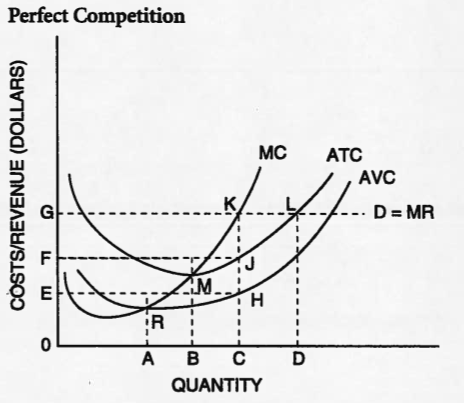
This perfect competitor operate in the long run will produce at which point?

If the product price is $85, how many units of output must the firm produce in order to maximize profits?
0
3
4
5
6

