
 Worksheets
Structures of Earth
Total questions: 26
Worksheet time: 20mins
Name
Class
Date
1.
What boundary do the plates scrap across each other?
a)
Subduction
b)
Buckling
c)
Transform
d)
Divergent
2.
When the plates move away from each other is what type of boundary?
a)
Divergent
b)
Subduction
c)
Buckling
d)
Transform
3.
What type of boundary does sea floor spread occur?
a)
Subduction
b)
Divergent
c)
Buckling
d)
Transform
4.
Where do most volcanoes and earthquakes occur?
a)
Near the plate tectonics boundaries
b)
Inland
c)
Only in the oceans
d)
Away from the plate tectonics boundaries
5.
Which type of plate boundary would cause mountains to form
a)
Transform
b)
Convergent
c)
Divergent
d)
Reform
6.
This layer of Earth is the thickest and contains convection currents
a)
crust
b)
outer core
c)
mantle
d)
inner core
7.
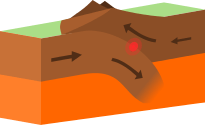
What type of plate boundary is this?
a)
Plate
b)
Divergent
c)
Convergent
d)
Transform
8.

What type of event will occur at this boundary?
a)
Earthquake
b)
Volcano Eruption
c)
Tornado
d)
Mountain Building
9.
What layer is the hottest?
a)
Core
b)
Crust
c)
Mantle
10.

Which layer is made up of iron and nickel?
a)
Crust
b)
Mantle
c)
Inner Core
d)
Lithosphere
11.
What layer of Earth do we live on?
a)
Crust
b)
Core
c)
Mantle
12.
True or False: The Earth's crust is thick melted rock
a)
True
b)
False
13.
True or False: The Earth's crust is made of rock
a)
True
b)
False
14.
Rock that forms when minerals form from solutions or sediment from older rocks get pressed and cemented together.
a)
Sedimentary Rock
b)
Metamorphic Rock
c)
Igneous Rock
15.
The process by which water, wind, ice, and changes in temperature break down rock into fragments called sediments.
a)
Deposition
b)
Erosion
c)
Weathering
d)
Igneous Rock
16.
Rock that forms when pressure, temperature, or chemical processes change existing rock.
a)
Igneous Rock
b)
Sedimentary Rock
c)
Metamorphic Rock
d)
Rock Cycle
17.
_______ rock forms from magma/lava
a)
Metamorphic
b)
Sedimentary
c)
Igneous
18.
The process by which sediment is moved from one place to another. Can be caused by water, wind, ice, and gravity.
a)
Rock Cycle
b)
Uplift
c)
Deposition
d)
Erosion
19.

This rock started as molten magma. What type of rock is this?
a)
Sedimentary
b)
Igneous
c)
Metamorphic
20.
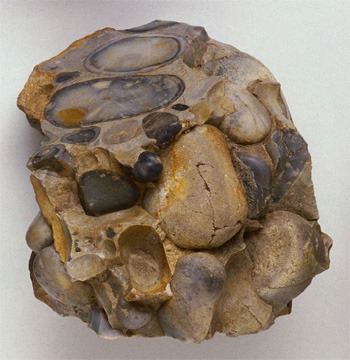
This rock was formed by smaller pieces of rock that settled at the bottom of a lake millions of years ago. What type of rock is this?
a)
Sedimentary
b)
Igneous
c)
Metamorphic
21.

This rock is made from tiny pieces of other rocks that settled to the bottom of a valley millions of years ago. What type of rock is this?
a)
Sedimentary
b)
Igneous
c)
Metamorphic
22.

After lots of time, pressure, and heat, you get this kind of rock. What type of rock is this?
a)
Sedimentary
b)
Igneous
c)
Metamorphic
23.
What are the 3 major types of rocks?
a)
Igneous, Metamorphic, Sedimentary
b)
Metamorphic, Igneous, Cementation
c)
Brown, Red, Gray
d)
Streak, Hardness, Breakage
24.
Which of these is an example of erosion
a)
Light Shinning onto a mountain
b)
Rain breaking down rock
c)
Wind blowing away sediment
d)
All of the above
25.
What is the major cause of weathering and erosion to form canyons?
a)
wind
b)
ice
c)
glaciers
d)
moving water
26.
What happens when a metamorphic rock melts?
a)
It becomes sediment
b)
It becomes an igneous rock
c)
It becomes magma
d)
It becomes a sedimentary rock
100 %

