
 Worksheets
Heat Transfer
Total questions: 48
Worksheet time: 48mins
Name
Class
Date
1.
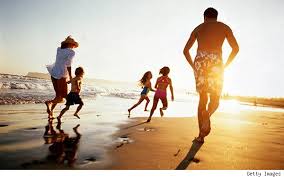
The sun shines down on this family as the play on the beach.
a)
conduction
b)
convection
c)
radiation
2.

A group of friends gather around a fire to stay warm.
a)
conduction
b)
convection
c)
radiation
3.

Walking on the warm sand sand with your bare feet.
a)
conduction
b)
convection
c)
radiation
4.

Which direction will the heat flow while this person holds a hot cup of tea?
a)
from the cup to her hand
b)
from her hand to the cup
c)
no heat is transferred
5.
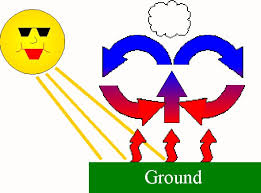
Warm air rises and the cool air sinks.
a)
conduction
b)
convection
c)
radiation
6.

Heat transfers from an area of ____temperature to an area of ___ temperature.
a)
high to low
b)
low to high
c)
high to high
7.
Poor conductors like wood and plastic are called:
a)
conductors
b)
insulators
c)
burners
8.
Warm air is __________ dense than cold air and rises creating convection currents.
a)
more
b)
less
9.
Why does food wrapped in aluminum foil keep warm for a long time?
a)
Aluminum foil is an insulator and prevents heat loss by conduction.
b)
Aluminum foil forms an air-tight seal and prevents heat loss by convection.
c)
The silver surface of the foil reflects heat in and prevents heat loss by radiation.
d)
The silver surface of the foil absorbs heat from the surroundings and keeps the food warm.
10.
A chair is several feet from a fireplace. The side of the chair facing the fireplace gets warm due to
a)
conduction
b)
convection
c)
radiation
11.
Hot coffee is stirred with a spoon; the spoon gets hot due to
a)
conduction
b)
convection
c)
radiation
12.
The metal skewer gets so hot that you drop your marshmallow into the campfire because of
a)
conduction
b)
convection
c)
radiation
13.
A house burns down. The vinyl siding of the house next door warps due to
a)
conduction
b)
convection
c)
radiation
14.

What line segment represents only the solid state?
a)
A-B
b)
B-C
c)
C-D
d)
D-E
15.
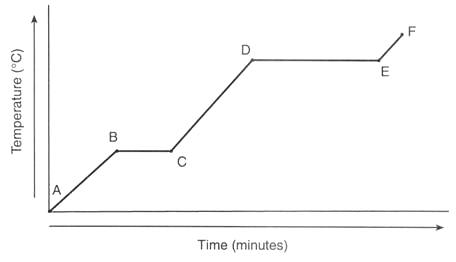
Between which points is the temperature of the substance remaining constant?
a)
A-B only.
b)
A-B, C-D, E-F
c)
B-C only.
d)
B-C, D-E
16.

Between which points is the temperature of the substance increasing?
a)
A-B only.
b)
A-B, C-D, E-F
c)
B-C only.
d)
B-C, D-E
17.

What state of matter is segment 5?
a)
Solid
b)
Liquid
c)
Gas
d)
Plasma
18.
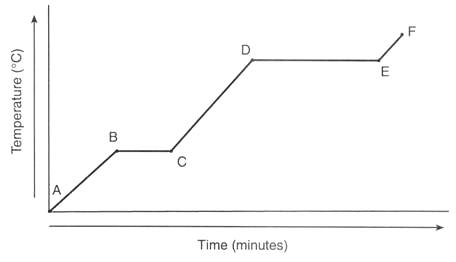
Between which points is the substance changing state?
a)
A-B only.
b)
A-B, C-D, E-F
c)
B-C only.
d)
B-C, D-E
19.
True or false: melting and freezing occur at the same temperature!
a)
True
b)
False
c)
I don't know
20.

A substance's heating curve is shown in the graph. What is its boiling point?
a)
100 C
b)
60 C
c)
80 C
d)
20 C
21.
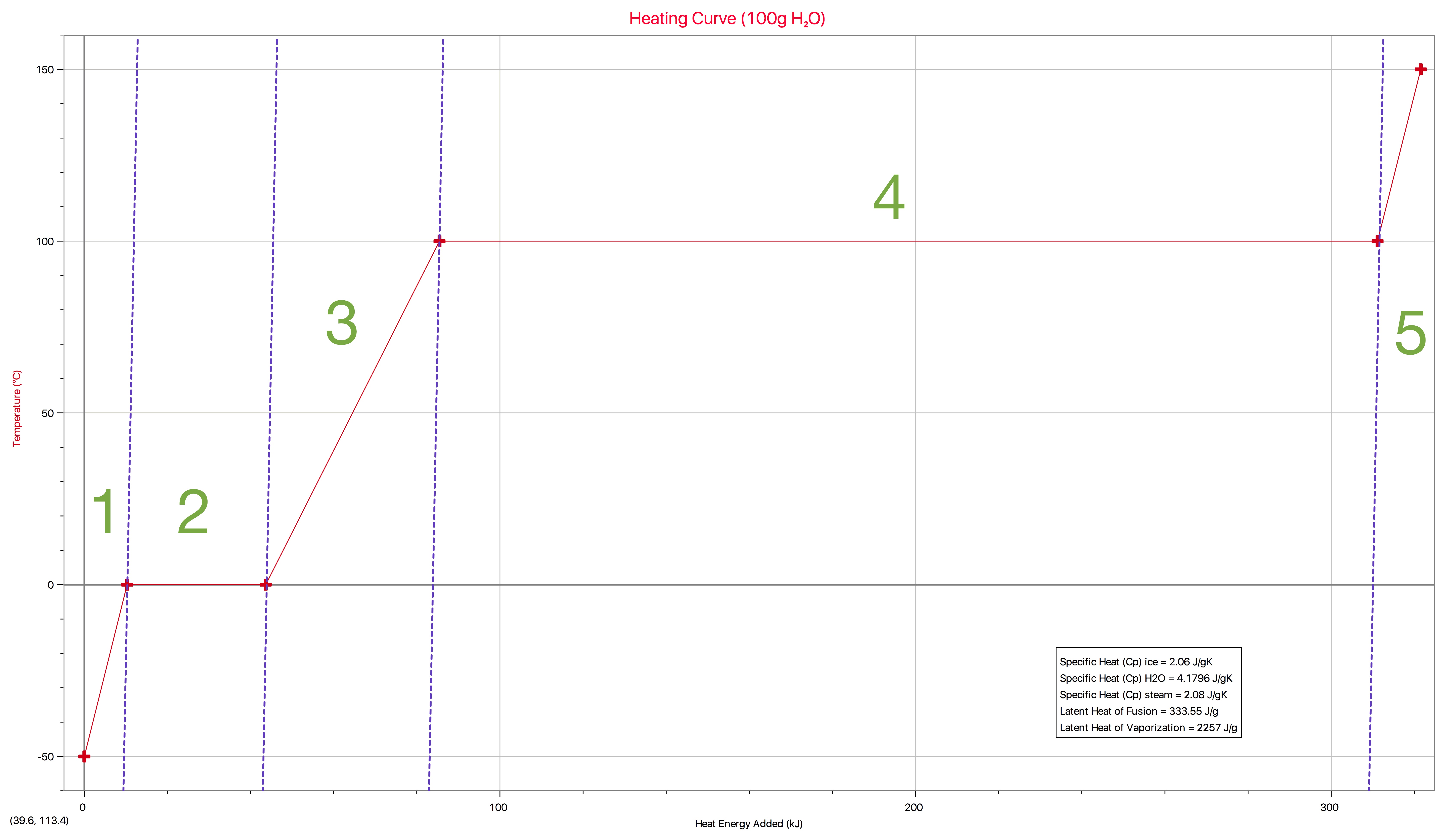
In which region(s) of the graph does a phase change occur?
a)
Region 1, 3, & 5
b)
Region 2 & 4
c)
Region 1 only
d)
Region 1 & 2
22.
In which region(s) of the graph would the substance be a solid only?
a)
Region 1
b)
Region 2
c)
Region 3
d)
Region 4
23.
In which region(s) of the graph would the substance be a liquid and a gas?
a)
Region 2
b)
Region 3
c)
Region 4
d)
Region 5
24.
Which of the following terms identifies the change from a liquid to gas?
a)
Vaporization
b)
Condensation
c)
Deposition
d)
Sublimation
25.
When the temperature of matter increases the particles...
a)
speed up and move closer
b)
speed up and move farther apart
c)
slow down and move closer together
d)
slow down and move farther apart
26.
No definite shape, but has a definite volume
a)
Gas
b)
Liquid
c)
Solid
27.
Definite shape and a definite volume.
a)
Gas
b)
Liquid
c)
Solid
28.
No Definite Shape and No Definite Volume
a)
Gas
b)
Liquid
c)
Solid
29.
Phase change from a solid to a gas.
a)
sublimation
b)
deposition
c)
condensation
d)
evaporation
30.
Phase change from a gas to a liquid.
a)
condensation
b)
evaporation
c)
melting
d)
deposition
31.
What happens to the energy of particles in a substance as it changes from gas, to liquid, to solid?
a)
KE decreases
b)
KE increases
c)
KE stays the same
d)
KE goes up and then goes down
32.

From 30 degrees to 55 degrees, what state of matter is the substance?
a)
Solid
b)
Liquid
c)
Gas
d)
Plasma
33.

The graph shows a cooling curve for an unknown substance. What is happening during segment DE?
a)
boiling
b)
condensation
c)
freezing
d)
melting
34.

Describe the substance between letters E and F.
a)
Gas
b)
Liquid
c)
Melting
d)
Evaporating
35.
What is condensation?
a)
gas to solid
b)
gas to liquid
c)
liquid to solid
d)
solid to liquid
36.
When the temperature of matter decreases the particles ...
a)
speed up and move farther apart
b)
speed up and move closer together
c)
slow down and move farther apart
d)
slow down and move closer together
37.
Most substances ___ when they are cooled.
a)
contract
b)
expand
c)
stay the same
d)
none of the above
38.
The transfer of energy as electromagnetic waves
a)
conduction
b)
convection
c)
radiation
d)
heat
39.
A material that reduces or prevents the transfer of energy by heat
a)
thermal conductor
b)
thermal insulator
c)
heat
d)
temperature
40.

Thermometer number 1 represents temperatures in degrees ___.
a)
Kelvin
b)
Celsius
c)
Fahrenheit
d)
Absolute
41.

What temperature scale should be used to label thermometer number 2?
a)
Celsius
b)
Kelvin
c)
Fahrenheit
d)
Absolute
42.
Water freezes at ___.
a)
0 Celsius
b)
-273 Celsius
c)
100 Celsius
d)
32 Celsius
43.
Which of the following is a measure of the average kinetic energy of the particles in an object?
a)
temperature
b)
thermal energy
c)
potential energy
d)
specific heat
44.
What is the freezing point of water in Kelvin?
a)
273 K
b)
-100 K
c)
32 K
d)
0 K
45.
What temperature is absolute zero?
a)
0 Celsius
b)
273 Celsius
c)
0 Kelvin
d)
-273 Kelvin
46.
The temperature at which molecules in matter no longer move is called ___.
a)
absolute zero
b)
freezing point
c)
absolute freezing
d)
0 degrees Celsius
47.
Heat energy typically moves from ___.
a)
lower temperature matter to higher temperature matter.
b)
higher temperature matter to lower temperature matter.
c)
matter at one temperature to other matter at a similar temperature.
d)
objects of unstable temperature to objects of stable temperature.
48.
What is the only type of thermal energy transfer that can take place across a vacuum (empty space)?
a)
radiation
b)
convection
c)
conduction
d)
No heat transfer can occur through a vacuum
100 %

