
 Worksheets
law of superposition
Total questions: 30
Worksheet time: 19mins
Name
Class
Date
1.
The Law of Superposition helps scientists to determine what?
a)
The absolute age of rock layers
b)
The age of fossils
c)
The relative age of rock layers
d)
the super powers of rocks
2.

According to the law of superposition, the oldest fossils are found
a)
At the top of the rock layers
b)
Near the bottom of the rock layers
c)
In the middle of the rock layers
d)
Somewhat near the surface
3.

Which rock layer in the diagram seems to be the oldest?
a)
F
b)
E
c)
B
d)
A
4.

According to the law of superposition, which layer is the youngest?
a)
A
b)
B
c)
C
5.
Which type of dating method can be used on rock layers by applying the Law of Superposition?
a)
relative dating
b)
absolute dating
c)
radioactive dating
d)
radiometric dating
6.

Which of the following is the oldest?
a)
Layer L
b)
Intrusion D
c)
Intrusion H
d)
Layer E
7.

Which of the following correctly lists the layers in order from oldest to youngest?
a)
A, B, C, D, E
b)
E, B, C, D, A
c)
E, D, C, B, A
d)
C, B, A, D, E
8.

Which Rock layer or intrusion is the youngest?
a)
A
b)
B
c)
C
d)
D
9.

Which rock cycle process follows weathering and erosion?
a)
Sedimentary Rock Formation
b)
Compaction and Cementation
c)
Deposition
d)
Heat and Pressure
10.

Which type of rock leads to melting, weathering and erosion, and heat and pressure.
a)
Sedimentary
b)
Igneous
c)
Metamorphic
d)
Biological
11.
What is the law of crosscutting relationships?
a)
when the fault is younger than the rock it cuts through
b)
the boarders between plates
12.
Before absolute dating of rocks/fossils was developed in the 20th century, geologists had to rely on ________________ dating
a)
Romantic
b)
Relative
c)
Nuclear
d)
Solar
13.
Which type of dating method can be used on rock layers by applying the Law of Superposition?
a)
relative dating
b)
absolute dating
c)
radioactive dating
d)
radiometric dating
14.

Letter "F" is a....
a)
inclusion
b)
intrusion
c)
fault
d)
unconformity
15.
How do MOST fossils form?
a)
living things die and their remains are quickly buried by
sediments
b)
the hard parts of an organism dry out in the air
c)
the soft parts of an organism change to stone
d)
freezing preserves the remains of an organism
16.
How old do Paleontologists believe the Earth is?
a)
2015 years old
b)
3.6 billion years old
c)
4.6 billion years old
d)
4.6 million years old
17.

According to the law of superposition, which layer is the youngest?
a)
A
b)
B
c)
C
18.
states that the geologic feature which cuts another is the younger of the two features
a)
law of horizontality
b)
cross cutting relationships
c)
law of superposition
d)
uniformitarianism
19.
Which of the following is an index fossil?
a)
brachiopods
b)
tyrannosaurus rex
c)
coprolites
d)
trilobites
20.

Which layer contains the oldest index fossils?
a)
Layer 1
b)
Layer 2
c)
Layer 3
d)
Layer 4
21.

What type of fossil is this?
a)
Mold
b)
Cast
c)
Preserved remains
d)
Trace fossil
22.

What type of fossil is this?
a)
Trace fossil
b)
Mold
c)
Cast
d)
Carbon film
23.

What type of fossil is an imprint in a rock?
a)
cast
b)
trace
c)
mold
d)
whole/part
24.

What type of fossil is pictured?
a)
cast
b)
petrified fossil
c)
preserved remains
d)
trace fossil
25.
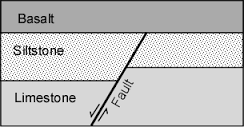
What are the relative ages of the features in order from oldest to youngest?
a)
Limestone, Basalt, Fault, Siltstone
b)
Siltstone, Fault, Basalt, Limestone
c)
Limestone, Fault, Basalt, Siltstone
d)
Limestone, Siltstone, Fault, Basalt
26.
The deposit of rock/sand into a new location.
a)
Erosion
b)
Deposition
27.

What type of fossil is this?
a)
Preserved remains
b)
Petrified
c)
Mold
d)
Cast
28.

What is the correct order of the rock layers from oldest to youngest?
a)
B, C, D, E, A
b)
A, B, C, D, E
c)
E, D, C, B, A
d)
B, C, D, A, E
29.
Fossils are usually found in
a)
igneous rock
b)
extrusions
c)
intrusions
d)
sedimentary rock
30.
TRUE or FALSE: Archaeologists use artifacts to study the past.
a)
True
b)
False
100 %

