Wayground logo

Free Printable Worksheets

Font size

S
M
L
XL
Worksheets

Plate Tectonics

Total questions: 34

Worksheet time: 59mins

Name
Class
Date
1.
_______ are formed when two continental plates collide.
a)
Mountain ranges
b)
Transform faults
c)
Rift valleys
d)
Volcanoes
2.
The theory of continental drift was first proposed by __________.
a)
Thomas Edison
b)
Alfred Wegener
c)
Benjamin Franklin
d)
Harry Hess
3.
Plates move apart at _________ boundaries.
a)
volcanic
b)
divergent
c)
convergent
d)
transform
4.
The San Andreas Fault in California is an example of a ________.
a)
divergent boundary
b)
convergent boundary
c)
transform fault
d)
subduction zone
5.
Which type of plate boundary occurs at B?
a)
convergent
b)
divergent
c)
transform
d)
country
6.
Which type of plate boundary is shown at A?
a)
transform boundary
b)
convergent boundary
c)
divergent boundary
d)
fractured boundary
7.
When plates slide past one another, _________ occur.
a)
divergent boundaries
b)
convection currents
c)
subduction zones
d)
transform faults
8.
The huge pieces of the earth's crust are called ____________________________. 
a)
crust
b)
plates
c)
directions
d)
seismos
9.
Where 2 plates are moving together
a)
Divergent Boundary
b)
Convergent Boundary 
c)
Transform Boundary 
10.
Which type of plate boundary DOES NOT cause volcanoes?
a)
Convergent
b)
Transform
c)
Divergent
11.
Ocean-to-ocean and subduction are two types of which boundary?
a)
divergent
b)
transform
c)
convergent
12.
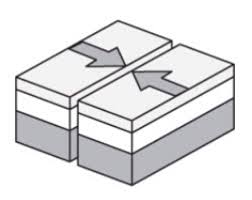
Which kind of plate boundary is this?
a)
divergent boundary
b)
transform boundary
c)
convergent boundary (ocean to continent)
d)
convergent boundary (continent to continent)
13.
Which kind of plate boundary is this?
a)
divergent boundary
b)
transform boundary
c)
convergent boundary (ocean to continent)
d)
convergent boundary (ocean to ocean)
14.
Which kind of plate boundary is this?
a)
divergent boundary
b)
transform boundary
c)
convergent boundary (ocean to continent)
d)
convergent boundary (continent to continent)
15.
Which kind of plate boundary is this?
a)
divergent boundary
b)
transform boundary
c)
convergent boundary (ocean to continent)
d)
convergent boundary (continent to continent)
16.
Name the boundary
a)
convergent boundary
b)
divergent boundary
c)
transform boundary
d)
sergent boundary
17.
In which type of boundary do the plates go away from each other?
a)
convergent
b)
normal
c)
divergent
d)
transform
18.
What kind of plate boundary is shown here?
a)
divergent
b)
convergent
c)
transform
d)
strike slip
19.

a mid ocean ridge is created at what kind of boundary?

a)

convergent

b)

divergent

c)

transform

20.

folded mountains are formed at which type of boundary?

a)

convergent

b)

divergent

c)

tranform

21.

trenches are created at which type of boundary?

a)

convergent

b)

divergent

c)

transform

22.

volcanoes and volcanic islands are formed at which type of boundary?

a)

convergent

b)

divergent

c)

tranform

23.

faults are formed at which type of boundary?

a)

convergent

b)

divergent

c)

transform

24.

rift valley's are formed at which type of boundary?

a)

convergent

b)

divergent

c)

transform

25.

new ocean crust forms along which boundary type

a)

convergent

b)

divergent

c)

ocean trench

d)

subduction zone

26.

The movement of the tectonic plates is caused by

a)

the rotation of the Earth.

b)

convection currents in the mantle

c)

the gravity of the iron-nickel core.

d)

the Moho discontinuity.

27.

In some areas of the world, like California and Japan, earthquakes are a common occurrence. How can this best be explained?

a)

The strong ocean currents are undermining both areas causing earthquakes.

b)

Both areas are located near the edge of the Pacific Ocean, the unstable sand causes earthquakes.

c)

Both areas are subjected to strong ocean wind and waves that causes earthquakes.

d)

Both areas are on the boundary of active plates, the motion of the plates causes earthquakes.
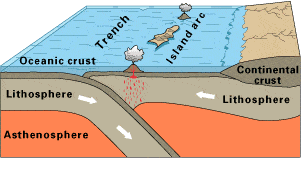
28.

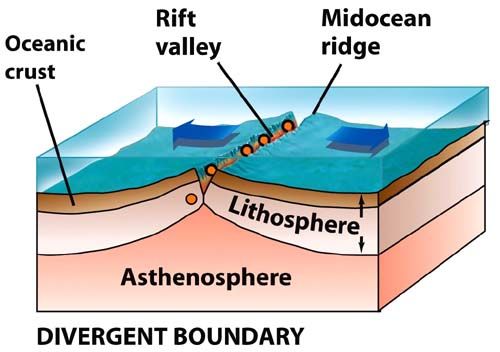
Observe this diagram of a plate boundary. One statement BEST describes what is happening. It is that

a)

the oceanic crust is melting.

b)

the denser ceanic crust is subducting under the less dense oceanic crust

c)

volcanic islands are forming.

d)

the tectonic plates are moving away from each other.
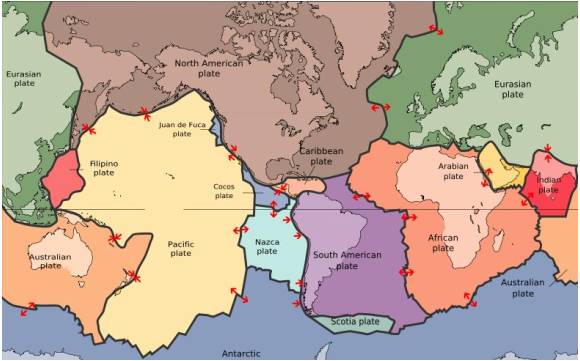
29.

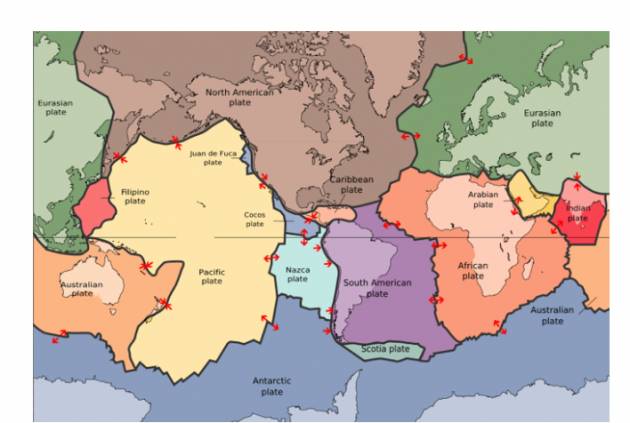
The map in the picture shows tectonic plate boundaries. This map would be useful in predicting the location of future

a)

droughts

b)

hurricanes

c)

earthquakes

d)

tornadoes

30.

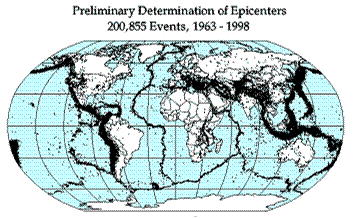
Earthquake epicenters (center of where the earthquakes started) were mapped for a 35 year period in the diagram above. The black dots indicate these epicenters. The black dots appear along what feature on Earth?

a)

hot spots

b)

plate boundaries

c)

rift zones

d)

sea floor spreading

31.
The Earth’s surface is not a solid surface but is divided into
a)
several oceanic plates.
b)
continental and crustal plates.
c)
seven continental plates.
d)
continental and oceanic plates.
32.

Where are earthquakes MOST LIKELY to occur?

a)

close to the equator

b)

close to the center of tectonic plates

c)

at divergent or convergent plate boundaries

d)

at transform plate boundaries

33.

The 2004 Indian Ocean tsunami was caused by a shift in two plates that pushed one section of the sea floor under another section of the sea floor by 5 meters. What type of boundary is this?

a)

divergent

b)

convergent

c)

transform

d)

metamorphic

34.

What is the source of energy that drives plate movement?

a)

the subducton of the sea floor

b)

the different densities of the oceanic and crustal plates

c)

convection currents in the asthenosphere

d)

the friction force between the plates that move past each other