
 Worksheets
LMS 8th Grade Science Homework #10
Total questions: 20
Worksheet time: 21mins
Name
Class
Date
1.
Wet weather on U.S. Gulf Coast during winter, which is usually the dry season
- Fewer hurricanes in the North Atlantic
-Strong winds storms on west coast
-Heavy Rains in South America
-Droughts in Australia, Africa, and Southern India, Indonesia
-Reduced tropical upwelling, causing lower fish catches and coral death
a)
El nino
b)
La nina
2.

Why does the area around the equator stay the same temperature all year?
a)
The equator rotates slower than the poles.
b)
The equator remains the same distance from the sun.
c)
The equator always receives direct sunlight.
d)
The equator has 18 hour days.
3.
Which change would cause the Northern Hemisphere to have cooler winters and hotter summers?
a)
A faster rotation
b)
A tilt less than 23.5 degrees
c)
A slower rotation
d)
A tilt of more than 23.5 degrees
4.

A cold front is approaching Minneapolis. What will happen to the air temperature?
a)
stay the same
b)
increase
c)
decrease
5.
A __________ is the lines between air masses.
a)
low pressure system
b)
high pressure system
c)
front
6.
True or False: Changes in wind speed and direction can indicate a storm or change of temperature
a)
True
b)
False
7.
The Earth's ____________ is the layer of gases that surround the planet and make it possible for living things to survive on Earth.
a)
atmosphere
b)
water cycle
c)
shell
d)
land
8.
The amount of precipitation in an area is measured and collected by which weather tool?
a)
Anemometer
b)
Rain Gauge
c)
Wind Vane
d)
Barometer
9.
A warm front means the air temperature will
a)
stay the same
b)
increase
c)
decrease
10.
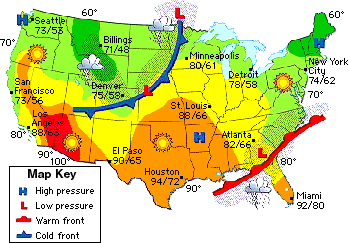
A low pressure system is located over Georgia. What type of weather will they have?
a)
clear, sunny skies
b)
cloudy and rainy
11.
A high pressure system is located north of New York City. What type of weather will be experienced there?
a)
clear, sunny skies
b)
cloudy and rainy
12.
Equal areas of which surface will absorb the most insolation?
a)
Partially melted snowfield
b)
Blacktop parking lot
c)
White sand beach
d)
Lake surface
13.

During which interval is the object not moving?
a)
B to C
b)
C to D
c)
D to E
d)
only at point A
14.

During which interval is the object traveling at a constant velocity?
a)
B to C
b)
D to E
c)
F to G
d)
it traveling at a constant velocity during all of the intervals shown.
15.

During which interval is the object slowing down?
a)
A to B
b)
D to E
c)
E to F
d)
G to H
16.

During which interval are the forces on the object BALANCED (Net Force= 0 N)?
a)
A to B
b)
B to C
c)
D to E
d)
F to G
17.
What are the basic building blocks for all matter?
a)
atoms
b)
elements
c)
compounds
d)
chemicals
18.
What do we call a substance consisting of a single atom?
a)
coefficient
b)
element
c)
compound
d)
molecule
19.
What do we call a chemical substance made up of 2 or more different types atoms bonded together?
a)
formula
b)
atom
c)
subscript
d)
compound
20.
When __________ form, the elements lose there individual chemical properties and take on new properties.
a)
compounds
b)
atoms
c)
subscript
d)
formula
100 %

