
Font size
 Worksheets
Evidence for Evolution #2
Total questions: 12
Worksheet time: 3600secs

Which of the following are HOMOLOGOUS structures?
bee wings and bird wings
legs on a beetle and legs on a cat
whale flipper and bat wing
human eyebrows and ant antenna

Which images illustrate ANALOGOUS structures?
1, 2
1, 3
2, 3
1, 2, 3

These limbs provide evidence of common ancestry because they....
have the same basic structure
Perform the same function
Are the same size
Are parts of mammals

Which wings illustrate HOMOLOGOUS structures?
bat & butterfly
bat & bird
butterfly & bird
bat, butterfly, & bird

The cave fish and minnow are related to each other but the cave fish is blind and only has the remnants of an eye. What type of structure is this?
homologous
analogous
vestigial
convergent

Which of the following are ANALOGOUS structures?
bee wings and bird wings
legs on a beetle and legs on a cat
whale flipper and bat wings
human eyebrows and ant antenna

All these organisms have similar arm bones. What is the reason for this?
The function of these bones is the same in all animals
They live in similar environments
They have a common ancestor
All organisms resemble humans

Which of the following pieces of evolution EVIDENCE deals with comparing similar structures in various species?
fossil record
comparing embryology
comparing biochemistry
comparing anatomy
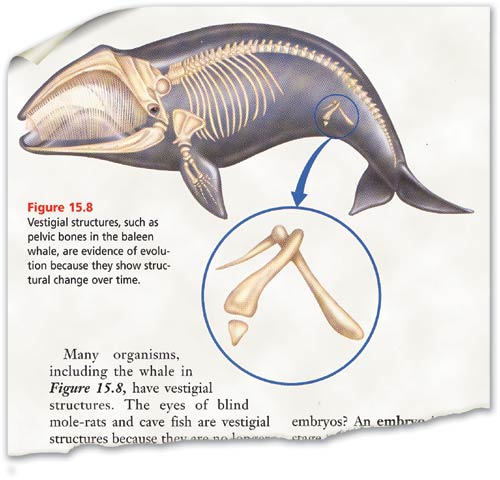
The hind leg bones in a whale are examples of....
homologous structures
analogous structures
fossils
vestigal structures
Which of the following are ANALOGOUS structures (3)?


Which are HOMOLOGOUS structures (2)?


Giraffes have the same number of vertebrae in the neck as do humans. What line of evolutionary evidence is this?
comparative anatomy
comparative biochemistry (DNA)
comparative embryology
fossil evidence

