wayground logo

Free Printable Worksheets

Font size

S
M
L
XL
Worksheets

Unit 2 Review

Total questions: 60

Worksheet time: 37mins

Name
Class
Date
1.
Intrusive Igneous rocks will be 
a)
coarse grain
b)
fine grain
2.
Coarse or Fine?
a)
coarse
b)
fine
3.
Igneous rock that forms from lava on Earth's surface
a)
Organic Rock
b)
Intrusive Rock
c)
Clastic Rock
d)
Extrusive Rock
4.
Igneous rock that forms when magma hardens beneath Earth's surface
a)
intrusive Rock
b)
compaction
c)
Chemical Rock
d)
Clastic Rock
5.
The process by which igneous rocks are formed...
a)
heat and pressure deep underneath earth's surface
b)
melting and cooling of magma
c)
compaction and cementation of sediments
6.
Sedimentary rocks are formed by
a)
Cooling of lava or magma
b)
Heat and pressure
c)
Compacting and cementing
7.
How is sediment formed?
a)
Weathering and Erosion
b)
Melting
c)
Pressure
8.
What is the breaking down of rocks?
a)
Weathering
b)
Clastic
c)
Vesicular
9.
What is deposition?
a)
Pieces of sediment come to rest on a surface
b)
Movement of sediment
c)
Breaking down of sediment 
10.
When metamorphic rocks are formed, the extreme heat is usually caused by the _______.
a)
gravity in the atmosphere
b)
collision of tectonic plates
c)
the fiery hot magma in the Earth's mantle
d)
weight of the mountains
11.
__________  metamorphic rocks have mineral grains that are not arranged in distinct bands.
a)
Conglomerate
b)
Non-foliated
c)
Foliated
d)
Permeated
12.
How do metamorphic rocks form? 
a)
Heat and Pressure
b)
Compaction & Cementation
c)
Cooling of Magma
d)
Sediments & Glue
13.
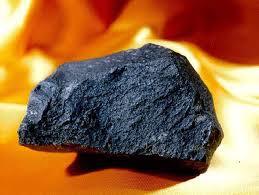
Which texture best describes the rock above?
a)
porphyritic 
b)
nonfoliated
c)
foliated
d)
clastic
14.
A metamorphic rock changes into an igneous rock by what two processes?
a)
Melting and cooling
b)
Extreme heat and pressure
c)
Compaction and cementation
d)
Weathering and erosion
15.
What is the MAIN way rocks are classified?
a)
Their color and shapes
b)
How they form
c)
Mineral bands
d)
Where they form
16.
True/False: Igneous rocks can only turn into metamorphic rocks.
a)
True
b)
False
17.
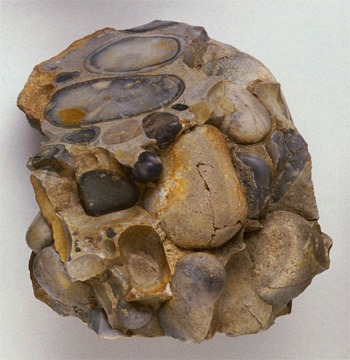
This rock was found near the mouth of a volcano. What type of rock is this?
a)
Sedimentary
b)
Igneous
c)
Metamorphic
18.
This rock was formed by smaller pieces of rock that settled at the bottom of a lake millions of years ago. What type of rock is this?
a)
Sedimentary
b)
Igneous
c)
Metamorphic
19.
This rock started as lava that cooled and then was heated and put under pressure over time. What type of rock is this?
a)
Sedimentar
b)
Igneous
c)
Metamorphic
20.

The type of plate boundary where two plates come together is a .....

a)

Convergent Boundary

b)

Divergent Boundary

c)

Transform Boundary

d)

Plate Boundary

21.
What type of event will occur at this boundary?
a)
Earthquake
b)
Volcano Eruption
c)
Tornado
d)
Mountain Building
22.
A divergent boundary occurs when plates ....
a)
Pull apart
b)
Come together
c)
Slide past each other
d)
subducting
23.
Which of the following is the name of the ancient supercontinent formed 28 Million Years ago.
a)
Pangea
b)
Gondwanda
c)
Laurasia
d)
Neverland
24.
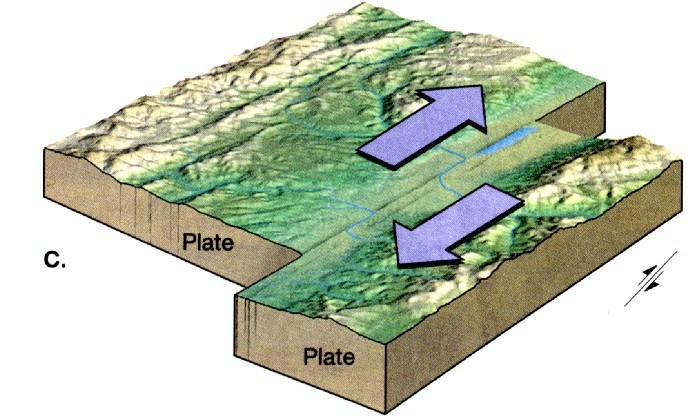
What type of plate boundary is this?
a)
Transform
b)
Convergent
c)
Divergent
d)
Plate
25.
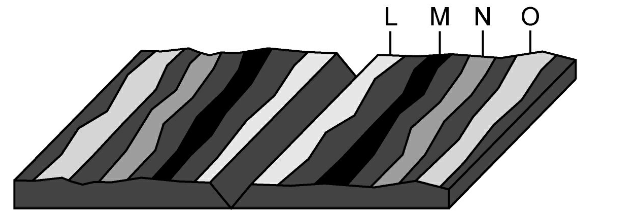
Where would the oldest rock be found?
a)
L
b)
M
c)
N
d)
O
26.
Mountains are created when....
a)
Two continental plates collide
b)
Two oceanic plates pull apart
c)
An Oceanic plate subducts under a Continental Plate
d)
Two continental plates pull apart
27.

The Great Rift Valley in Africa and the Mid-Ocean Ridge were all created by this boundary

a)

Divergent

b)

Convergent

c)

Reform

d)

Transform

28.
Earthquakes and volcanoes are most likely found in which locations?
a)
At plate boundaries
b)
in oceans
c)
in the middle of continents
d)
in the middle of plates
29.
The Himalayas in Asia are an example of what type of plate boundary?
a)
divergent
b)
continent-to-continent convergent
c)
ocean-to-continent convergent
d)
transform
30.
The process for new oceanic lithosphere forming at mid ocean ridges
a)
Continental Drift
b)
Seafloor Spreading
c)
Plate Tectonics
d)
Pangaea
31.
Ocean trenches always form at subduction zones where dense oceanic crust subducts.
a)
True
b)
False
32.
The circular pattern of heating, rising, cooling, sinking of magma in the mantle causing tectonic plates to move.
a)
Plate Tectonics
b)
Convection Currents
c)
Pangaea
d)
Subduction
33.
Hot spots are volcanically active areas that are not near tectonic plate boundaries.
a)
True
b)
False
34.
Who proposed their hypothesis of the continental drift in 1912?
a)
Albert Einstein
b)
Alfred Wegener
c)
Dmitri Mendeleev
d)
Neil Armstrong
35.

What are the 4 agents of erosion?

a)

Wind, water, earth, fire

b)

Wind, water, gravity, glaciers

c)

Gravity, glaciers, fire, earth

d)

Wind, gravity, fire, glaciers

36.

What is an example of chemical weathering?

a)

Wind eroding rock

b)

Water eroding a creek bed

c)

Acid rain eroding mountains

d)

Glaciers cutting into rock formations

37.

What is an example of physical weathering?

a)

Water dissolving minerals in rocks

b)

Oxidation causing rocks to "rust"

c)

Acid rain eroding mountains

d)

Glaciers cutting into rock formations

38.

Where does chemical weathering occur more?

a)

Areas with high biodiversity

b)

Areas with warm temperatures, high rainfall, and lush vegetation

c)

Cool, dry areas with repeated heating and thawing

d)

Warm, dry areas with low vegetation

39.

Where does physical weathering occur more?

a)

Areas with high biodiversity

b)

Areas with warm temperatures, high rainfall, and lush vegetation

c)

Cool, dry areas with repeated heating and thawing

d)

Warm, dry areas with low vegetation

40.

What does an oceanic-oceanic plate boundary form?

a)

Rift Valley

b)

Island arc and trench

c)

Volcanic hotspots

d)

Mountain ranges

41.

What does an oceanic-continental plate boundary form?

a)

Island arc and trench

b)

Volcanic hotspots

c)

Rift Valley

d)

Volcanic mountain range and a trench

42.

What are the 3 reasons the plates are moving?

a)

Mantle convection, gravity pull, and Earth's rotation

b)

Mantle convention, ridge push, and Earth's rotation

c)

Mantle convection, ridge push, and the Coriolis effect

d)

Mantle convection, gravity pull, and ridge push

43.

What is seafloor spreading?

a)

New crust is formed at trenches and destroyed at ocean ridges

b)

New crust is formed at ocean ridges and destroyed at trenches

c)

The process of the seafloor spreading out and will eventually take over the continental areas

d)

New crust is formed in volcanoes and destroyed during earthquakes

44.

What is the point within the Earth's crust where an earthquake originates called?

a)

Epicenter

b)

Focus

c)

P wave

d)

S wave

45.

What is the point of Earth's surface above where an earthquake starts called?

a)

Epicenter

b)

Focus

c)

P wave

d)

S wave

46.

How do Tsunamis form?

a)

Major tidal changes

b)

Changes in Earth's rotation

c)

Vertical movement of the ocean floor

d)

Horizontal movement of the ocean floor

47.

Where are volcanoes located?

a)

Transform plate boundaries

b)

Hawaii

c)

Convergent or Divergent boundaries

d)

Only divergent boundaries

48.

What is an example of a hotspot?

a)

Mt. Fuiji

b)

Mt. St. Helens

c)

Mt. Wannahakalouge

d)

Hawaii

49.

How are effusive eruptions characterized?

a)

Sends lava and ash high into the sky

b)

Eruption is quiet with lots of flowing lava

c)

Explodes giant boulders of volcanic rock

d)

Do not happen often

50.

How are explosive eruptions characterized?

a)

Sends lava and ash high into the sky

b)

Eruption is quiet with lots of flowing lava

c)

Much less dangerous

d)

Happen often

51.

How does soil form?

a)

Weathering, erosion, and fire

b)

Weathering, plate tectonics, and organisms dying and decaying

c)

The rock cycle and plate tectonics

d)

Weathering, organisms living in rock, and organisms dying and decaying to add to the soil

52.

What characteristics does horizon A have?

a)

Rich in humus, gray to black

b)

enriched with clay, contains minerals washed out from topsoil

c)

Weathered parent material directly above bedrock

d)

Layer of loose debris and organic matter at the surface of soil

53.

What characteristics does horizon B have?

a)

Rich in humus, gray to black

b)

enriched with clay, contains minerals washed out from topsoil

c)

Weathered parent material directly above bedrock

d)

Layer of loose debris and organic matter at the surface of soil

54.

What characteristics does horizon C have?

a)

Rich in humus, gray to black

b)

enriched with clay, contains minerals washed out from topsoil

c)

Weathered parent material directly above bedrock

d)

Layer of loose debris and organic matter at the surface of soil

55.

What characteristics does horizon O have?

a)

Rich in humus, gray to black

b)

enriched with clay, contains minerals washed out from topsoil

c)

Weathered parent material directly above bedrock

d)

Layer of loose debris and organic matter at the surface of soil

56.

What is a soil horizon?

a)

Top view of a soil profile

b)

The vertical sequence of soil layers

c)

A distinct layer in a soil profile

d)

The view of soil from left to right

57.

What soil has distinct layers?

a)

Poorly developed

b)

Well developed

c)

Rainforest

d)

Mountain areas

58.
The process by which the ocean floor sinks beneath a deep-ocean trench and back into the mantle is known as _______
a)
convection
b)
continental drift
c)
subduction
d)
conduction
59.
The Earth's lithosphere separated into pieces called
a)
boundaries
b)
plates
c)
litho-pieces
60.
Breaks in the Earth's crust where rocks have slipped past each other are called
a)
 plate boundaries
b)
faults
c)
cracks