
 Worksheets
Ecology Ch 3-6
Total questions: 29
Worksheet time: 16mins
Name
Class
Date
1.
Anything that can decrease the size of a population including living (biotic) and non living (abiotic) features of an ecosystem such as predators and drought.
a)
limiting factor
b)
habitat
c)
ecosystem
d)
carrying capacity
2.

What does a food web represent?
a)
All connections of energy flow throughout all organisms in a habitat.
b)
The specific ways that mutualism is carried out.
c)
A single pathway or energy flow between organisms.
d)
How carnivores get their food.
3.
Which of the following is the correct equation for PHOTOSYNTHESIS?
a)
CO2 + light + H2O --> O2 + Sugar
b)
CO2 + sugar + H2O --> O2 + light
c)
O2 + light + H2O --> CO2 + Sugar
d)
CO2 + O2 + H2O --> Light+ Sugar
4.
Which of the following interactions is an example of symbiosis?
a)
an insect acts as a pollinator for a plant species
b)
a population of hummingbirds migrates during the summer
c)
a tropical bird performs a courtship dance for a mate
d)
a mother bear feeds and protects her cubs
5.

The diagram below depicts the water cycle. Which process is represented by the number 2?
a)
precipitation
b)
evaporation
c)
surface runoff
d)
condensation
6.
The series of changes an environment will take to restore itself after a disturbance is called
a)
climax community
b)
climax change
c)
succesion
d)
population growth
7.
What is the difference between primary and secondary succession
a)
Primary is slow and secondary is fast
b)
Secondary begins with soil
c)
Primary begins with soil
d)
Secondary begins with rock
8.
Cleaning birds pick at an alligators teeth
a)
Parasitism
b)
Commensalism
c)
Mutualism
d)
Predator
9.
Toxins in the environment do what as they move up the food chain?
a)
Increase
b)
Decrease
c)
Stay the same
10.

What is a niche?
a)
the place where a species lives
b)
what a species eats
c)
the role of a species
d)
how a species uses resources
11.
Some bacteria in the soil can change nitrogen compounds back into
a)
proteins
b)
nitrogen gas
c)
sugar
d)
oxygen
12.
Limiting factor not determined by population density
a)
density-dependent
b)
density-independent
c)
biotic potential
d)
carrying capacity
13.
The carrying capacity is the _______ number of individuals in a population that can live in one area.
a)
smallest
b)
sampling
c)
community
d)
largest
14.
The number of wild horses per square kilometer in a prairie is the horse population’s
a)
density
b)
dispersion
c)
size
d)
birthrate
15.

What type of graph is this?
a)
exponential growth
b)
logistical growth
16.
limiting factor that relies on the number of organisms in a given area
a)
density-dependent
b)
density-independent
c)
biotic potential
d)
carrying capacity
17.
Which of the following is NOT a density-dependent limiting factor?
a)
flood
b)
disease
c)
predation
d)
competition
18.
Which of the following is a density-independent limiting factor?
a)
disease
b)
emigration
c)
earthquake
d)
parasitism
19.
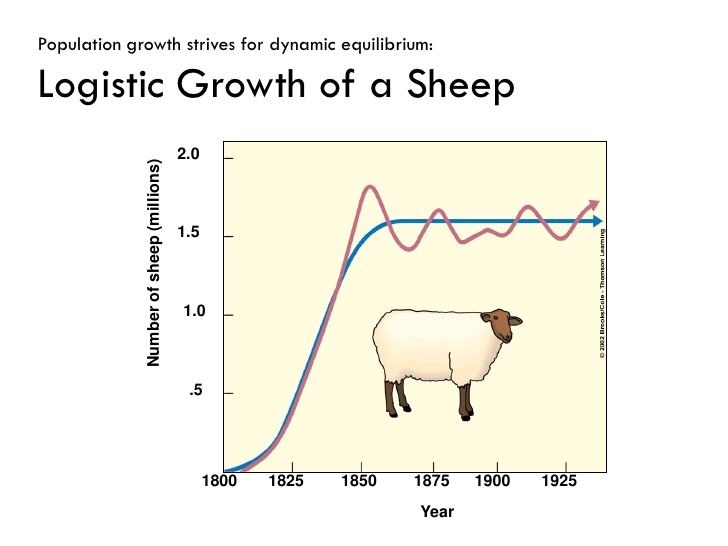
What is the carrying capacity for this sheep population?
a)
1.8 million
b)
1.25 million
c)
1.6 million
d)
1.o million
20.

How would you describe the population?
a)
Growing
b)
Steady (not much change)
c)
Decreasing
d)
Rapid growth
21.

How would you describe the population?
a)
Rapid Growing
b)
Steady (not much change)
c)
Decreasing
22.
The number of different species of plants and animals in area refers to what vocabulary word?
a)
Speciation
b)
Biodiversity
c)
Extinct
d)
Ecosystem
23.
Why is biodiversity important in fighting disease in food crops?
a)
It prevents one disease from wiping out an entire food crop.
b)
It prevents habitat loss of native species.
c)
It provides different foods for different populations.
d)
It prevents fungal disease from wiping out corn crops.
24.
The illegal capture or killing of an organism, often for money, is called...
a)
poaching
b)
harvesting
c)
fragementation
d)
extinction
25.
Food, water, sunlight, shelter, and space are resources that are often __________.
a)
limiting factors
b)
wet
c)
messy
d)
found in rocks
26.

Which type of growth is best illustrated by this rabbit population?
a)
exponential
b)
logistic
c)
S-shaped
d)
predator-prey
27.

How many primary consumers are there in this food web?
a)
1
b)
2
c)
3
d)
4
28.

If there is 1000 Kcal available in the producers in trophic level 1, how much energy is available in the herbivores in trophic level 2?
a)
10 Kcal
b)
1 Kcal
c)
100 Kcal
d)
1000 Kcal
29.
How does decay effect the biomass in a log
a)
Decay adds biomass to the log
b)
Decay reduces biomass in the log
c)
Decay does not effect the biomass of a log
100 %

