
 Worksheets
Waves Practice
Total questions: 37
Worksheet time: 28mins
Name
Class
Date
1.
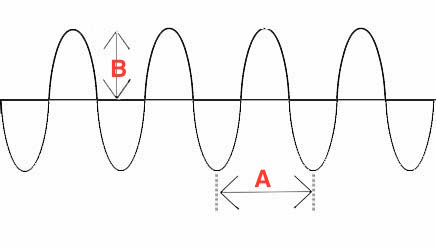
What property of this wave is represented by the letter "A"
a)
amplitude
b)
crest
c)
trough
d)
wavelength
2.
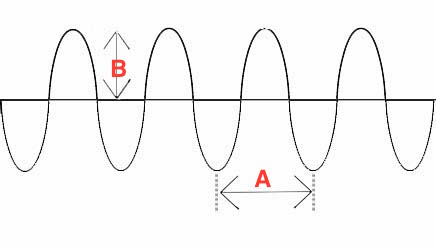
What property of the wave is represented by the letter "B"?
a)
amplitude
b)
crest
c)
trough
d)
wavelength
3.
The highest point on a wave is:
a)
the crest
b)
the trough
c)
the top
d)
the coast
4.
The lowest point on a wave is the:
a)
Amplitude
b)
Crest
c)
Trough
d)
Wavelength
5.
The number of wavelengths that pass a point each per second is:
a)
frequency
b)
period
c)
longitudinal
d)
transverse wave
6.
Which statement best explains the difference between longitudinal and transverse waves?
a)
Longitudinal waves have troughs, while transverse waves have crests.
b)
Longitudinal waves produce energy, while transverse waves consume energy.
c)
Particles in longitudinal waves travel towards a force, while particles in transverse wave travel away from a force.
d)
Particles in longitudinal waves travel in the direction of the wave, while particles in transverse waves travel perpendicular to the wave.
7.
Which of these is the best way to produce a longitudinal wave?
a)
heating a block of iron
b)
freezing a tray of water
c)
squeezing and releasing a metal spring
d)
shaking a rope up and down
8.
All waves carry
a)
energy
b)
light
c)
matter
d)
particles
9.
What do we call the part of a compressional wave that is when the waves are squeezed together?
a)
compression
b)
rarefaction
c)
crest
d)
trough
10.
What do we call the part of a compressional wave that is spread a part?
a)
compression
b)
rarefaction
c)
crest
d)
trough
11.
Name the type of wave that matter moves at right angles to the direction of the wave?
a)
compressional waves
b)
mechanical waves
c)
transverse waves
d)
ultraviolet rays
12.

What kind of wave is pictured below?
a)
compressional wave
b)
transverse wave
c)
sound wave
d)
mechanical wave
13.

Which letter represents the wave crest?
a)
A
b)
B
c)
C
d)
D
14.

Which letter represents the wave trough?
a)
A
b)
B
c)
C
d)
D
15.
Sound waves are...
a)
cool
b)
not cool
c)
transverse waves
d)
longitudinal waves
16.
The direction of a transverse waves is ____ to the disturbance/vibration.
a)
equal
b)
less than
c)
at an acute angle
d)
at a right angle
17.
Which of the following items would work well in space?
a)
A. flashlight
b)
B. radio
c)
C. guitar
d)
D. drum set
18.

Sound waves are _______________
a)
Transverse waves
b)
Longitudinal waves
c)
Circular waves
d)
Seismic waves
19.

It is the part of the wave where the particles are close together. It is part A on this picture.
a)
Compression
b)
Amplituide
c)
Rarefaction
d)
Wavelength
20.

It is the part of the wave where the particles are spread out. It is part B in this picture.
a)
Compression
b)
Rarefaction
c)
Amplitude
d)
Wavelength
21.
The distance between two identical parts on a wave. For example one compression, to the next compression.
a)
Compression
b)
Rarefaction
c)
Amplituide
d)
Wavelength
22.
It is measured as how far the particles of a wave travel from the rest position. It is also how loud the sound wave is.
a)
Compression
b)
Rarefaction
c)
Amplitude
d)
Wavelength
23.
Sound waves require a medium to travel through.
a)
True
b)
False
24.

What kind of waves can travel through space?
a)
electromagnetic waves
b)
compressional waves
c)
longitudinal waves
d)
sound waves
25.

Which wave has a greater frequency?
a)
A
b)
B
26.

You can't hear sounds in outer space because there is no
a)
matter
b)
light
c)
energy
d)
heat
27.
When a wave's amplitude increases it means
a)
it's carrying more energy
b)
its wavelength gets longer
c)
its frequency increases
d)
its wavelength decreases
28.

Of the following, ________ have the greatest frequency of the electromagnetic spectrum.
a)
ultraviolet rays
b)
gamma rays
c)
radio
d)
visible waves
29.

All waves carry ________ as they travel from one place to another.
a)
matter
b)
space
c)
energy
d)
water
30.
A wave that does not require a medium
a)
A. electromagnetic wave.
b)
B. surface
wave
c)
C. medium
d)
D. transverse
wave
31.
Which travels faster, light or sound?
a)
light
b)
sound
32.

A sound wave is propagating through the air from left to right as shown in the diagram above.
The wave in the diagram above can best be described as ―
The wave in the diagram above can best be described as ―
a)
electromagnetic
b)
longitudinal
c)
pulse
d)
transverse
33.

Which wave has the largest amplitude?
a)
A
b)
B
c)
C
d)
none of the above
34.

What wave has the most troughs?
a)
A
b)
B
c)
C
d)
D
35.

Which waves have the same amplitude?
a)
BD
b)
AB
c)
AC
d)
AD
36.

Which letter identifies the wavelength?
a)
A
b)
B
c)
C
d)
D
37.

The diagram below represents a transverse wave.The wavelength of the wave is equal to the distance between which two points?
a)
C and E
b)
A and G
c)
B and F
d)
D and F
100 %

