
 Worksheets
Evolution Quiz
Total questions: 22
Worksheet time: 14mins
Name
Class
Date
1.
What is another name for natural selection?
a)
survival of the smartest
b)
survival of the fastest
c)
survival of the biggest
d)
survival of the fittest
2.
What is the study of organisms at the early stages of development?
a)
DNA studies
b)
embryology
c)
extinction
d)
fossil record
3.
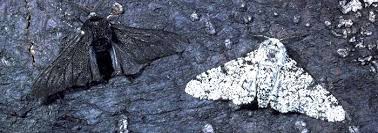
Predict which moth would increase in population
a)
light
b)
dark
4.
The cause of artificial selection is…
a)
The environment
b)
Humans
c)
Mutation
d)
Gene Flow
5.
Darwin wrote that organisms with traits that are best suited to the environment will ________________
a)
increase in number
b)
become extinct
6.
Which of the following is NOT an example of natural selection?
a)
People selectively breeding hamsters.
b)
Insect populations developing resistance to certain pesticides.
c)
Bacteria becoming resistant to antibiotics.
d)
Male birds of certain species developing colorful feathers to attract female mates.
7.

Common ancestry can be shown through the following, called:
a)
Fossils
b)
Homologous structures
c)
Comparative embyrology
d)
Analogous structures
8.

The forelimbs of penguin, alligator, bat, human are which of the following?
a)
homologous structures
b)
vestigial structures
9.

Two organisms that are closely related would have
a)
very similar DNA sequence
b)
exactly the same DNA sequences
c)
no proteins in common
d)
completely different DNA sequence
10.

The hip bones in a whale are examples of
a)
homologous structures
b)
analogous structures
c)
fossils
d)
vestigal structures
11.
A fossil of an extinct dinosaur is found and the anatomy of the fossil shows similarities to that of a bird. What could this mean?
a)
This is purely by chance and isn't significant
b)
The extinct dinosaur and modern bird share a common ancestor
c)
All dinosaurs evolved into birds and that's why there aren't any dinosaurs alive today
d)
Dinosaurs choose to fly, and evolved into birds to escape predation and capture food
12.
Structures that are inherited from a common ancestor are homologous.
a)
True
b)
False
13.
When would convergent evolution occur?
a)
When organisms share a common ancestor
b)
When organisms live in similar environments
c)
When organisms become increasingly different
d)
When organisms experience a change in their environment
14.
Analogous structures show common ancestry.
a)
True
b)
False
15.
Which of the following pieces of evolution evidence contain both homologous and vestigial structures?
a)
fossil record
b)
comparing embryology
c)
comparing biochemistry
d)
comparing anatomy
16.
Similar structures because of sharing a similar habitat
a)
Homologous
b)
Analogous
c)
Vestigial
17.
In convergent evolution, organisms share physical similarities because they
a)
have a common ancestor
b)
live in similar environments
c)
develop homologous structures
d)
are closely related
18.
Two organisms that have a common ancestor but overtime evolved into different species. What is this called
a)
convergent
b)
divergent
c)
coevolution
19.
What animals did Charles Darwin study when at the Galapagos Islands?
a)
Giraffes
b)
Seagulls
c)
Seals
d)
Finches
20.
For Darwin, how have animals and plants survived?
a)
Through luck
b)
Through natural selection
c)
Through careful management
d)
Through choice
21.
The study of where organisms live
a)
biogeography
b)
continental drift
c)
natural selection
d)
embryology
22.
Which of the following is shows evidence for evolution?
a)
Direct observation
b)
Biogeography
c)
DNA Comparisons
d)
All of the above
100 %

