wayground logo

Free Printable Worksheets

NEW

Font size

S
M
L
XL
Worksheets

Evolution

Total questions: 43

Worksheet time: 1hrs 26mins

Name
Class
Date
1.

What significance did the fossil Lucy have?

a)

She was the oldest fossil found

b)

She was the link between ape and human

c)

She was the smartest ape to live

d)

She was the only ape fossil found in Ethiopia
2.
Who is the father of evolution?
a)
Darwin
b)
Mendel
c)
Newton
d)
Einstein
3.
When all of the organisms of a species have died it is called
a)
evolution
b)
extinction
c)
adaptation
d)
natural selection
4.
What is the study of organisms at the early stages of development?
a)
DNA studies
b)
embryology 
c)
extinction
d)
fossil record
5.
What is this an example of?
a)
vestigial structures
b)
embryology
c)
homologous structures
d)
fossil record
6.
Which layer is the oldest?
a)
1
b)
2
c)
3
d)
4
7.
Two organisms that are closely related would have
a)
very similar DNA sequence
b)
exactly the same DNA sequences
c)
no proteins in common
d)
completely different DNA sequence
8.
A remnant or trace of an organism from the past is called a _______.
a)
Ancestor
b)
Skeleton
c)
Fossil
d)
Imprints
9.
Structures with the same parts have different functions; suggests that organisms share a common ancestry
a)
vestigial structures
b)
homologous structures
c)
adaptive radiation
d)
fossil
10.
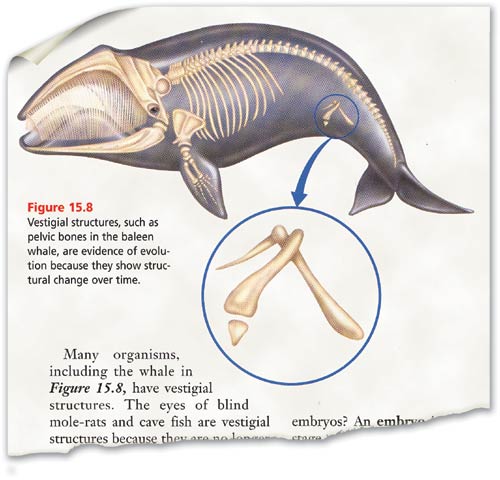
Which of the following is an example of a vestigial structure?
a)
the wings of a red-tailed hawk
b)
the hind limbs of a house cat
c)
the fins of sharks
d)
the tailbone of a human
11.
The diagram shows fossils in different rock layers. Which of these statements about the age of these fossils is most likely correct?
a)
Fossil A and C are the same age
b)
Fossil B is older than fossil C
c)
Fossils A is older than fossil B
d)
Fossil D is older than fossil C
12.
What characteristic did Darwin observe about the finches on the Galapagos Islands?
a)
Their feathers 
b)
Genotypes 
c)
Their beaks
d)
Their body sizes
13.
When an organism completely dies out, it is called.....
a)
Adaption
b)
Extinction
c)
Fossilization
d)
Mutation
14.
What is the advantage of having different shaped beaks?
a)
To look different from other species.
b)
To be able to eat the food readily available in the environment.
c)
To protect itself against predators.
d)
To protect itself against prey.
15.
The opossum and kangaroo both incubate their young in a pouch. This provides evidence that they---
a)
are descended from a common ancestor
b)
Have very similar skeletal structures
c)
belong to the same species
d)
must range great distances to eat
16.
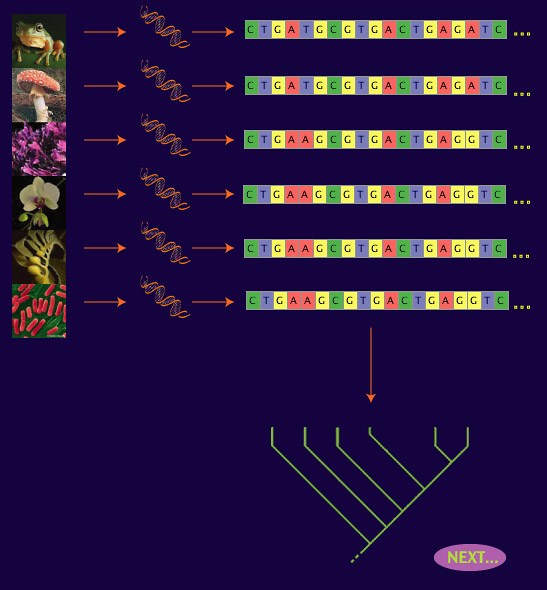
What do these three organisms have in common?
a)
They have stomachs of the same size
b)
They have DNA made up of the same components
c)
They have eyes that see the same ways
d)
They have brains that are the same size
17.
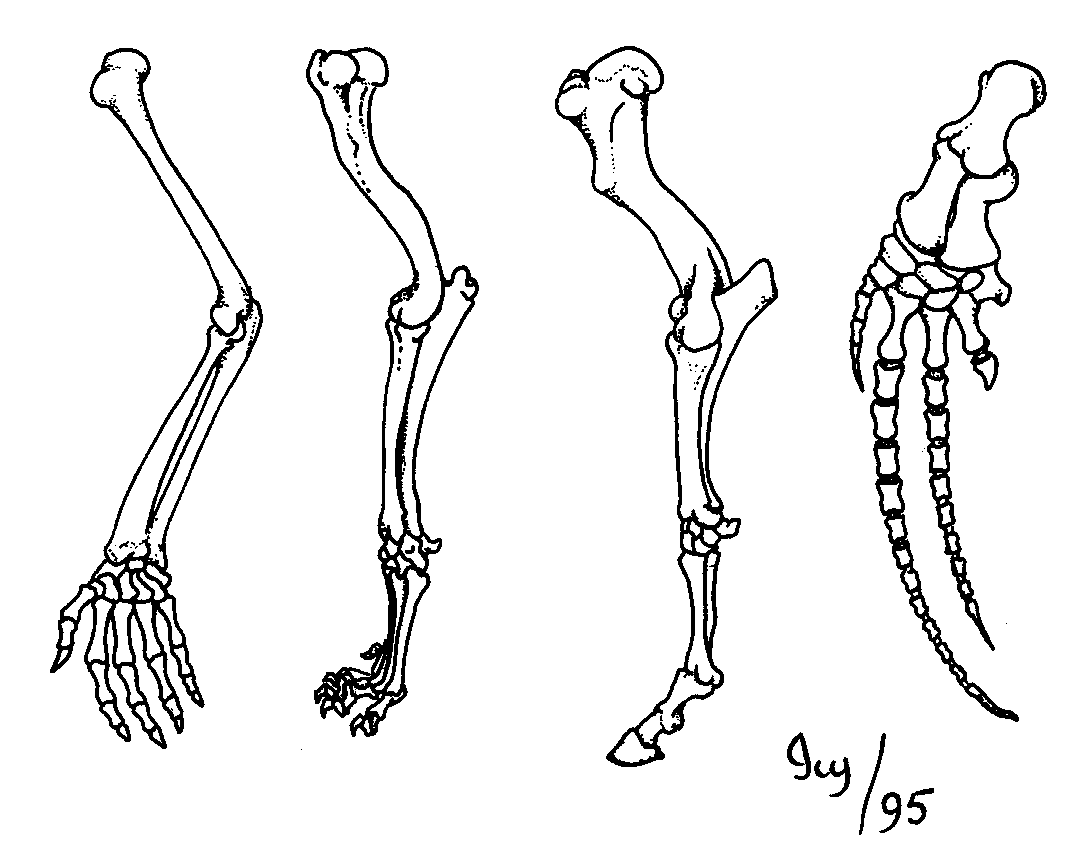
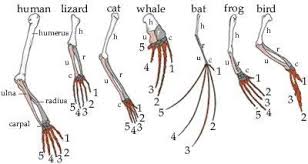
The similarities of the bones in the diagram provide evidence that---
a)
The organisms shown lived in the same natural envionrment
b)
The organisms shown may have developed from a common ancestor
c)
The organisms shown have the same genetic diseases
d)
All vertebrate species have identical forelimbs
18.
Scientist sometimes compare the limbs of these organisms to look for evidence of common ancestry.
These limbs provide evidence of common ancestry because they— 
a)
have the same basic structure
b)
are the same size
c)
are parts of mammals
d)
perform the same function
19.

The animals in the picture do not live in the same population. They are found in different parts of the world, but are all still part of the camel family. What can be said about these animals?

a)

They belong to the same species

b)

It is difficult for them to find food to eat

c)

They have a very similar skeletal structure

d)

They descended from a common ancestor

20.
What is a Vestigial Structure?
a)
Structures that have a common function and suggest common ancestry
b)
The traits of organisms that result from sharing a common ancestor: such traits often have similar embryological origins
c)
genetically determined structures or attributes that have apparently lost most or all of their ancestral function in a given species
d)
I don't know :(
21.
Why is the fossil record most important to scientists?
a)
It's our only record of dinosaurs
b)
It tells us that very few animals have gone extinct
c)
It suggests that species have evolved over time
d)
It proves that humans have always dominated the earth
22.
What is a diagram that shows characteristic relationships among organisms called?
a)
Cladogram
b)
Karyotype chart
c)
Punnet square
d)
Biogeography
23.
A fossil of an extinct dinosaur is found and the anatomy of the fossil shows similarities to that of a bird. What could this mean?
a)
This is purely by chance and isn't significant
b)
The extinct dinosaur and modern bird share a common ancestor
c)
All dinosaurs evolved into birds and that's why there aren't any dinosaurs alive today
d)
Dinosaurs choose to fly, and evolved into birds to escape predation and capture food
24.
What is this an example of?
a)
vestigial structures
b)
fossil record
c)
homologous structures
d)
embryology
25.

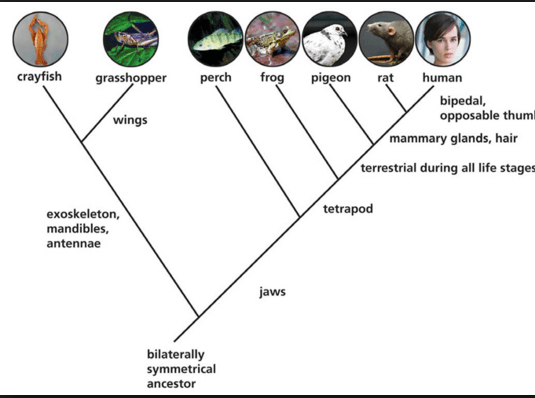
According to the cladogram, which organism is most distantly related to the human?

a)

crayfish

b)

grasshopper

c)

perch

d)

frog

26.
The __________ tells the history of life, past environments on Earth, and how different organisms have changed over time.
a)
fossil record
b)
law of superposition
c)
absolute age
d)
relative dating
27.
Fossils are preserved most often in which of the following substances? 
a)
Ice
b)
Sedimentary Rock 
c)
Asphalt
d)
Amber
28.
Change over time is
a)
evolution
b)
generation
c)
growth
d)
biogenesis
29.
What is an example of?
a)
embryology
b)
fossil record
c)
homologous structures
d)
vestigial structures
30.
What would indicate that a series of fossils represent evolution?
a)
the fossils were identical
b)
the fossils were found in the same layers of rock
c)
the fossils show similarities
d)
the fossils were completely different
31.
The tree of life is a metaphor for what idea?
a)
we came from a common ancestor
b)
we need water and sunlight to survive
c)
we have multiple species
d)
we are old
32.
Which of the following is not a piece of evidence for evolution?
a)
Homologous structures
b)
embryology
c)
fossil age
d)
vestigial structures
33.

Studying which of the following would provide the best evidence that two organisms share a common ancestor?

a)

Amino Acid Sequence

b)

Dietary Preferences

c)

Habitat Requirements

d)

Social Group Interactions

34.

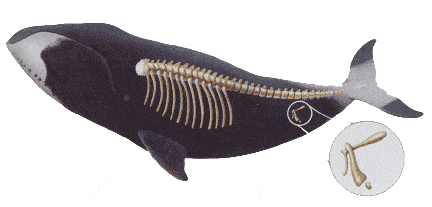
Whales, which live in the water, have hips. These structures are important for carrying the weight of animals that walk on land. Finding this body part in animals that don’t walk on land is best explained how?

a)

Whales have evolved this structure because it might be useful in the future.

b)

Whales are able to interbreed with other animals that have hips.

c)

Whales have a diet that includes other animals that have this structure.

d)

Whales share a common ancestor with animals that walk on land.

35.

The embryos of two different organisms are observed to have similar features. What is the most reasonable conclusion that can be drawn from this observation?

a)

The organisms will share these same features as adults

b)

These organisms will have the same role in the same habitat.

c)

These organisms will take the same amount of time to develop.

d)

These organisms are related by a shared common ancestor.

36.

Studying the embryology of animals provides important evidence to support claims of shared evolutionary history. What feature of embryology makes it capable of providing data for common evolutionary history not readily available from other sources?

a)

As the embryo develops, it reveals the expression of genes

b)

The growth of the embryo is achieved by differentiation of cells.

c)

A developing embryo exhibits structures not present in the adult animal.

d)

The development of embryos of a certain species is consistent.

37.

The collection of fossils and their placement

in chronological order, for example, through

the location of the sedimentary layers in which they are found or through radioactive dating

a)

Fossil Record

b)

Embryology

c)

Relative Dating

d)

Radioactive Dating

38.

Study of the structure of animals and their parts.

a)

Embryology

b)

Anatomy

c)

Geology

d)

Paleontology

39.

The quality or state of having many

different forms, types, ideas, etc.

a)

Vestigial

b)

Diversity

c)

Cladogram

d)

Homologous

40.

The sequence of heritable changes that occurred among species since the origin of life on Earth.

a)

Evolutionary History

b)

DNA

c)

Charles Darwin

d)

Cladogram

41.

When organisms are descended from a single ancestor they share this.

a)

Tree of Life

b)

Anatomy

c)

Common Ancestor

d)

Evolution

42.

Technique used to determine how old a rock

is by analyzing the amounts of a radioactive

isotope and its decay products in the rock.

a)

Relative Dating

b)

Radioactive Dating

c)

Darwin Dating

d)

Fossil Dating

43.

The arrangement of things in the order that they occurred.

a)

Relative Dating

b)

Fossil Record

c)

Chronological Order

d)

History