wayground logo

Free Printable Worksheets

Font size

S
M
L
XL
Worksheets

TCAP Review

Total questions: 139

Worksheet time: 3hrs 24mins

Name
Class
Date
1.
This variable in an experiment is the one being deliberately changed by the scientist. 
a)
dependent variable
b)
independent variable
c)
data
d)
control group
2.
An experiment is performed on plants to see how different liquids affect plant growth. Each plant in the experiment is given a different liquid; water, apple juice, or milk. Each plant has the same amount of soil, sunlight, and listens to the same music. In this investigation, the independent variable is ...
a)
The type of plant
b)
The amount of sunlight
c)
The type of music
d)
The type of liquid
3.
A student wants to test the effects of type of exercise on heart rate.  What is the dependent variable?
a)
heart rate
b)
type of exercise
c)
amount of exercise
d)
time of day exercise occurs
4.
Squidward found new reeds to tryout for his clarinet.  He used an APPLAUSOMETER to measure applause after playing  Under the Sea with each reed.  The results were put in the table.
What was the independent variable?
a)
The Song
b)
The Reed
c)
The Applause
5.
A testable explanation to a problem that has not yet been tested. 
a)
data
b)
theory
c)
hypothesis
d)
fact
6.
Why do we want to test one variable at a time?
a)
Because it is hard to setup a data table with more
b)
To know what is causing the changes. This helps us understand cause and effect.
c)
It is what has always been done
7.
Research Question: Does the type of gasoline put in a car effect how fast the car can drive. What is the independent variable?
a)
Type of gasoline
b)
which car the gas is put into
c)
how fast the car can drive
d)
how much gas is put into the car
8.
What can you conclude from this bar graph?
a)
Birds die when they eat corn
b)
More species eat sunflowers than sorghum
c)
Birds fly a long way to eat sunflower
d)
Zero species of birds eat Thistle
9.
Which plant group had a pH level of 6.8?
a)
2
b)
3
c)
4
d)
5
10.
A line graph shows changes....
a)
compared to others
b)
always in degrees
c)
over time
d)
using bars
11.
______ means to be prejudiced towards / against something & you let it affect the results of your experiment 
a)
effect
b)
cause
c)
error
d)
bias
12.
What order do the steps of the Design Process go in?
a)
ask, brainstorm, plan, evaluate, explain
b)
brainstorm, ask, plan, evaluate, explain
c)
ask, plan, brainstorm, evaluate, explain
d)
ask, evaluate, explain, brainstorm, plan
13.
Which is NOT a step in the engineering process?
a)
Design your solution
b)
Test your prototype
c)
Make a perfect prototype
d)
Define the problem
14.
In the engineering design process, after you plan, what's next?
a)
Create
b)
Improve
c)
Imagine
d)
Ask
15.

Which use of recent technology has had hazardous results on the environment?

a)

building outdoor furniture using recycled plastics

b)

identifying areas on Earth using a global positioning system

c)

disposing of unwanted cell phone batteries in landfills

d)

searching online information using a cell phone searching online information using a cell phone

16.

Which metal object listed in the data table has a density closest to that of silver?

a)

Gold

b)

Lead

c)

Aluminum

d)

Iron

17.
In a properly written scientific name, which part is lowercase?
a)
species
b)
genus
c)
phylum
d)
family
18.
What are the 8 levels of classification of living things from most general to most specific?
a)
domain, kingdom, phylum, class, order, family, genus, species
b)
domain, kingdom, class, phylum, order, family, genius, species
c)
domain, kingdom, family, class, order, family, genus, species
d)
domain, king, phillip, class, order, family, genus, species
19.
To what specific taxon would you assign this organism?
a)
Class Insecta
b)
Order Scorpiones
c)
Order Araneae
d)
Order Amblypygi
20.
To what order does the first organism belong? (red)
a)
Order Diptera
b)
Order Odonata
c)
Order Ephemeroptera
d)
Order Coleoptera
21.
This kingdom includes complex, multicellular organisms that are usually green, have cell walls, and make sugar by photosynthesis
a)
fungi
b)
bacteria
c)
plantae
d)
archaea
22.
A student discovers an arachnid with a segmented abdomen, long legs, and a tail with no stinger. The student uses the dichotomous key below to identify it. Which arachnid has the student found?
a)
Whip Scorpion
b)
Wind Scorpion
c)
Daddy long legs
d)
Scorpion
23.
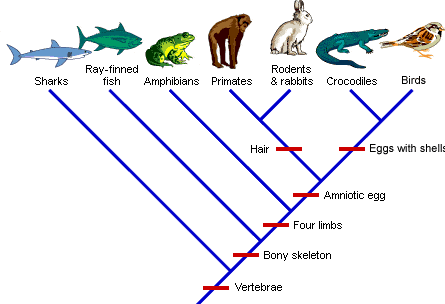
According to this cladogram, sharks are MOST closely related to which organism? 
a)
Amphibians
b)
Ray finned fish
c)
Crocodiles
d)
Birds
24.
A dichotomous key for trees is provided. Hikers found a tree that has large brown cones and single sharp needles. What species of tree have the hikers found?
a)
Juniper
b)
Pine
c)
Spruce
d)
Fir
25.
A dichotomous key for insects is given. To what order does an insect with two pairs of scaly wings belong?
a)
Coleoptera
b)
Heteroptera
c)
Diptera
d)
Lepidoptera
26.
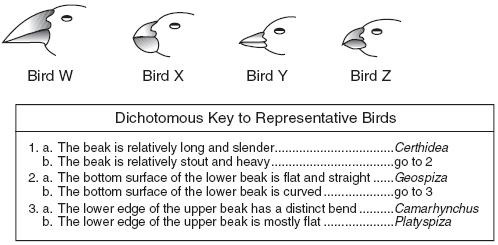
What is the name of bird W?
a)
Certhidea
b)
Geospiza
c)
Camarhynchus
d)
Platyspiza
27.
The great barrier reef of Australia is the largest coral reef in the world and known to have brutal hot summers.  Some species of turtles stay well below the surface during the summer months. This behavior is most likely to help the turtle by
a)
avoiding sharks
b)
getting better oxygenated water
c)
keeping their body temp low
d)
be close to the plants they eat
28.
Most foxes of the desert have a reddish brown coat but the artic fox has a white coat. How has this adaptation allowed the arctic fox to survive over many years?
a)
it gives it warmth during the summer
b)
it makes the fox look meaner
c)
it keeps it warm
d)
its protects it from prey using camoflauge 
29.
 characteristic or trait that helps an organism survive in its environment
a)
skills
b)
speciation
c)
natural instinct
d)
adaptation
30.
Charles Darwin noticed that birds of the Galapagos Islands were very similar in size and shape but their beaks were very different. What is the explanation for birds having different beaks? 
a)
gathering food
b)
building nest
c)
fighting
d)
scaring predators
31.
An environment has a type of bug where some are red and some are blue. The red bugs always have red offspring and the blue bugs always have blue offspring. The birds in the environment always eat the blue bugs first. Over a long period of time, there will be
a)
more blue bugs than red bugs
b)
only red bugs in the environment
c)
only blue bugs in the environment
d)
changes in the red bugs so the birds will want them
32.
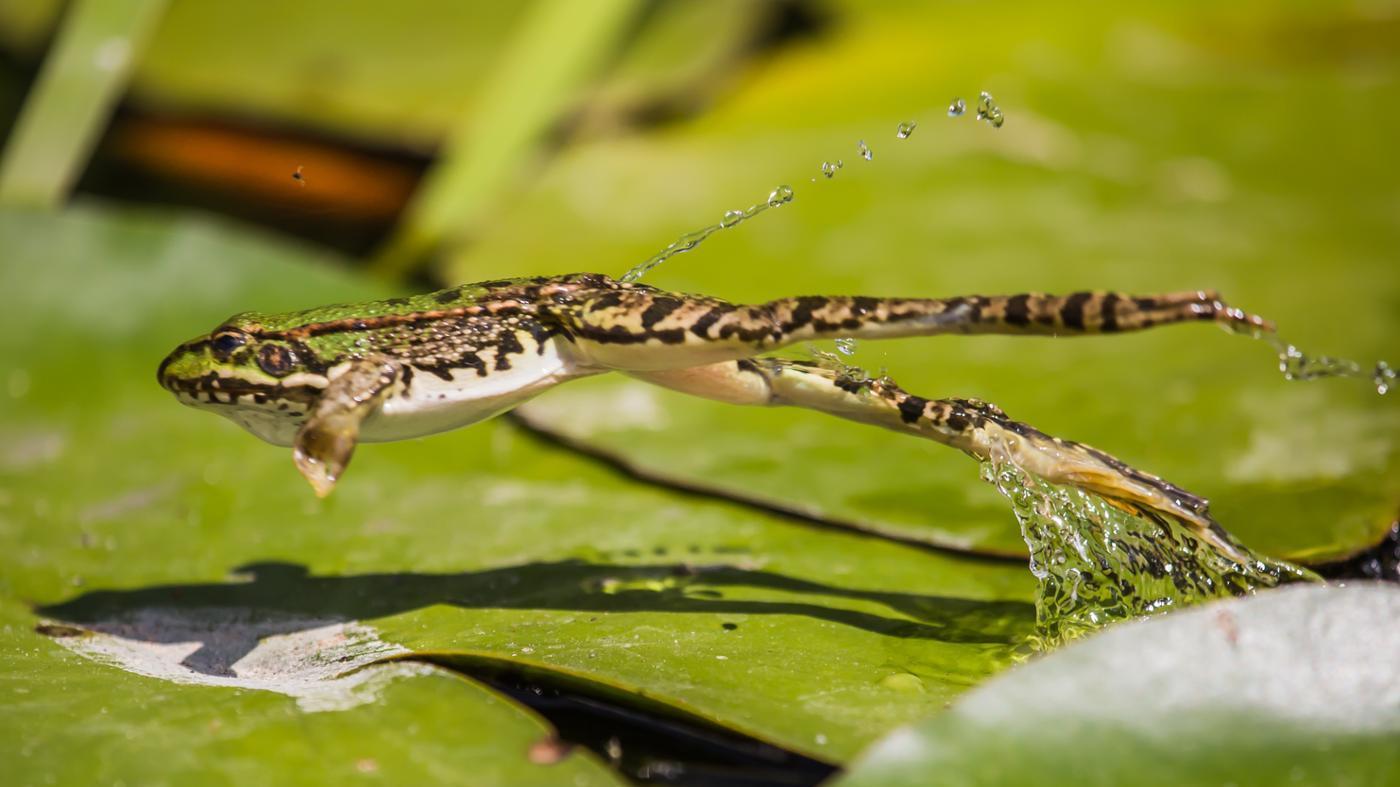
Frogs have webbed feet that help them to swim in water. Webbed feet in frogs are an example of a
a)
niche
b)
variation
c)
adaptation
d)
learned behavior
33.
What is a dichotomous key used for in science?
a)
To organize biomes
b)
Classify organisms
c)
Identify bacteria only
d)
None of these
34.
Which of the following variations would help members of a rabbit population survive if the climate turned very hot?
a)
Thinner fur
b)
Ability to run faster
c)
Ability to jump higher
d)
Ability to eat more
35.
An engineering team needs a ____________ in order to test a new design.
a)
blueprint
b)
problem
c)
prototype
d)
brain
36.
A product used to benefit living things is ___________ ? (example: crutches)
a)
biology
b)
biotechnology
c)
biosphere
d)
biotics
37.
A group of engineers have developed four types of bicycles.  They recorded data about tire strength.  What would be a good way for engineers to communicate results of their testing?
a)
A measurement of the bicycles.
b)
Detailed drawings of each bicycle.
c)
Bar graph comparing the amount of wear and tear on the tires.
d)
Data table showing pedal usage.
38.
A prosthetic device assists a damaged body part. Is a walker, something that people use to get around, considered a prosthetic device?
a)
No because people that use it have legs.
b)
Yes because it assists a damaged body part.
39.
If you were designing a way to improve the technology of an artificial lung, which of these criteria should you include in your design?
a)
It should be made from affordable materials.
b)
It should efficiently pump oxygen.
c)
It should match the color of the old lung.
d)
It should be able to be controlled by the patient.
40.

What is the atomic number?

a)

the number of protons

b)

the number of protons and neutrons

c)

the number of neutrons

d)

the number electrons

41.
What is the mass number?
a)
the number of protons
b)
the number of protons and neutrons
c)
the number of neutrons
d)
the number of protons and electrons
42.
How are neutrons different from protons and electrons?
a)
Neutrons are neutral   Protons are positive and Electrons are negative
b)
Neutrons are negative, Protons are positive and Electrons are neutral
c)
Neutrons are positive, Protons are negative and Electrons are neutral
d)
They all have the same charge
43.
Which group of the periodic table is composed of inert (not reactive)  gases?
a)
alkali metals
b)
alkaline earth metals
c)
halogens
d)
noble gases
44.
Each column in the periodic table is called a 
a)
period
b)
group
c)
cluster
d)
unit
45.
In the modern periodic table elements are arranged by:
a)
atomic mass
b)
atomic number
c)
valence electrons
d)
number of isotopes
46.
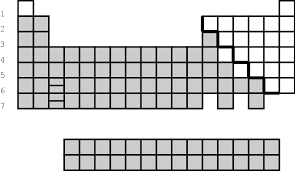
In what section would Transition Metals be found?
a)
orange
b)
light blue
c)
blue
d)
white
47.
Elements on the left side of the periodic tables are 
a)
metals
b)
nonmetals
c)
metalloids
d)
noble gases
48.
What is the name of group 17
a)
halogens
b)
nobles gases
c)
alkali metals
d)
alkaline earth metals
49.
How many Valence electrons does Iodine Have?
a)
6
b)
8
c)
7
d)
1
50.
The colored part of the periodic table is.....
a)
nonmetals
b)
metals
c)
metalloids
d)
gases
51.
Elements which are shiny, conduct electricity and heat are called
a)
metal
b)
nonmetal
c)
metalloid
d)
nonexistent
52.
What are the states of matter?
a)
solid, liquid, and juice
b)
solid and liquid
c)
solid and gas
d)
solid, liquid, and gas
53.

Which form of matter has a definite shape and takes up space (has definite volume)?

a)

liquid

b)

solid

c)

gas

d)

clay

54.
Which form of matter take the shape of a container like this juice?
a)
liquid
b)
solid
c)
glass
d)
gas
55.
What is happening when my ice cream changes from a solid to a liquid?
a)
freezing
b)
melting
c)
burning
d)
evaporation
56.
Which state of matter?
a)
Solids
b)
Liquids
c)
Gases 
d)
Plasmas 
57.
Which state of matter? 
a)
Solids
b)
Liquids
c)
Gases 
d)
Plasmas 
58.
Which state of matter? 
a)
Solids
b)
Liquids
c)
Gases 
d)
Plasmas 
59.
What state of matter does sublimation skip? 
a)
Solid
b)
Gas
c)
Liquid
60.
Which state of matter is this? 
a)
Solid
b)
Liquid
c)
Gas
61.
what is the definition of chemical change?
a)
any change that results in the formation of new chemical substances. 
b)
changing clothes
c)
matter cannot be created or destroyed, only change form
d)
changes affecting the form of a chemical substance, but not its chemical composition.
62.
Which of the following is NOT an example of a physical change?
a)
crumpled paper
b)
pencil sharpening
c)
shrunken clothing
d)
sour milk
63.
Is burning wood a chemical or physical change?
a)
chemical
b)
physical
64.
Is bleaching your hair a physical or chemical change?
a)
physical
b)
chemical
65.
Photosynthesis is an example of a
a)
physical change
b)
chemical change
66.
One cup of water is left outside for two days when it was checked there was only half a cup left. What happened?
a)
evaporation; chemical change
b)
condensation; physical change 
c)
evaporation; physical change
d)
condensation; chemical change
67.
Which of the following describes a precipitate?
a)
a liquid forms when a block of metal is heated
b)
a solid forms when one liquid is poured into another
c)
a gas forms when a solid is placed in a liquid
d)
bubbles form when an acid is poured on a rock
68.
Which of the following is a sign that a chemical reaction has occurred?
a)
change in shape
b)
melting
c)
formation of a gas
d)
dissolving
69.
In physical changes, substances might change in __________ but not in __________.
a)
appearance, composition
b)
volume, state of matter
c)
texture, color
d)
weight, mass
70.
On a camping trip, Mrs. Benavides roasts a marshmallow in the campfire. She notices that the roasted marshmallow smells and tastes differently than the uncooked marshmallows. What change has taken place, and how does Mrs. Benavides know?
a)
a chemical change because the marshmallow changed in taste, color and smell
b)
no change because the marshmallow is not a new substance
c)
only a physical change because the marshmallow changed in size
d)
a chemical change because the marshmallow only changed in pH level
71.
The atmosphere of Earth is comprised mostly of oxygen and -
a)
carbon
b)
hydrogen
c)
silicon
d)
nitrogen
72.
Which elements are in the formula shown  SnCl2 ?
a)
Tin and Chlorine   
b)
Tin, Carbon and Lithium   
c)
Sulfur, Nitrogen and Chlorine   
d)
Sulfur, Nitrogen, Carbon and Lithium
73.
How many different elements are in an amino acid with the formula C5H11NO2S?
a)
3 elements
b)
4 elements
c)
5 elements
d)
6 elements
74.
A pure substance made up of two or more elements that are chemically combined. 
a)
compound          
b)
atom
c)
mixture 
d)
element
75.
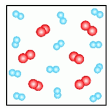
This diagram represents a _____.
a)
pure substance that is a compound
b)
mixture of elements
c)
pure substance that is an element
d)
mixture of compounds
76.
This diagram represents a _____.
a)
pure substance that is a compound
b)
mixture of elements
c)
pure substance that is an element
d)
mixture of compounds
77.
This diagram represents a _____.
a)
pure substance that is a compound
b)
mixture of elements and compounds
c)
pure substance that is an element
d)
mixture of compounds
78.
This diagram represents a _____.
a)
pure substance that is a compound
b)
mixture of elements and compounds
c)
pure substance that is an element
d)
mixture of compounds
79.
About how much of Earth's atmosphere is oxygen?
a)
21%
b)
78%
c)
35%
d)
50%
80.
Two gases that make up 99% of Earth's atmosphere
a)
carbon dioxide & oxygen
b)
nitrogen & carbon dioxide
c)
nitrogen & oxygen
d)
nitrogen & water vapor
81.
Gas with the highest percentage in our atmosphere is
a)
oxygen
b)
carbon dioxide
c)
ozone
d)
nitrogen
82.
The tool used to measure the mass of a substance or object is a ______________.
a)
balance
b)
graduated cylinder
c)
ruler
d)
thermometer
83.
Which units of measurement are used for volume?
a)
grams
b)
centimeters
c)
grams/milliliter
d)
milliliter
84.
Which lab tool might you use to measure the volume of a liquid?
a)
electric scale
b)
bunsen burner
c)
test tube
d)
graduated cylinder
85.
Which box has a higher density?  
a)
Box A
b)
Box B
c)
cannot be determined
d)
they are the same
86.
Which liquid is the least dense?
a)
oil
b)
water
c)
syrup 
d)
plastic bottle
87.
What is the volume of Object X?
a)
10.0 cm3
b)
15.0 cm3
c)
20.0 cm3
d)
25.0 cm3
88.
The density of this material is 2 g/cm3.
There are 24 cm3  Find the total mass.
a)
12 grams
b)
48 grams
c)
12 g/cm3
d)
48 g/cm3
89.
What is the density of a rock if its mass is 36g and its volume is 12 cm3?
a)
432 g/cm3
b)
0.33 g/cm3
c)
48 g/cm3
d)
3 g/cm3
90.
What is the density of an object with a volume of 4 cm3 and a mass of 8 g?
a)
4 g/cm3
b)
12 g/cm3
c)
2 g/cm3
d)
32 g/cm3
91.
The number in front of a compound or element is a 
a)
Subscript
b)
Coefficient
c)
Superscript
d)
Charge
92.
Is this equation balanced?
a)
yes
b)
no
c)
Not enough information
93.
Is this equation balanced?
a)
yes
b)
no
c)
Not enough information
94.
What is the Law of Conservation of mass?
a)
Mass is created in a chemical reaction
b)
Mass is created in a physical change
c)
New chemicals formed from a chemical reaction have a larger overall mass than the original reactants
d)
Mass is never created or destroyed
95.
Anything that has mass & takes up space
a)
gravity
b)
force
c)
matter
d)
volume
96.
Substances that form as the result of a chemical reaction
a)
products
b)
reactants
c)
coefficients
d)
subscripts
97.
Substances present at the start of a chemical reaction
a)
subscripts
b)
coefficients
c)
reactants
d)
products
98.
Electrons in the outermost orbit or shell
a)
quarks
b)
molecules
c)
valence
d)
compounds
99.
Is this chemical equation balanced?
2Na + Cl2 ----> 2NaCl
a)
Yes
b)
No
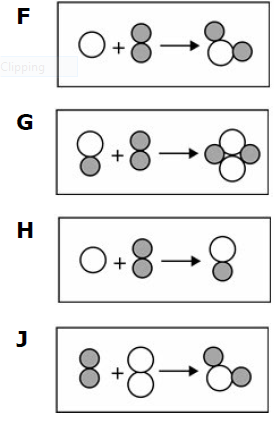
100.
Which of the following models best demonstrates a balanced chemical equation?
a)
F
b)
G
c)
H
d)
J
101.
Tastes bitter
a)
Acids
b)
Bases
c)
neutral 
d)
All
102.
Tastes sour
a)
Acids
b)
Bases
c)
Salts
d)
All
103.
pH greater than 7.
a)
Acids
b)
Bases
c)
All
d)
pure water
104.
pH less than 7.
a)
Acids
b)
Bases
c)
All
105.
Which of the following word pairs correctly completes the sentence below?
_______ are corrosive substances characterized as having a strong smell, a sour taste, and a _______.
a)
Acids; pH less than 7
b)
Acids; pH greater than 7
c)
Bases; pH greater than 7
d)
Bases; pH less than 7
106.
Holly has an unknown substance in a beaker. She wants to determine the relative pH of the unknown substance. She places a piece of blue litmus paper into the substance, and the litmus paper stays blue.
The substance in the beaker
a)
is a base.
b)
has a neutral pH.
c)
is an acid.
d)
does not have a pH.
107.
Which of the following statements is correct?
a)
Blue litmus paper turns red when placed in a base.
b)
Red litmus paper turns blue when placed in a base.
c)
Blue litmus paper stays blue when placed in an acid.
d)
Red litmus paper stays red when placed in a base.
108.
Feels slippery.
a)
Acids
b)
Bases
c)
neutral 
d)
All
109.

Mass stays the same from one place to the next, but weight can change.

a)

True

b)

False

110.

What is weight?

a)

The amount of push and pull your body is creating.

b)

How many pounds something weighs.

c)

The force of gravity pulling your mass to the center of Earth.

d)

The force of gravity pushing your mass away from the Earth.

111.

What do you call the amount of matter in an object?

a)

pressure

b)

weight

c)

mass

d)

force

112.

Why would you weigh less on the moon compared to your weight on Earth?

a)

less gravity on the moon

b)

less sunlight on the moon

c)

more gravity on the moon

d)

less air on the moon

113.
The bigger an object is the more ___________ it has
a)
force
b)
energy
c)
mass
d)
orbit
114.
The more mass an object has the more ________________ it has.
a)
energy
b)
force
c)
mass
d)
gravity
115.
The planet with the most gravity in the Solar System is
a)
Moon
b)
Earth
c)
Jupiter
d)
Sun
116.
Which movement is the result of gravity?
a)
A wheel turning
b)
A knife cutting bread
c)
An electric fan blowing air
d)
A raindrop falling to the ground
117.
The spinning of the Earth on its axis is
a)
rotation
b)
revolution
c)
precession
d)
nutation
118.
The Earth's motion around the Sun is called its
a)
rotation
b)
revolution
c)
precession
d)
nutation
119.
If two objects are charged alike, they will ______________.
a)
attract to each other
b)
repel each other
120.
If two objects are oppositely charged, they will ____________________.
a)
attract each other
b)
repel each other
121.
How are the poles of a bar magnet marked?
a)
+ and -
b)
N and  S
c)
E and W
d)
N and W
122.
Where is the magnetic force of a magnet the strongest?
a)
At the poles
b)
In the middle
c)
At the North Pole
d)
At the South Pole
123.
What does this picture show?
a)
positive charges
b)
negative charges
c)
the magnetic field
d)
an electric circuit
124.
Earth's center is made mostly of  ________.  That is one reason Earth is a large magnet.
a)
lava
b)
magma
c)
iron
d)
copper
125.
You've built an electromagnet. The electric current flows through the....
a)
screw
b)
wire
c)
paper clips
d)
none of the above
126.
These magnets operate by using the earth's natural agnatic field, cannot be turned on and off, and are permanent magnets. 
a)
electron magnet
b)
temporary magnets
c)
electomagnets
d)
bar magnets
127.
Which best explains WHY a bar magnet would not be attracted to a magnetic object when held 3-4 inches above the object?
a)
The objects had opposite poles
b)
The objects had like poles
c)
The object was not within the magnetic field of the magnetic object. 
d)
There was not an magnetic attraction between the two objects. 
128.
What happens if you break a magnet in half? 
a)
One half will have a north pole only and one half will have a south pole only. 
b)
Neither half will have a pole. 
c)
Each half will be a new magnet, with both a north and south pole. 
d)
Neither half will be able to attract or repel. 
129.
Which statement is NOT true of gravity
a)
All matter attracts all other matter
b)
the more mass an object has the more gravity
c)
the closer two objects are the stronger the gravity between them
d)
only the largest objects have gravity
130.
A student wants to build an electromagnet. The student has a copper wire and an iron nail, but they are missing one thing. What else does the student need? 
a)
a battery
b)
a cord
c)
a light bulb
d)
paperclips
131.
The magnetic field of an electromagnet travels from the north pole of the "magnet" to the south pole. 
a)
True
b)
False
132.
Which subatomic particle has a negative charge?
a)
Proton
b)
Neutron
c)
Electron
133.
What makes an electromagnet stronger?
a)
Increase the number of wire wraps around the iron core
b)
decrease the strength of the power source
c)
remove the source of current
d)
lightning bolts hitting a tree
134.
This is a picture of a simple electromagnet. How can the electromagnet be made stronger?
a)
Add more coils of wire to the nail.
b)
Use a smaller battery.
c)
Reverse the poles of the magnet.
d)
Remove all the coils and the nail.
135.
How are electromagnets different from magnets?
a)
magnets can be turned on/off
b)
you can turn an electromagnet on/off
c)
magnets are more powerful
d)
magnets have a North and South pole
136.
In order to make an electromagnet, you need a  
a)
battery, nail, and magnet
b)
battery, wire, and nail
c)
magnet, nail, and wire
d)
all of the above
137.
What will happen when these magnets are brought close together?
a)
They will attract each other.
b)
They will repel each other.
c)
Both magnets will turn to the left
d)
Both magnets will turn to the right
138.

Electricity can be generated using a magnet and a solenoid (coil of wire).

Which of the following diagram best identifies how an electric current is produced?

a)
b)
c)
139.

Which choice below correctly describes how this simple generator induces electrical current?

a)

Opposite poles of two magnets facing each other will produce electricity

b)

The metal in the coil chemically reacts with the magnetic field.

c)

A wire coil rotating between two magnets will result in the flow of electrical charge.