
 Worksheets
AQA Science Glossary
Total questions: 16
Worksheet time: 10mins
How close a measurement is to the true value is called..
Accuracy
Precision
Significant
Estimate
When a measurement is repeatable it is said to have...
High precision
Low precision
High accuracy
Low accuracy
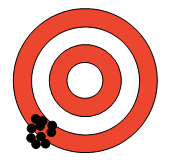
A measurement where it is made by the same person taking repeats using the same method and equipment and obtains the same results is said to be .....
Reproducible
Consistent
Accurate
Precise
Repeatable
A measurement where it is repeated by a different person, or by using different equipment or techniques, and the same results are obtained is said to be .......
Reproducible
Consistent
Precise
Accurate
Repeatable
Describe in detail how you could obtain more accurate results. (3 Marks)
Calculate mean
Remove anomalous results
plot a graph, draw a line of best & ignore anomalous points
Repeat experiment
Share results
It is better to repeat each measurement at least three times.
Explain why this is likely to give a more accurate result. (3 marks)
Anomalous results to be detected & removed
A mean to be calculated
Reduces random errors.
Shows a pattern
Results are more precise
Some students in your class may have done an investigation to test the same hypothesis. Explain how using the results of other people may help you decide if your investigation is reproducible. 3 marks
Results should be compared to see if they are similar.
Need the same pattern or trend is present results for investigation to be reproducible
Other group must use the same variables to compare
Other group must use the same chemicals/equipment to compare.
Need the exact same results for the investigation is reproducible.
Describe briefly how you would do a preliminary investigation to find a suitable value for your control variable (3 marks)
Decide on a value for the control variable.
Do the experiment for the highest and lowest value you intend to do for the dependent variable.
Do the experiment for the highest and lowest value you intend to do for the independent variable.
A suitable control variable will show a clear pattern between the two results, if results are the same repeat with a different control variable value.
When doing an investigation a student noticed the reading on the balance was 0.12 g when nothing was on it.
State what type of error this is.
Describe two ways the student could overcome this error.
(3 marks)
Zero error
Random error
Zero the balance then repeat the readings,
Subtract 0.12 g from the readings obtained
Ignore this as all the results will be the same anyway!
Hypothesis : ‘Increasing the concentration of a reactant in a chemical reaction will decrease the time it takes for the reaction to finish.’
What is the independent variable?
Concentration of reactant
Temperature of reactant
Time taken for reaction to finish
Amount of reactant
Volume of reactant
Hypothesis : ‘Increasing the concentration of a reactant in a chemical reaction will decrease the time it takes for the reaction to finish.’
What is the dependent variable?
Concentration of reactant
Temperature of reactant
Time taken for reaction to finish
Amount of reactant
Volume of reactant
Hypothesis : ‘Increasing the concentration of a reactant in a chemical reaction will decrease the time it takes for the reaction to finish.’
What could be control variables in this experiment?
Concentration of reactant
Temperature of reactant
Time taken for reaction to finish
Amount of reactant
Volume of reactant
What would be defined as the quantity between readings, eg a set of 11 readings equally spaced over a distance of 1 metre would give an interval of 10 centimetres
Interval
Range
Resolution
Uncertainty
What would be defined as the smallest change in the quantity being measured of a measuring instrument that gives a perceptible change in the reading.
Resolution
Precision
Uncertainty
Variable
What would be defined as the interval within which the true value can be expected to lie, with a given level of confidence or probability, eg 'the temperature is 20 °C ± 2 °C
Range
Uncertainty
Resolution
Precision

